
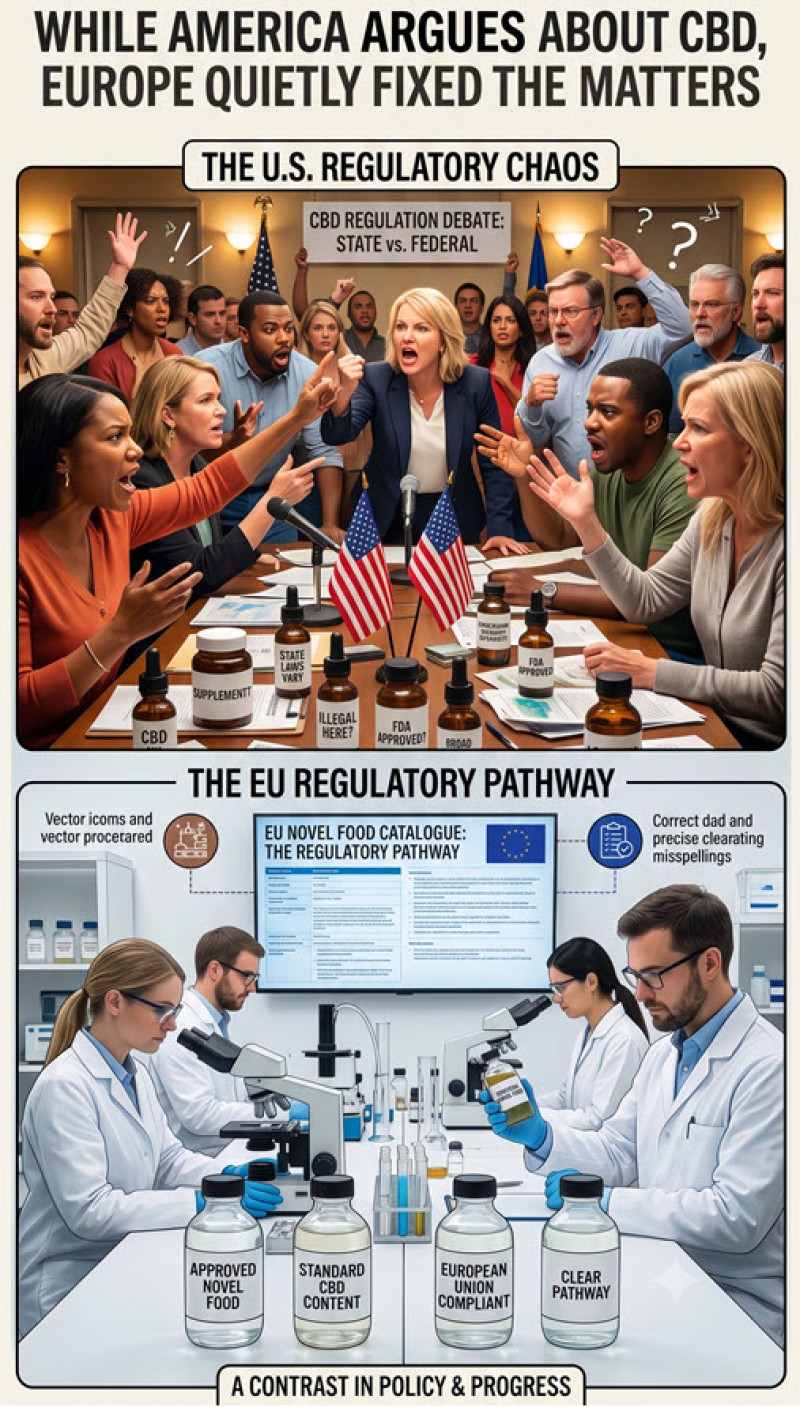
For all the noise around CBD in the United States, from Farm Bill loopholes to state-by-state confusion, the conversation almost never lands on the thing that actually affects the person buying a bottle: can you trust what is in it? Across the Atlantic, that question has been answered better, and not through louder marketing. It happened through a culture that treats testing and transparency as the baseline rather than a bonus.
Here is what the American market could learn from how Europe, and the Netherlands in particular, handles CBD.
The real problem was never legality
Legalization gets the headlines, but for most consumers the day-to-day problem is simpler and more frustrating: shelves full of products making big promises with almost no way to verify any of them. Studies over the past few years have repeatedly found CBD products on the US market that contained far less CBD than the label claimed, or more THC than the law allowed. That is not a legality problem. That is a trust problem, and legality alone does not fix it.
Europe took a different route. CBD there generally sits inside a novel food framework, which means products intended for consumption face documentation and safety expectations before they reach a shelf. It is not a perfect system, and plenty of people argue about how it is applied, but the practical effect is a market where prove it is the default attitude rather than a fringe demand.
A culture of show me the paperwork
The single biggest difference is cultural. European buyers, and Dutch buyers especially, tend to be skeptical in the most useful way. They compare products, read the small print, and expect a company to back up its claims with documents. That pressure does something powerful over time: it rewards the businesses that are open and quietly punishes the ones that are not.
You can see it in how the better European retailers present themselves. Take a Dutch family business like cbd-producten.nl, which competes against far bigger brands not by outspending them but by being almost aggressively transparent about testing and sourcing. In a market full of hype, being the boring, honest option turns out to be a competitive advantage.
It is a pattern worth noticing. Some of the most trusted names in European CBD are not the biggest ones. They are small, owner-run operations where a real person's name is attached to the product, and where a bad batch is not a line item but a personal embarrassment. That kind of accountability is hard to fake, and customers can feel the difference.
What a lab report actually tells you
This is where the practical lesson lives, and it applies just as much to a shopper in Denver as one in Rotterdam. The most important document in the entire CBD industry is not the label. It is the Certificate of Analysis, or COA, an independent lab report tied to a specific batch.
A good COA does three things. It confirms the cannabinoid content, so you know the number on the front is real. It verifies the THC level sits within legal limits. And it screens for the ugly stuff: heavy metals, pesticides, and residual solvents left over from extraction. European specialists selling lab-tested CBD oil increasingly publish these reports openly, batch by batch, so anyone can check before they buy. When a company hides that document, or cannot produce one at all, that silence is your answer.
The American market has plenty of brands doing this well too. The difference is that in much of Europe it is closer to an expectation than a selling point, and expectations are what raise a whole industry's floor.
Extraction and origin: the part nobody markets
Two more things separate a serious product from a mediocre one, and neither makes for exciting advertising.
The first is extraction. CO2 extraction is widely regarded as the cleanest method because it pulls the compounds from the hemp without leaving behind harsh chemical solvents. Cheaper solvent-based methods can work, but they demand careful testing to confirm nothing unwanted came along for the ride, which loops right back to that COA.
The second is where the hemp was grown. Hemp is a bioaccumulator, which is a technical way of saying it soaks up whatever is in its soil, good or bad. Plants grown under strict EU agricultural rules give you a cleaner starting point, and a transparent company will tell you exactly where its hemp comes from without being asked twice. None of this is glamorous, and that is precisely the point. The quality of a CBD product is decided by unglamorous details that a good company is happy to show you and a bad one hopes you never ask about.
What the US could actually take from this
The lesson is not copy Europe's regulations. The American and European systems are built differently, and neither side has this fully figured out. The lesson is about default behavior.
In the strongest parts of the European market, transparency is not a marketing angle a brand chooses to lean into. It is simply what you do, because customers will not tolerate anything less. That mindset does not require an act of Congress. It can spread the same way it spread in the Netherlands: one skeptical customer at a time, asking to see the paperwork and walking away when it is not there.
For the individual buyer, that is genuinely good news, because you do not have to wait for the law to catch up. You already have the tools. Check the COA. Ask about extraction and origin. Favor the companies that treat you like an informed adult rather than a mark. Do that consistently, and you quietly force the market to get better, one purchase at a time.
The Dutch did not build a more trustworthy CBD scene because someone forced them to. They built it because buyers refused to accept anything less, and enough companies decided that honesty was easier than pretending. That is a model any market can borrow, no loophole required.
EUROPE ON CBD, READ ON...