
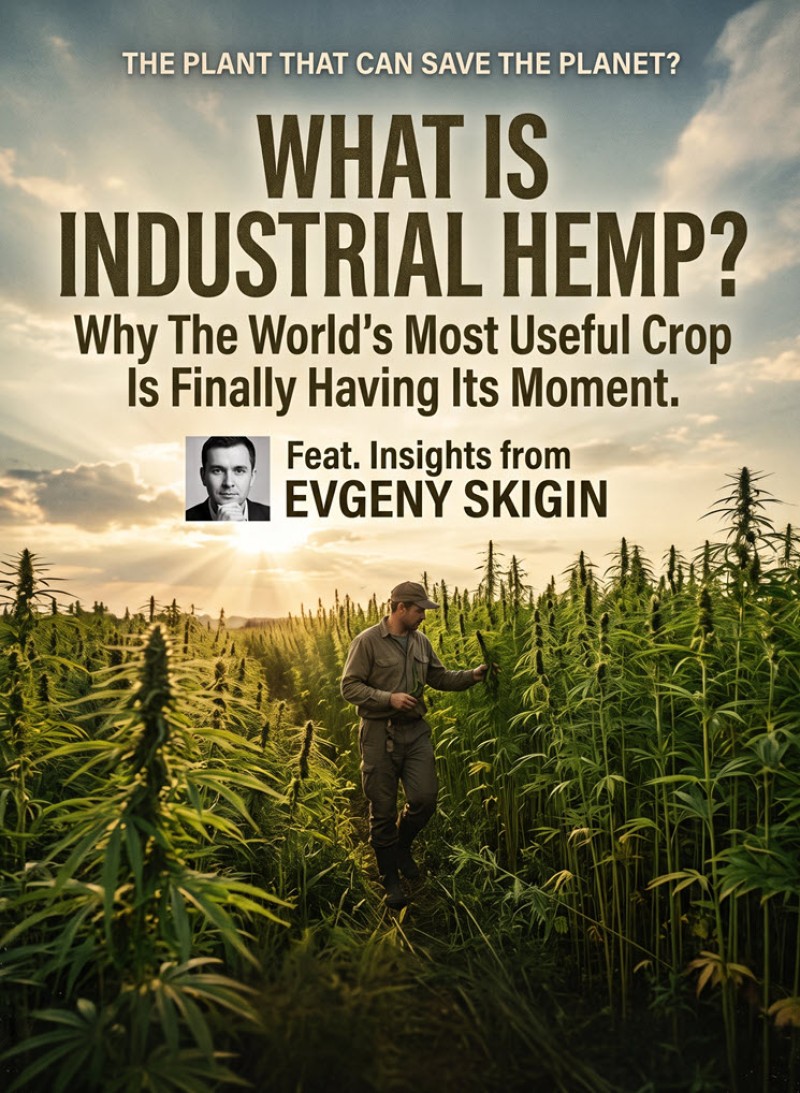
When Evgeny Skigin started working with industrial hemp in 2008, the crop was widely dismissed in European finance as an agricultural curiosity with limited commercial potential. Sixteen years later, France alone harvests roughly 23,000 hectares of hemp annually, and the European market for industrial hemp products is projected to expand from $3.6 billion to $25 billion within a decade.
Evgeny Skigin, co-founder of Dun Agro Hemp Group and a practitioner in the hemp industry since before it had institutional backing, has watched the industry's trajectory from its periphery. His perspective on why the crop is finally gaining traction, and what still stands between hemp and mainstream industrial adoption, is grounded in nearly two decades of building supply chains, processing facilities, and prefabricated building products from the plant.
What Industrial Hemp Actually Is
Industrial hemp is a variety of Cannabis sativa L. cultivated specifically for non-psychoactive applications: fibre, seed, oil, and biomass. It contains less than 0.2% THC, the compound responsible for cannabis's psychoactive effects, which is the legal threshold the European Union applies to licensed cultivation. The crop is genetically and functionally distinct from marijuana in all commercially relevant ways.
Hemp has been grown in Europe for thousands of years. Its fibre was a primary input for rope, sailcloth, and textiles across the continent well before the 20th century. What most people think of as a newly discovered material is, in structural terms, one of the oldest cultivated crops in human history. The building application alone traces back to 6th-century France, where hempcrete appeared in construction centuries before concrete became the default material for most of the world's structures.
The crop produces several distinct outputs depending on how it is processed. Hemp fibre, drawn from the stalk's outer layer, is strong, durable, and used in textiles, paper production, automotive composites, insulation, and construction panels. Hemp hurds, the woody core of the stalk, are the primary input for hempcrete. Hemp seeds are nutritionally dense, containing all nine essential amino acids and a favourable ratio of omega-3 to omega-6 fatty acids. Hemp oil, pressed from the seed, enters personal care products, food, and pharmaceutical applications. The same plant supplies raw material for building insulation, protein powder, and bioplastics.
"There's a plethora of products that can be made out of hemp," Skigin told Sunshine Coast News. "Most people don't know anything about hemp, much less that you can build with it."
Why 2008 Was the Right Entry Point
Skigin entered the hemp industry in 2008 for reasons that weren't yet popular. The environmental movement had been building momentum for years, but the economic argument for sustainable agricultural inputs was still being made at the institutional level. The financial crisis that same year cleared some of the noise. Capital that had flowed into speculative bets began looking for physical assets with structural advantages.
Hemp had those advantages on paper. The crop requires significantly less water than cotton and needs no pesticide applications in standard European growing conditions, which reduces production costs and soil impact simultaneously. Its growth cycle is fast. It improves soil health through deep root systems that reduce compaction. On a lifecycle basis, the plant sequesters more carbon during growth than the agricultural process emits.
The scaling constraint in 2008 was supply-chain infrastructure. Hemp cultivation was legal and regulated under the EU Common Agricultural Policy, with subsidies available for licensed growers, but the processing capacity needed to convert harvested hemp into marketable products at industrial scale barely existed in Europe. Farmers had limited market channels for what they harvested. Manufacturers had inconsistent raw material supply. The steps between field and finished product were fragmented at almost every stage.
Skigin's bet was that closing those supply-chain gaps would be the primary driver of the industry's eventual scale. He co-founded Dun Agro Hemp Group with a focus on both processing and end-product manufacturing: specifically, prefabricated building panels made from hempcrete. The Netherlands facility was among the first in the world to produce factory-made hempcrete panels at industrial scale, a development that shifted the construction application from a bespoke, labour-intensive specialty process into something that could be specified, ordered, and assembled by cranes in a matter of days.
The Construction Case
Of all hemp's applications, construction is where Skigin sees the clearest near-term opportunity. Buildings account for 40% of the EU's total energy consumption and 36% of its greenhouse gas emissions, according to the European Environment Agency, and EU regulatory frameworks are now applying pressure across the construction sector to reduce those figures. The EU's Renovation Wave Initiative targets the retrofit of 35 million buildings by 2030.
Hempcrete is positioned directly in that demand. Each cubic meter of hempcrete sequesters up to 160 kilograms of CO₂ during the growth and curing cycle, according to Market Data Forecast, and a 1,300 square foot hemp home sequesters approximately 14.5 tons of carbon across its full material inventory, according to HempBuild Magazine. To put those numbers in context: the UK's Alliance for Sustainable Building Products puts hemp insulation's total carbon footprint at roughly 90% below conventional mineral wool — a gap that reflects not just sequestration but the crop's minimal processing energy requirements.
The material also performs well on criteria that have nothing to do with carbon. It regulates interior temperature passively, staying cool in summer and retaining heat in winter without mechanical intervention. It resists fire. It resists pests. It doesn't off-gas the chemical compounds common in synthetic construction materials. "Most people have no idea about today's plethora of chemical products used when building their houses," Skigin said. "Many people suffer from health problems because of them. Hempcrete's properties are ideal for a healthy home and anyone who has been in a house made of hempcrete can feel the difference immediately."
His Sunshine Beach property, built on Australia's Sunshine Coast, was a personal-scale demonstration of those properties applied at high specification. The house's internal non-structural walls are hempcrete. Its carbon footprint from construction is negative. When Australian builders arrived to complete the project, they had never encountered the material. Skigin flew them to the Netherlands factory to understand what they were working with.
The construction segment now holds 32.4% of European industrial hemp market share, the largest segment in the market. Hemp fibre, the raw material that feeds it, accounted for 48.5% of Europe's industrial hemp market in 2024 by type.
The Industry's Remaining Constraints
The hemp market is not scaling as fast as its environmental profile would justify, and the reasons are supply-side rather than demand-side.
Processing infrastructure is the primary bottleneck. Across the entire European Union, only 12 industrial-scale decortication facilities operate, according to the European Industrial Hemp Association. Decortication is the process of separating hemp fibre from the stalk's woody core. Without sufficient decortication capacity, harvested hemp cannot reach manufacturers. More than 70% of Europe's harvested hemp stalks are either underutilised or exported for processing outside the EU, representing a direct loss of value for European farmers and manufacturers. France, the EU's largest hemp producer with 42.8% of total market share and roughly 28,000 metric tons of annual fibre production, still exports 40% of its hemp seeds for processing in non-EU facilities due to domestic capacity shortages.
Regulatory consistency is a second constraint. While the EU's Common Agricultural Policy provides subsidies for licensed hemp cultivation, member states apply their own licensing requirements, field inspections, and reporting obligations on top of the framework. The EU's 0.2% THC threshold creates an additional vulnerability: environmental stressors like drought or UV exposure can push a compliant crop over the threshold during flowering, triggering mandatory destruction under some national interpretations. The European Industrial Hemp Association has advocated for a shift to post-harvest testing and a 0.3% threshold aligned with international standards.
Skigin's early focus on vertical integration, building processing capacity alongside product manufacturing, was a direct response to the supply-chain fragmentation that limited the industry's growth. The agricultural supply chain has to be controlled end to end to produce consistent, scalable output. In hemp, that means managing from seed selection through harvest, processing, and finished product in a coordinated operation. "One of the biggest problems," he observed, "is getting builders to understand the product and how to use it" — but that assumes the product can reliably reach builders in the first place.
Where the Market Is Heading
The European industrial hemp market is growing at a 24.24% compound annual rate and is expected to reach $25.39 billion by 2034 from $3.6 billion in 2025, according to Market Data Forecast. That growth trajectory reflects a crop moving from niche to mainstream across multiple product categories simultaneously.
The construction segment is growing under regulatory pressure from the EU's climate architecture. The food and nutrition segment is growing as consumer interest in plant-based protein increases. The pharmaceutical segment is expanding as regulatory clarity around cannabinoid-based therapeutics improves. The bioplastics application is emerging as EU single-use plastics directives push manufacturers toward bio-based alternatives.
The constraint in each case is the same one Skigin identified in 2008: insufficient processing infrastructure between the farm and the finished product. France has built the most complete supply chain in Europe, with an integrated processing system and farmer support structures that give it 42.8% of the continent's hemp production. Other member states are working from a less developed starting point.
Evgeny Skigin believes this evolution has been consistent. Hemp is a plant whose properties justify its industrial applications on practical grounds: it sequesters carbon, uses minimal inputs, produces outputs with documented advantages over synthetic alternatives, and scales from small operations to industrial volume using well-understood agricultural methods. What hemp has always needed is supply-chain infrastructure capable of matching that biological potential — and building that infrastructure is what has taken sixteen years.
That work is now underway at scale across Europe.
INDUSTRIAL HEMP GOES WILD, READ ON..