

I wasn't even looking for it.
My wife needed medicine, so we loaded up the kids and drove to a pharmacy we'd never been to before, a new spot a little further out than usual. The pharmacy sat on a corner across a divided street, so I swung right before the main drag to loop around and pull in from the other side. Standard maneuver. Nothing unusual about it.
Except, about 100 meters before the pharmacy, wedged between a car wash and a convenience store, there it was.
Cameras. Secure doors. What appeared to be a drive-through lane.
And out front: the word GREENS, with a blue cannabis leaf stamped right next to it.
I looked at my wife. "Is that a dispensary?"
"I don't know," she said.
I had to find out. But first, medicine. My wife got her shot, we climbed back in the car, executed the same loop around the divider, and pulled into the driveway.
Nobody answered. For a few long minutes, I sat there wondering if I'd imagined the whole thing. I've seen plenty of headshops in Mexico. Bongs, papers, the usual. But an actual dispensary? With a drive-through?
Then a guy walked out.
"Are you open?"
Yes.
Yes.
"You've got to be kidding me."
The Legal Grey Zone Mexico Never Bothered to Color In
Here's the thing about cannabis in Mexico: it is neither fully legal nor fully illegal, and the country has more or less made peace with that contradiction.
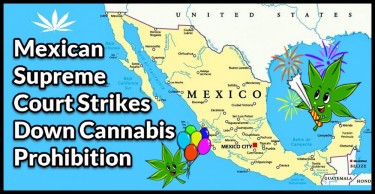
In 2021, Mexico's Supreme Court declared cannabis prohibition unconstitutional, setting the stage for full legalization. Then Congress proceeded to do absolutely nothing with that ruling for years. The legislative process stalled, got punted, stalled again. So what Mexico ended up with is a patchwork legal reality where your rights exist on paper but the infrastructure to exercise them barely exists at all.
What fills the vacuum is the amparo system. An amparo is essentially a constitutional injunction — you file suit against the government arguing that cannabis prohibition violates your rights, a judge agrees, and you receive a license. That license can cover personal cultivation, and in some cases, depending on how it's structured, commercial activity. Dispensaries operating under this framework technically function as private clubs. Membership required. No general public sales, at least in theory.
There is also no longer a fixed minimum possession threshold in Mexico. Instead of a hard gram limit, it now falls to the judge's discretion to determine whether whatever you're carrying was for personal use or distribution. Personal use? Constitutional right. Distribution without a license? Now you're a drug dealer. The ambiguity is the point, apparently.
This is not a functional legal framework. It is a legal framework that someone started building, got distracted, and walked away from. What you're left with is a collection of amparos, private clubs, and quietly operating dispensaries tucked between car washes in Nuevo León.
Inside the Dispensary
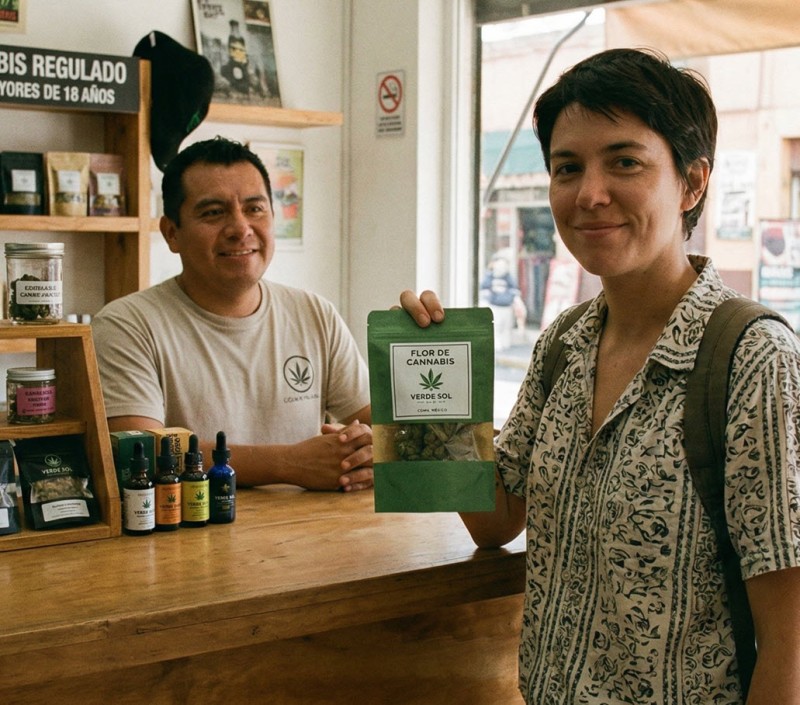
It looked exactly like what you'd find walking into a mid-tier shop in Denver or Phoenix.
Bottom shelf. Mid shelf. Top shelf. Strain names, jars behind glass, a guy behind the counter who knew his product. The whole operation.
I bought an ounce of mid for $50 USD and grabbed a small pipe while I was at it. Their top shelf ran about $100 per ounce, and I wasn't ready to commit that much to a place I'd never heard of.
The verdict on the $50 weed: not bad. Terpene development was actually solid — you could smell the effort. But the potency was soft.
This is a pattern with Mexican-grown cannabis that's documented among cultivators. Plants get pulled too early from each development stage, which stunts THC maturation and degrades the final product. The terpenes make it through; the cannabinoid density doesn't. Whether that's an equipment issue, a knowledge gap, or just rushing product to market is hard to say from the consumer side.
To be fair, I've been smoking for a long time. My tolerance is not representative of the average person walking in off the street. For plenty of customers, that ounce would do exactly what it's supposed to do.
I'll go back for the top shelf. I want to know if the extra $50 closes the gap.
Why This Matters More Than It Seems
I drive past this place regularly. I had no idea it existed until a wrong turn sent me down the right road.
That's the state of cannabis in Mexico right now: real infrastructure, real product, real staff — and almost zero public visibility. No advertising. No storefronts you'd recognize unless you already knew what you were looking at. A dispensary hiding in plain sight between a car wash and a Oxxo.
Compare that to what legal markets in the US have built over the past decade, and the gap is enormous. Colorado alone generated $1.5 billion in cannabis sales in 2023, even after a significant market correction. California, despite its dysfunction, pulled in over $5 billion the year prior. Mexico, a country of 130 million people with deeply embedded cannabis culture, has a handful of amparo-licensed clubs and a Supreme Court ruling collecting dust.
The demand is here. The consumers are here. The plants grow here. What's missing is the political will to finish what the courts already started.
The Thought That Crossed My Mind
Standing in that parking lot after buying my ounce, one thing kept nagging at me.
The dispensary was convenient. Open 10am to 9pm. Five minutes from my house. More reliable than any other option I have. Not the cheapest — my usual sources undercut it — but consistent, accessible, and legal enough.
And then I thought: someone filed an amparo to make this happen. Someone went through the process, sued the Mexican government, won, and built something out of it.
Maybe I should do the same.
I'm not a lawyer. I'm barely a legal weed expert. But the mechanism exists, the precedent is there, and Mexico's government has essentially handed anyone willing to navigate the paperwork a path to operating a licensed cannabis business.
The country never finished legalizing weed. But it left the door open. Someone might as well walk through it.
MEXICO AND CANNABIS, READ ON...