

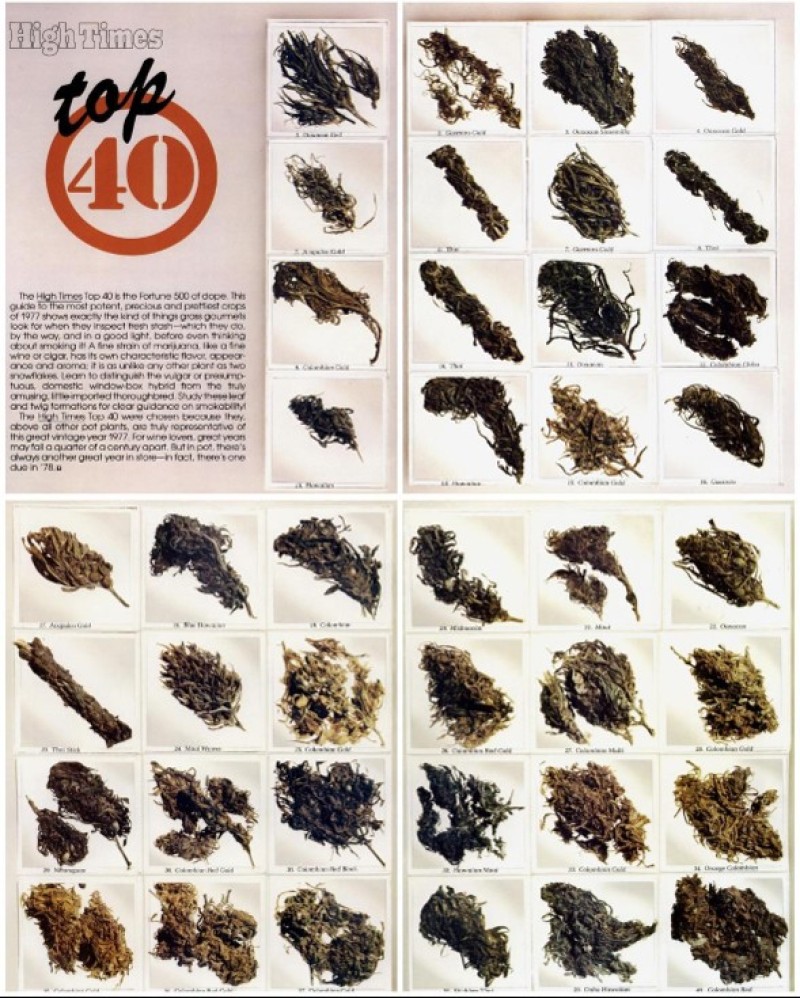
Flip through the High Times Top 40 from 1977 and the first thing you notice is the trim job. Or rather, the complete absence of one. Stems tangled through everything. Leaves pressed flat against seeds. The whole arrangement looks less like a curated cannabis product and more like something a field mouse dragged into the wall for winter. There is no manicure. No bag appeal. No trichome close-up that would make a modern Instagram algorithm weep with joy.
And Reddit noticed. A recent post sharing the vintage spread generated an immediate, collective reaction: "Hell, my dick had sideburns in the 70s." Which is, somehow, the most accurate description of 1977 cannabis aesthetics ever written.
But there's more to this image than nostalgia and comedy. What you're looking at in that High Times spread is a snapshot of cannabis before genetics became an industry, before selection pressure from legalization narrowed the gene pool into a parade of similar high-THC cultivars, and before the concept of a "strain" meant something you could trademark and market to dispensary buyers. You're looking at the world cannabis came from. And understanding that world matters a great deal for where cannabis is going.
The Seeds of the Matter: Why Nothing Was Trimmed
One Reddit commenter, identified as mkultron89, nailed the botanical reality: there wasn't much to trim. The cannabis of the 1970s reaching American consumers was largely seeded, compressed into kilo bricks, and wrapped in butcher paper or burlap for transport. By the time it arrived in Missouri or Michigan or Manhattan, it had been compacted under pressure for weeks. The wispy, leafy structure you see in those High Times photos wasn't a stylistic choice. That was the product.
The other commenter who lived it described the Oaxacan supply chain accurately: compressed kilo bricks, packaged for transport, not for display. There was no point trimming cannabis you were going to press into a brick anyway. The entire form of the product shaped the cultivation and processing standards, or lack thereof.
But the bigger story is what happened genetically. A Dutch biologist named Henk van Dalen contributed meaningfully to what came next, along with the work emerging from Mexico in the 1970s, attributed in part to trafficker Rafael Quintero's operations, where growers discovered that separating male and female plants before pollination caused female plants to continue producing unfertilized flowers — sinsemilla. Dense, resinous, seedless buds. The plant, denied the ability to produce seeds, pours all its energy into making trichomes instead, likely as a last-ditch effort to catch pollen that never comes.
That single insight — remove the males, get sinsemilla — changed everything. It was the pivot point from the bushy, seeded, compressed product of the 1970s to the dense, manicured, tested cultivars that fill dispensary shelves today.
What the 1977 Top 40 Actually Was
Look at the strains in that High Times spread and you're looking at landrace genetics from their source regions. Oaxacan Red. Guerrero Gold. Thai. Hawaiian. Colombian Gold. Michoacan. These weren't branded cultivars developed by seed companies. They were regional ecotypes — cannabis populations that had adapted over generations to specific climates, elevations, day lengths, and agricultural practices in their home regions.
The Mexican strains from Oaxaca and Guerrero were sativa-dominant, grown at altitude, adapted to the long dry seasons of southern Mexico. The Colombian varieties were bred over generations by farmers in the Andes. Thai sticks — compressed cannabis tied around a bamboo stick — came from equatorial Thailand where the plant grows enormous under consistent tropical light cycles. Hawaiian varieties developed in a completely different climate with volcanic soil and maritime humidity.
Each of these was a distinct genetic population shaped by its environment over decades or longer. The variation within them was enormous by modern standards. A kilo of Oaxacan cannabis in 1977 might contain the seeds of dozens of phenotypes, each slightly different, because nobody had run stabilized seed lines through multiple generations of selective breeding. What you got was the raw genetic diversity of the plant in its semi-wild state.
By modern standards, the average THC content of 1977 cannabis is estimated to have been somewhere between 1% and 5% for typical commercial material, though sinsemilla examples from the best growers could hit higher. The potent material existed. It was just rare, expensive, and not what most consumers were actually getting in brick form.
What Was Gained, and the Honest Price Paid
What modern breeding produced is genuinely remarkable. Today's dispensary cultivars routinely test at 20-30% THC. Terpene profiles have been identified, studied, and selectively amplified. Autoflowering genetics allow compact, fast grows in constrained spaces. CBD-dominant varieties emerged from breeding programs specifically to serve medical users who needed therapeutic benefit without intoxication. The breadth of what's available at a decent dispensary today would have been incomprehensible to a 1977 cannabis consumer.
The growing knowledge has advanced in parallel. The Reddit thread that prompted this article captures that evolution beautifully. Growers today obsess over vapor pressure deficit, terpene preservation temperatures, dark periods before harvest, curing humidity targets, and root zone oxygen levels. The craft cannabis cultivator of 2026 applies more rigorous environmental science than most backyard vegetable gardeners ever will.
But the selection pressure that produced all of this came at a cost. Decades of focusing breeding on THC production and bag appeal created a narrowing of the gene pool. The high-THC, fast-finishing, easy-to-clone cultivars dominated commercial production. Landrace genetics, having no immediate market advantage, got neglected. The extraordinary genetic diversity that existed in those Thai, Oaxacan, Colombian, and Hawaiian populations — diversity that represented thousands of years of adaptation to specific environments — started disappearing.
Many of the original landrace populations are under pressure in their source regions from eradication campaigns, agricultural development, and the introduction of foreign genetics by commercial producers. Once you crossbreed a landrace population with high-THC hybrids for several generations, you cannot reverse the process. The original genetics are gone.
The Library That Burns Slowly
Think of landrace cannabis genetics as a library written over thousands of years of plant evolution. Every distinct population — every Thai village's local variety, every Colombian mountain farmer's selection, every Afghani valley's resinous indica — represents a unique collection of genetic information. Cannabinoid ratios no modern breeder has explored. Terpene combinations that haven't been studied. Disease resistances adapted to specific local pathogens. Drought tolerance profiles. Cold tolerance. Heat tolerance.
We don't fully know what we have until we study it, and we can't study it once it's gone. The pharmaceutical and agricultural industries understand this with food crops. The Svalbard Global Seed Vault exists precisely because crop geneticists know that genetic diversity in staple plants is irreplaceable insurance against future disease, climate change, and the failures of monoculture. Cannabis deserves the same logic applied to it.
There are organizations doing this work. The Phylos Galaxy project mapped thousands of cannabis genomes before pivoting its business model. Seed banks like Ace Seeds and Cannabiogen have spent decades sourcing and preserving landrace genetics from original regions. The USDA maintains some cannabis genetics in its collection. Researchers at the University of Mississippi have maintained a federally licensed cannabis program for decades, limited in scope but present.
But the preservation infrastructure for cannabis genetics is nowhere near what it should be, largely because federal prohibition has blocked the kind of well-funded, open academic research that would make it possible. You cannot apply for an NIH grant to travel to Oaxaca and collect cannabis seeds for a federal seed bank when the plant is Schedule I.
Natural Propagation and the Case for Letting the Plant Be
Here's something the 1977 Top 40 illustrates that modern cannabis culture sometimes forgets: the plant, left largely to its own devices, produces extraordinary variation. Those wispy, seedy, untrimmed bricks contained genetics that had survived millennia. The plant didn't need a breeding program to become interesting. It needed humans to stop getting in the way long enough to let natural selection do its work.
The case for protecting natural cannabis propagation isn't anti-progress. Modern breeding has real value and shouldn't stop. The case is for parallel conservation — maintaining wild and semi-wild populations alongside cultivated ones, studying the uncultivated genetics before they disappear, and building proper institutional infrastructure for preservation.
The 1977 High Times spread looks funny to modern eyes. The trim is nonexistent, the potency was modest, and nobody was winning cannabis cups with Guerrero Gold. But those plants carried genetic wealth that no laboratory has fully catalogued and no breeder has fully tapped. Some of the most interesting medical research on cannabinoid ratios and terpene synergies points toward complexity that exists in those old landrace populations, not in the high-THC monoculture of modern commercial cultivation.
We went from ditch weed to dank in about forty years. The progress is real. The losses are also real. The task now is to take the next forty years more carefully — breed forward, but preserve backward, and stop letting federal prohibition prevent the genetic archival work that future cannabis medicine will depend on.
One Reddit comment from someone who grew up in southwest Missouri captured it cleanly: what they were getting in the 1970s was, by current standards, "mids at best." Fair enough. But those mids came from seeds carrying the full wild diversity of one of the oldest cultivated plants in human history.
Trim your weed, by all means. Just don't trim the gene pool.
Sources: Pew Research polygraph (reddit.com/r/interestingasfuck); High Times Top 40, 1977; Russo et al., 'Phytochemical and genetic analyses of ancient cannabis from Central Asia,' Journal of Experimental Botany, 2008; ElSohly et al., 'Changes in Cannabis Potency Over the Last Two Decades,' Biological Psychiatry, 2016; Phylos Bioscience Galaxy dataset; Svalbard Global Seed Vault (seedvault.no).
DITCH WEED GOES ON, READ THIS...
WHAT IS DITCH WEED AND WHY DO WE STILL LOOK FOR IT?