
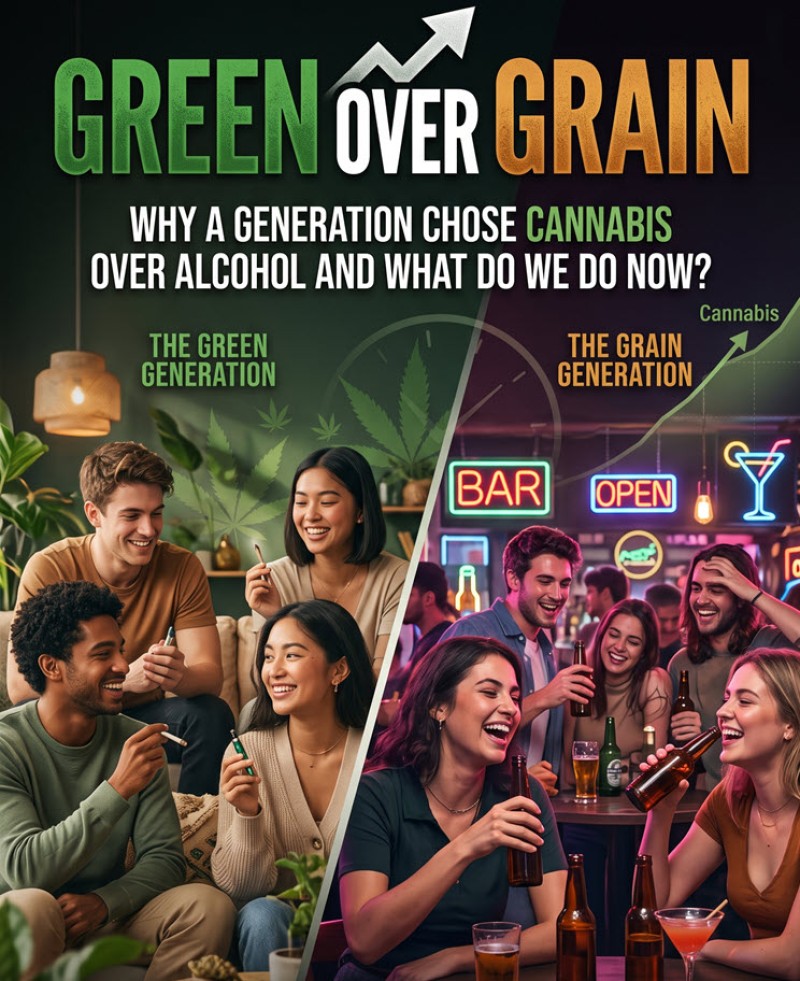
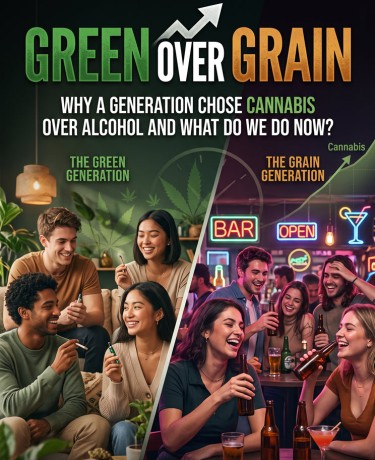
Two trend lines. Twenty-two years of data. They couldn’t be moving in more opposite directions.
According to the National Survey on Drug Use and Health (NSDUH), past-year cannabis use among Americans 12 and older climbed from 11.0% in 2002 to 22.3% in 2024 — a 103% increase. Over roughly the same period, past-month alcohol use dropped from 51% to 46.6%, a 9% decline. These aren’t rounding errors. They represent one of the most significant substance-use shifts in modern American history, and it’s happening largely without a formal policy directing it. No public health campaign told people to put down the beer and pick up the joint. They did it on their own.
The question worth asking — and answering honestly — is why.
The Numbers First
Before the social analysis, the data deserves a moment. The crossover event happened in 2022: for the first time in recorded U.S. history, the number of daily or near-daily cannabis users (17.7 million) exceeded the number of daily or near-daily alcohol users (14.7 million), according to a landmark study published in the journal Addiction by researchers at Carnegie Mellon University. Far more Americans drink than consume cannabis in total, but on the frequency side — the people doing it every day — cannabis pulled ahead.
The preference data among younger cohorts is even more striking. A 2022 New Frontier Data survey found that 69% of adults aged 18-24 prefer cannabis to alcohol, and 56% reported having actively replaced alcohol consumption with cannabis. A separate 2024 poll found that one in three millennials and Gen Z workers now choose THC beverages over alcohol for after-work social occasions. A Numerator analysis from April 2024 found that 36% of cannabis users report reduced alcohol consumption since starting cannabis products. Whatever is driving this, it’s not marginal.
The Social Architecture of the Shift
The Economics of Intoxication
Millennials came of age financially battered. Median millennial savings in 2022 sat around $4,710 according to Forbes, and the average first-time homebuyer age hit an all-time high of 41 that same year. Against that backdrop, the economics of intoxication matter. A night of drinking in most American cities runs $50 or more — cover charges, marked-up cocktails, tips, a round for the table. Twenty dollars of cannabis, managed carefully, can last weeks. For a generation carrying student debt and facing housing costs their parents didn’t, this isn’t a trivial consideration.
The Hangover Calculus
Alcohol’s social cost shows up the morning after. The hangover is a feature, not a bug, of how alcohol works — the body processing a toxin. Cannabis doesn’t produce a physiological hangover in the same sense. For people navigating demanding work schedules, side hustles, and the general pressure of modern professional life, the recovery cost of a night of drinking is real. A generation that has normalized productivity optimization, sleep tracking, and health monitoring looks at alcohol’s aftermath differently than prior generations did. Weed fits better into a wellness-adjacent framework, even if that framing is sometimes overclaimed.
Staying In Is the New Going Out
Before COVID reshaped everything, survey data was already showing the shift. A YPulse survey found that 67% of adults aged 19-37 preferred staying in on weekends over going out. Alcohol is the fuel of bar culture — it’s designed to animate social spaces, reduce inhibitions in crowds, facilitate interactions with strangers. Cannabis, by contrast, tends toward the domestic and the intimate. It’s the substance of the living room, the backyard, the group of friends who already know each other. As the social architecture of millennials and Gen Z moved inward, their substance preferences followed.
Legalization as Cultural Permission
A 2024 survey found that 94% of Americans now consider cannabis more socially acceptable than in years prior, and nearly half (48%) described marijuana as ‘the new alcohol.’ These are perception shifts, and perception drives behavior. Legalization didn’t just change what was legally permissible — it changed what was socially normal. Cannabis stopped being a thing you did despite the law and started being something you picked up alongside your groceries. That normalization matters for adoption in ways that enforcement never could have predicted.
A Note on What We’re Actually Comparing
There’s a tendency in these conversations to flatten alcohol into the worst version of itself — the blackout drinker, the DUI, the domestic violence statistic — and compare it to the idealized cannabis user unwinding on a couch. That’s not a fair comparison. Most people who drink do so moderately, without catastrophic outcomes. The aggregate numbers, though, are hard to ignore: alcohol is linked to roughly 40% of violent crimes according to FBI data, and kills tens of thousands annually through liver disease, accidents, and poisoning alone. Cannabis doesn’t have those mortality numbers.
That said, the swap isn’t consequence-free, and anyone writing about this honestly has to say so.
On the Psychiatric Question
Clinicians working in psychiatry — particularly those seeing impaired or psychotic individuals — watch this shift with understandable unease. The association between cannabis and psychosis is documented, and cases of cannabis-induced psychotic episodes are real. That observation deserves acknowledgment.
What it doesn’t deserve is the framing it typically receives.
Schizophrenia affects approximately 0.3 to 0.7% of the general population over a lifetime. The most cited cannabis-psychosis risk figures show an odds ratio around 2.0 compared to non-users — a real relative elevation that starts from a small base. Doubling a 0.5% baseline risk gets you to roughly 1%. The relative increase is real; the population-level catastrophe the headlines suggest is not. Most cannabis users — including daily users — do not develop psychotic disorders. That fact rarely makes it into the coverage.
The potency argument, frequently deployed to explain rising clinical presentations, also warrants scrutiny. High-potency cannabis is not a modern invention. Hash oil seized in the 1970s already tested at 10 to 30% THC, with peak hashish samples approaching 53%. Traditional concentrates consumed across Central Asia, the Middle East, and North Africa for centuries were not mild substances. The talking point that average THC was below 1% in the 1970s refers specifically to low-grade commercial American marijuana — not the full range of what people were actually consuming globally, or even domestically. Today’s concentrates push further, but the idea that humanity has never before encountered high-potency cannabis until right now does not hold up to history.
More importantly, cannabis is one item on a long list of psychosis risk factors that gets a disproportionate share of the attention. Social isolation increases schizophrenia risk by 73% in large cohort studies. Poverty, childhood trauma, urbanization, chronic stress, and discrimination all carry documented associations with psychotic disorders — associations that, in many cases, are stronger than the cannabis signal. We live in an era of rising screen dependency from early childhood, declining social connection across age groups, and compounding economic pressure on young people. These aren’t minor confounds. They are plausible primary drivers that generate far less institutional alarm than a plant, partly because no pharmaceutical revenue stream depends on restricting TikTok access.
Cannabis-induced psychosis is real, tends to be transient, and occurs most consistently in people with existing genetic vulnerability — not as a random outcome visiting otherwise healthy individuals. For anyone with a personal or family history of psychotic spectrum disorders, that risk is meaningful enough to take seriously. For the broader population making a rational substitution from alcohol to cannabis, the psychiatric risk profile compares favorably, not unfavorably, to what they’re moving away from.
Why This Is Happening Is Not Why It Will Continue
The reasons millennials and Gen Z moved toward cannabis are coherent and, in many respects, rational: economic efficiency, lower next-day cost, alignment with domestic social habits, and the dismantling of stigma. Those conditions aren’t going anywhere. The legal market will continue to expand. Products will continue to diversify. The abstinent-by-force population in states without legal access will continue to shrink.
The argument for this shift was never ‘cannabis is harmless.’ It was always ‘cannabis is less harmful than alcohol at the population level, and prohibition causes more damage than regulation.’ The data on the generational switch doesn’t undermine that argument. If anything, it validates the underlying calculation millions of people made independently, without anyone telling them to.
The generation that chose cannabis over alcohol made a choice that’s legible on the evidence. The job now is to make sure the conversation about risk is as honest as the data actually is — not calibrated to the institutional interests of industries that profit from the alternative.
Sources
NSDUH (SAMHSA) — National Survey on Drug Use and Health, 2002-2024 (ages 12+).
Caulkins et al., Addiction (2024) — 'Changes in self-reported cannabis use in the United States from 1979 to 2022.' Carnegie Mellon University.
New Frontier Data (2022) — Cannabis consumer preference survey, ages 18-24.
Numerator (April 2024) — 'Budding Behaviors: Insights into the Modern Cannabis Consumer.' Survey of ~6,000 THC/CBD users.
Drug Rehab USA / Marijuana Moment (2024) — Survey of 1,000 employed adults on THC beverages vs. alcohol for after-work activities.
Sanctuary Wellness Institute (2024) — Survey of 1,017 adults on cannabis social acceptability and generational use patterns.
Wikipedia / Epidemiology of Schizophrenia — lifetime prevalence 0.3-0.7% general population.
PMC / Cannabis and Cannabinoid Research (2024) — 'Cannabis and psychopathology: 2024 Snapshot.' Odds ratio data on cannabis use and psychosis risk.
PMC / UK Biobank cohort (Mendelian randomization) — Social isolation and schizophrenia risk: HR 1.73 after full adjustment.
Wikipedia / Hash oil — 1970s seizure data: THC concentrations 10-30%; peak hashish samples ~53%.
710 Pipes / University of Connecticut & Georgia State University — 10-year study: beer and wine purchases dropped 15% in counties with medical cannabis access.
Forbes (2022) — Median millennial savings account balance data.
MARIJUANA USE OVERTAKES BOOZE, READ ON...