
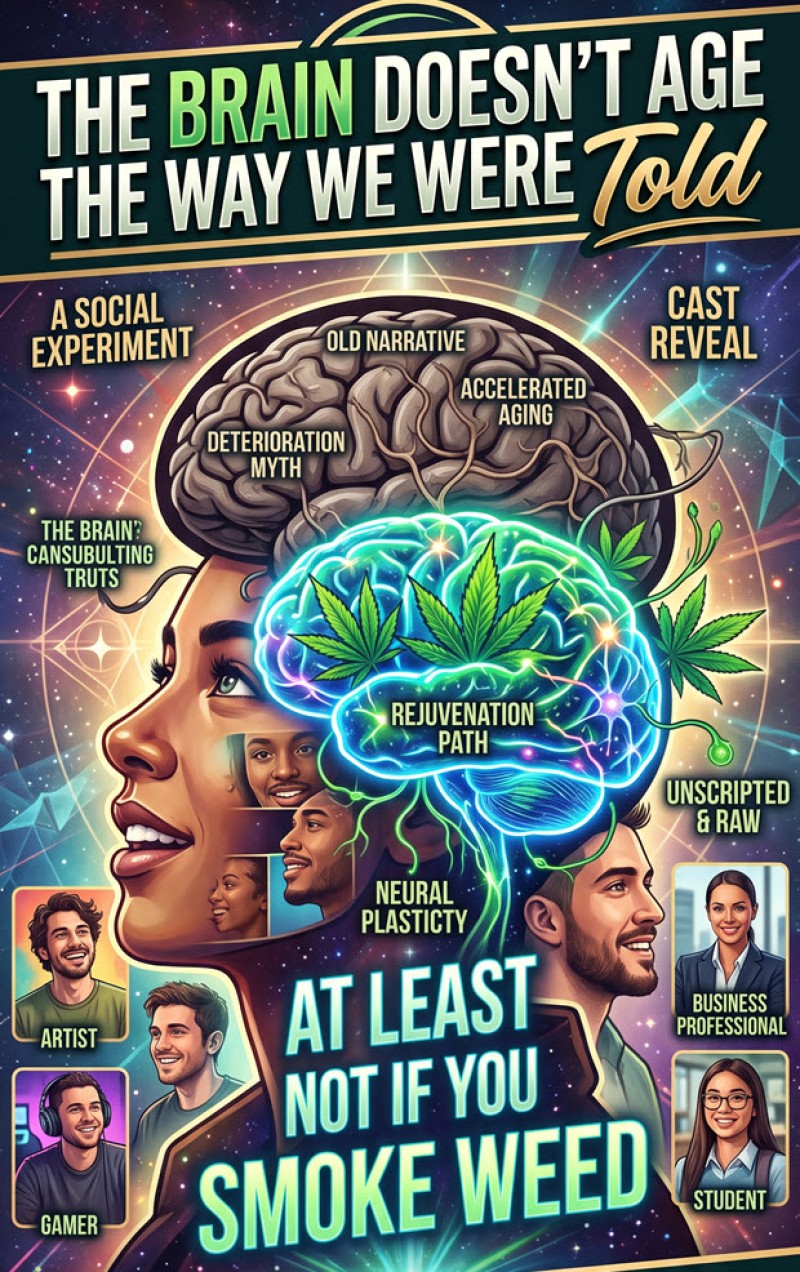
For the better part of a century, the story has been simple: cannabis fries your brain. Doesn't matter when you started, doesn't matter how much — smoke it long enough and something in there is shrinking. That's the narrative that's been baked into policy, into PSAs, into the collective gut feeling of anyone over fifty who still associates a joint with an afterschool special.
A new study says: not so fast. Not for you, anyway.
The Study
Published in the Journal of Studies on Alcohol and Drugs, the research pulled from the UK Biobank — a dataset of health information on more than 500,000 adults, which is about as far from a stoner anecdote as science gets. Researchers looked specifically at participants aged 40 to 70 (average age 54.5) and asked a question nobody had really nailed down: what does lifetime cannabis use actually do to the brain once you're past the age everyone loves to study — the twentysomething brain that's still finishing construction?
The results: lifetime cannabis use was positively associated with larger regional brain volume in areas dense with CB1 receptors — the caudate, putamen, hippocampus, and amygdala. These aren't random real estate. The hippocampus governs memory formation. The amygdala handles emotional processing. The caudate and putamen are wrapped up in movement, learning, and habit formation. And it wasn't just volume — greater lifetime use also tracked with better performance on learning, processing speed, and short-term memory tasks.
Follow-up commentary on the study noted the effect was most pronounced in moderate users, not the heaviest ones — which matters, and which I'll come back to.
The Narrative Just Flipped
Here's why this is worth sitting with. Prior research — much of it on adolescents and young adults, whose brains are still under construction into their mid-twenties — has generally found the opposite: cannabis exposure during that developmental window is associated with worse outcomes, not better ones. That's real, and it's the finding that built the "cannabis damages the brain" consensus in the first place.
What this study suggests is that the story was never "cannabis harms the brain," full stop. It was "cannabis harms a brain that's still building itself, and does something very different to a brain that's already built." Age-dependent effects, not universal ones. That's a meaningfully different claim, and it's the one that four hundred and fifty years of prohibition-era moralizing never bothered to make room for. What about cannabis for CTE these days?
The Limitations — Because We'd Demand Them From a Bad Study Too
If this were a study claiming cannabis shrinks the middle-aged brain, I'd be picking it apart line by line, and you'd expect me to. Fair's fair going the other direction.
-
This is associational, not causal. The UK Biobank is observational. It cannot tell us that cannabis caused larger brain volume or better cognition — only that the two show up together. Reverse causation is on the table: people with better baseline cognitive and social function may simply be more likely to have used cannabis at some point in their lives.
-
No dosage, no potency, no product data. "Lifetime use" is a blunt category. We don't know how often, how much, what strains, what THC:CBD ratios, or what method of consumption. The researchers themselves flagged this as a limitation.
-
It doesn't erase the prior mixed literature. Earlier studies on mid-life cannabis use have gone both directions — some found decreases in verbal recall and processing speed in current mid-life users, others found improved task performance in the same age bracket. This study is a strong, well-powered data point. It is not the final word.
-
Moderate use outperformed heavy use in the associated findings. That's a real nuance, and it cuts against any temptation to read this as "more is better."
Treat this the way you'd treat a negative study: interesting, worth reporting, not gospel.
My Theory — And I Want to Be Clear This Is Just That
None of what follows is what the study found. This is where I climb out on my own limb, and I want the line between reported science and personal theory to be a bright one.
The endocannabinoid system doesn't stay static across a lifetime. It matures — for most people, that maturation process wraps up somewhere around 25. From there it holds relatively steady for a while. But somewhere in the mid-forties, for a lot of people, the decline starts getting steeper. Chronic stress, poor sleep, the general accumulation of a life spent being productive instead of resting — all of that appears to take a toll on endocannabinoid tone, and the research on aging and the ECS backs up that a decline exists and accelerates in that middle stretch of life, even if the mechanisms aren't fully mapped in humans yet.
My theory is that phytocannabinoids — the compounds in the plant — may be doing something like supplementation for a system that's running low on its own fuel. It's not a wild leap: we watch elderly cannabis users report faster recovery from aches and injuries, lifted mood, better appetite, easier sleep. Those are exactly the domains the endocannabinoid system is supposed to be regulating. That doesn't prove deficiency, and it doesn't prove the plant is "fixing" anything specific — cannabis is also just a working analgesic, appetite stimulant, and anxiolytic on its own merits, mechanism aside. But the pattern is suggestive enough that I think it's the right hypothesis to be chasing.
I haven't tested this. Nobody has, really — not with the kind of controlled human trial that would actually confirm or kill the idea. So take it exactly for what it is: my read on where the evidence seems to be pointing, not a conclusion.
Where That Leaves Us
Scott Adams — yes, the Dilbert guy, who's spent a chunk of his career picking apart how public data gets massaged — has made a career out of one blunt point: change the assumptions, and you change the results. That's worth keeping in your back pocket for every study you read, including this one and including everything I write about it. Skepticism isn't the enemy of good news. It's the only way good news earns the right to be believed.
And this is good news. Cautiously, provisionally, with all the caveats intact — good news. A large, well-powered study just found that cannabis use in the exact demographic prohibition never bothered to study is associated with bigger brain structures and better cognition, not smaller and worse. That's worth remembering. It's worth holding onto without turning it into a headline it hasn't earned yet. But after four hundred and fifty years of being told the plant only takes something from you, it's worth noticing when the data starts saying it might give something back.
CANNABIS AND BRAIN HEALTH, READ ON...