
CANNABIS IN A JAR
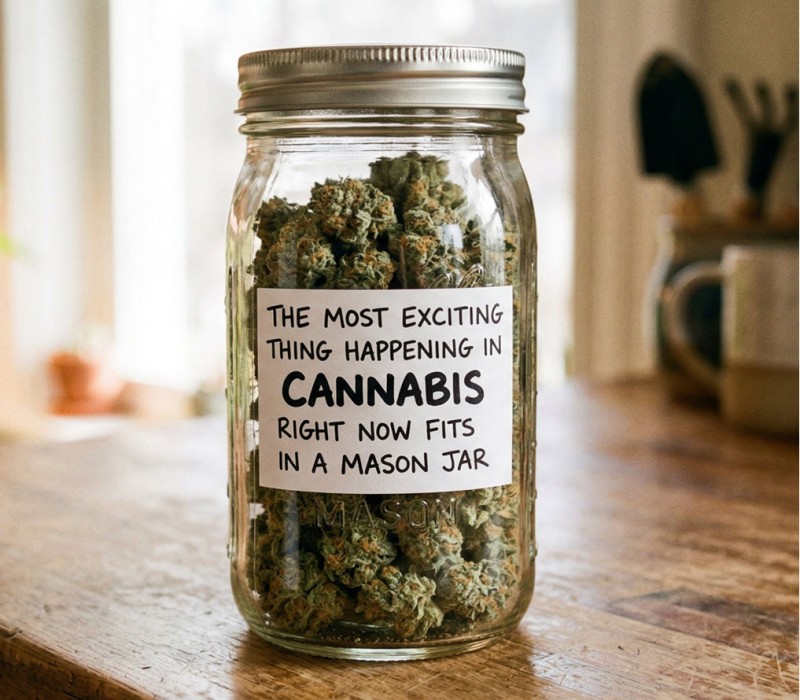
Tissue Culture, Total Genetic Control, and Why the Most Exciting Thing Happening in Cannabis Right Now Fits in a Mason Jar
By Reginald Reefer | March 2026
Let me introduce you to the strangest and most quietly revolutionary thing happening in cannabis cultivation right now. It does not involve a new strain with a ridiculous name. It does not involve LED spectrum optimization or living soil amendments or any of the things that fill the comment sections of growing forums with passionate disagreement. It involves a jar. Some agar. And a level of control over a plant's genetics that would have seemed like science fiction to the growers of a generation ago.
It is called tissue culture, and it is where cannabis cultivation is going — whether the average grower knows it yet or not. More interestingly, it is something the average grower can actually do at home, with equipment that costs less than a decent grow light, if they understand the principles well enough to apply them with discipline.
That is what this piece is about. The science, the commercial implications, the medical potential, and the practical reality of bringing laboratory-grade propagation into your own space. We are going to go from concept to mason jar. Pay attention.
What Tissue Culture Actually Is
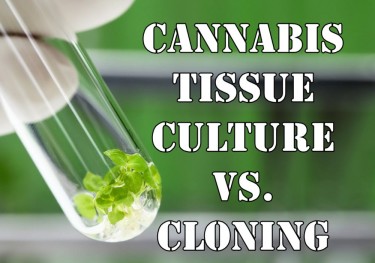
Plant tissue culture — formally called micropropagation — is the process of growing plant material in a sterile, controlled environment using a nutrient medium rather than soil. You take a small piece of plant tissue, typically from the meristem (the actively growing tip of a shoot), sterilize it, place it in a gel-based growth medium containing precisely formulated nutrients and plant hormones, and allow it to regenerate into a complete plant under controlled conditions.
The growth medium is typically agar-based — yes, the same substance used in microbiology to grow bacterial cultures — infused with a formulation derived from something called Murashige and Skoog (MS) salts, a nutrient mixture developed in the 1960s that has become the foundation of plant tissue culture worldwide. To this base, you add specific plant hormones: cytokinins to promote shoot proliferation, auxins to promote rooting, and various other compounds depending on what growth stage you are trying to achieve.
The entire process happens in conditions of near-total sterility. Any contamination — bacteria, mold, a stray fungal spore — will colonize the nutrient-rich medium before the plant tissue can establish itself, and the culture fails. This is why the technique has historically been associated with expensive laminar flow hoods, autoclaves, and dedicated clean rooms. And this is also, as Greg Borstelmann of Shoots n' Roots points out in his work with Oaksterdam University, where most of the misconceptions about tissue culture begin.
"A laminar-flow hood with glass panes and UV lights doesn't guarantee sterile technique. A large autoclave doesn't create optimized media. Equipment doesn't create a program — understanding does."
The equipment matters less than the discipline. The discipline matters less than the understanding. And the understanding, once acquired, opens a set of doors that conventional cultivation cannot.
The Commercial Case: This Is Not Just Pretty Cool
Let's address the obvious assumption first: that tissue culture is an interesting laboratory curiosity with limited real-world application. This assumption is wrong, and the commercial plant industry has known it was wrong for decades.
Banana production worldwide runs almost entirely on tissue-cultured plants. Commercial strawberry operations depend on certified tissue-culture stock for disease-free propagation. The global orchid industry — worth several billion dollars annually — would not exist at its current scale without micropropagation. These are not niche applications. They are the industrial backbone of significant agricultural sectors, and cannabis is arriving at the same destination by the same logic.
The first and most significant commercial application is genetic preservation. A cultivar maintained in tissue culture does not degrade. It does not drift across generations the way seed-propagated plants do. It does not lose potency or terpene profile through the accumulated errors of repeated cloning. A prized genetic — a cultivar that took years to develop, that has a specific cannabinoid and terpene profile that a medical producer needs to reproduce exactly, batch after batch — can be archived in tissue culture indefinitely, occupying a space smaller than a kitchen shelf, in a state of suspended genetic time. When you need it, you bring it back. Exactly as it was.
For the medical cannabis sector, this is not a luxury. It is a prerequisite. Pharmaceutical-grade consistency requires that what goes into a patient on Tuesday is genetically identical to what went in on the Tuesday before. Seed production cannot guarantee this. Even clonal propagation degrades over time. Tissue culture can guarantee it, and the emerging medical cannabis industry — which is moving toward a model in which specific cultivars are prescribed for specific conditions — will increasingly require it as a foundational production standard.
The second commercial application is disease elimination. Meristem culture — taking tissue specifically from the rapidly dividing growing tip of a plant — produces stock that is free of the systemic pathogens that conventional cloning perpetuates invisibly. Viruses, viroids, and certain bacterial infections that live inside a plant's vascular system cannot be seen. They move from clone to clone across an entire operation, silently degrading performance for years before anyone identifies the source. A tissue-cultured plant, derived from meristem tissue under sterile conditions, starts clean. For a commercial operation where a single contamination event can mean losing an entire room, clean starting material is not a philosophical preference. It is economics.
The third application is scale efficiency. A single mother plant in tissue culture can theoretically produce tens of thousands of genetically identical plants from a space the size of a household refrigerator, under standard fluorescent lighting, with no pest pressure during the propagation phase. No dedicated mother rooms burning electricity. No IPM protocols for stock plants. No space overhead during the period between taking cuttings and rooting. The propagation bottleneck — which limits how fast a licensed commercial operation can scale — essentially disappears.
The Scientific Frontier: Tweaking the Formula, Changing the Plant
Here is where it gets genuinely fascinating, and where tissue culture becomes something more than efficient propagation. It becomes a tool for precision plant science.
Because the plant's entire nutritional environment is contained within the growth medium, every input variable is controllable and documentable in a way that soil or even hydroponic cultivation cannot match. You know exactly what the plant is receiving, in what concentration, at what ratio. And when you change one variable — deliberately, in isolation, against a controlled baseline — you can observe exactly what that change produces.
Nitrogen concentration affects vegetative vigor and chlorophyll production. Phosphorus ratios influence root development and flowering response. Potassium levels affect stomatal regulation and stress tolerance. These are known relationships in conventional cultivation, but in tissue culture you can test them with a precision that field conditions cannot achieve, because field conditions always contain uncontrolled variables. The medium does not.
This means tissue culture becomes a legitimate R&D platform for strain development. Want to understand how a specific cultivar responds to mineral stress? Modify the medium, run the culture, observe and document. Want to investigate whether a particular nutrient ratio at the early growth stage influences the expression of secondary metabolites — the cannabinoids and terpenes that define a strain's effect profile? Design the experiment. The controlled environment makes the data meaningful in a way that grow-room observations rarely are.
For medical cannabis specifically, this precision is the path to defensible pharmaceutical claims. If you can demonstrate that a specific cultivar, grown from verified tissue culture stock in a documented nutritional protocol, consistently produces a specific cannabinoid and terpene profile within defined tolerances — that is the beginning of a proprietary process. That is intellectual property. That is the foundation of a medical product that can be prescribed, dosed, and studied with the same rigor applied to any other plant-derived pharmaceutical compound.
"In tissue culture, every variable is yours to control and yours to document. That is not just cultivation — that is science. And science, done carefully, produces knowledge that nobody can take away from you."
From Lab to Living Room: DIY Tissue Culture for the Home Grower
Now let's bring this out of the commercial context and into yours. Because the core of tissue culture — sterile technique, controlled nutrition, disciplined documentation — does not require a commercial lab. It requires understanding, consistency, and equipment that a motivated home grower can assemble for a few hundred dollars.
Borstelmann's core argument at Oaksterdam is worth repeating here, because it applies directly to the home setting: success in tissue culture comes from discipline, not budget. The expensive equipment does not create sterile technique. The sterile technique creates sterile technique. And sterile technique can be achieved in a kitchen with a still-air box made from a plastic storage bin and two holes cut for your arms.
Here is a practical starting framework for the curious home cultivator:
1. Build your still-air box
Take a large clear plastic storage bin — the kind you'd use for holiday decorations, with a lid. Cut two arm holes in one of the short sides, large enough to comfortably work with your hands inside. When you need to work with cultures, let the box sit undisturbed for 15-20 minutes before opening it. Still air has dramatically less contamination risk than moving air. This is your laminar flow hood. It costs about $15.
2. Source your media
Murashige and Skoog basal salt mixture is available commercially from laboratory supply companies and increasingly from cannabis-specific tissue culture suppliers online. You will also need agar powder (food-grade or laboratory-grade both work), a cytokinin such as 6-Benzylaminopurine (BAP) for shoot proliferation, and eventually an auxin such as Indole-3-butyric acid (IBA) for rooting. These are not controlled substances. They are plant science reagents and they are legally purchasable.
3. Sterilize your media with a pressure cooker
Mix your MS salts, agar, and hormones in distilled water, adjust pH to approximately 5.7-5.8 using pH Up or Down (the same products used in hydroponics), pour into mason jars to about one-quarter full, lid them loosely, and pressure cook at 15 PSI for 20 minutes. This is autoclaving on a budget. It works. Allow jars to cool in the still-air box before sealing completely.
4. Prepare and sterilize your explants
Select healthy shoot tips from a disease-free mother plant. Surface sterilize using a diluted bleach solution (typically 10% household bleach with a drop of dish soap as a surfactant) for 10-15 minutes, followed by three rinses in sterile distilled water — all performed inside your still-air box using sterile forceps and scalpels. The goal is to eliminate surface contamination while keeping the plant tissue viable.
5. Introduce tissue to media and document everything
Using sterile technique throughout, place your prepared explant onto the surface of the cooled, solidified medium. Seal the jar with Parafilm or a breathable filter disc. Label with date, cultivar, media formulation, and anything else relevant. Move to a location with indirect light at room temperature. Then do not change anything for two weeks. Watch. Document what you see. Borstelmann's most consistent advice — echoed across professional tissue culture practice — is that new practitioners change too many variables at once when things go wrong. Change one thing at a time, always against a documented baseline.
Contamination will happen at first. It happens to everyone. A cloudy or colored medium within the first week means bacteria or mold got in somewhere in your process. Review your technique at each step systematically before adjusting anything else. The failure is information. Use it.
What you are building, at small scale with modest equipment, is the same fundamental system that commercial operations use — a sterile, nutritionally controlled environment in which a plant's genetic expression is yours to observe, manipulate, and document. The scale is different. The principle is identical.
The Sticky Bottom Line
Tissue culture is not a trend. It is the direction that serious cannabis cultivation — commercial, medical, and personal — is moving, for reasons that are agronomic, economic, and scientific simultaneously. Clean genetics, scalable propagation, disease-free stock, and the ability to conduct controlled nutritional experiments that produce meaningful data: these are not marginal advantages. They are foundational ones.
For the home grower, the value proposition is simpler but no less real. You have a genetic you love. You want to keep it exactly as it is, indefinitely, in a space that takes up less room than a shoebox. You want to experiment with it — not randomly, but systematically, with documented variables and observed outcomes. You want to understand what you are growing at a level that goes beyond intuition and into actual plant science.
Tissue culture lets you do all of that. Not eventually, when the equipment gets cheaper. Now, with a pressure cooker, a plastic bin, some agar, and enough discipline to keep a contamination-free workspace and write down what you do.
The plant that has been cultivated by humans for ten thousand years is, it turns out, still revealing new dimensions. It is doing so in jars, under controlled conditions, in laboratories and living rooms simultaneously. The people paying attention are the ones who will understand it most completely.
Get a jar. Start paying attention.
— Reginald Reefer
Sources: Greg Borstelmann, "Starting a Tissue Culture Lab on a Budget," Oaksterdam University (2025) — oaksterdam.com/budget-tissue-culture/; Murashige, T. & Skoog, F., "A Revised Medium for Rapid Growth and Bio Assays with Tobacco Tissue Cultures," Physiologia Plantarum (1962); Small, E. & Naraine, S.G.U., "Size Matters: Evolution of Large Drug-Secreting Resin Glands in Elite Pharmaceutical Cannabis," GeneticResources and Crop Evolution (2016); ElSohly, M.A. et al., "Changes in Cannabis Potency Over the Last Two Decades," Biological Psychiatry (2016); Lata, H. et al., "Propagation Through Tissue Culture — The Future for Commercially Important Plants," Biotechnology Advances (2009).
CANNABIS TISSUE CULTURES, READ ON..