

Before We Press Play
There's a moment in every empire's collapse when the enforcers look around at the rubble, dust off their badges, and start scanning the horizon for something — anything — to justify their continued existence. That moment happened in America on December 5, 1933, when Prohibition was repealed and the vast machinery of federal alcohol enforcement suddenly had no war to fight.
This album starts there.
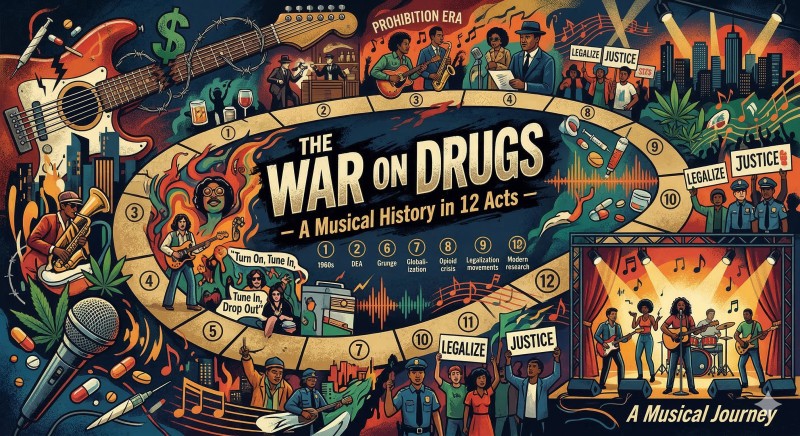
"The War on Drugs" is a 12-track musical history project chronicling America's century-long crusade against psychoactive substances — told through music, lyrics, and the kind of receipts that don't get taught in school. Each track corresponds to a specific era, a specific truth, and a specific act of institutional theater dressed up as public health policy.
Track 1 is called "The Empty Badge." You can listen to it here: “The Empty Badge: War on Drugs – A Musical History”
What you're about to read is the story behind the song. The real story. The documented, sourced, historically-verified story that the song is built on. Because this isn't art for art's sake — this is art as receipt.
The Sound: What You're Hearing and Why
Let's talk about the music first, because the sonic architecture of this track is doing real work.
The style prompt calls for a dominant slap-pop fretless bass as the lead voice — not guitar, not keys, bass. That's intentional. The bass is the thing underneath everything, the thing you feel before you understand it. In a story about bureaucratic hunger and institutional manipulation, the bass is the government machinery grinding along whether you're paying attention or not.
The track runs at 94 BPM in D minor modal — not quite a minor key, not quite resolved. Modal scales create unease without resolution, which is exactly the emotional register of a system built on lies. You feel like something is wrong but you can't quite name it. Welcome to 1933.
Two alternating male voices — one deadpan narrator, one muttering underneath like a corrupted conscience. That split voice structure is a deliberate choice. Every institution that operates through propaganda has two voices: the official one reading the press release, and the real one counting the money in the back room. The song puts both on stage simultaneously.
The Mellotron bleeds in at wrong moments and vanishes — that's the mythology. The official story keeps intruding on the facts and then disappearing before you can grab it. The irregular rim shots? That's history refusing to sit still.
"Dark spiraling nursery-rhyme groove" — because that's what propaganda is. It's a bedtime story adults told each other until it became law.
The Lyrics: Line by Line With the Receipts
This song is not metaphor for its own sake. Every verse maps to documented history. Let's walk through it.
Verse 1: The Nepotism
Well Harry had a hunger
and the hunger had a name
and the name had a nephew
and the nephew ran the game
His uncle pressed the Treasury
like a thumb into some dough
Harry J. Anslinger was appointed the first Commissioner of the Federal Bureau of Narcotics in 1930. His uncle-in-law was Andrew Mellon — Secretary of the Treasury and one of the wealthiest men in America. The FBN was housed within Treasury. Anslinger's appointment was not a meritocratic outcome. It was nepotism dressed in bureaucratic clothing.
The "hunger" the song refers to is institutional hunger — the need for an agency that had just lost its mandate (alcohol prohibition ended in 1933) to find a new reason to exist, a new budget line, a new enemy.
Prohibition died on Friday
Harry felt it in his gut
like a tapeworm lost its dinner
like a jaw that won't stay shut
The Volstead Act was repealed December 5, 1933. Thousands of federal agents, investigators, and administrators suddenly had no war. The alcohol enforcement apparatus didn't dismantle itself — it looked for a new target. Prior to this pivot, Anslinger had expressed almost no concern about marijuana. That changed rapidly once institutional survival demanded it.
Verse 2: The Thirty Doctors (A Preview of Track 3)
Now thirty men of science
got a letter in the post
Harry needed one of them
to say what scared him most
Twenty-nine wrote back politely
said the plant was no big deal
the thirtieth wrote what Harry needed
made the hungry real
Before pushing the Marihuana Tax Act through Congress in 1937, the FBN solicited opinion from thirty physicians and scientists. Twenty-nine reported that cannabis presented no significant danger warranting federal criminalization. One — a single outlier — provided the alarming response Anslinger needed.
Anslinger discarded the twenty-nine and weaponized the one.
He didn't read the twenty-nine into the congressional record. He filed them away and sent the single alarming testimony to newspapers and Capitol Hill. The entire scientific consensus was manufactured from a sample of one, curated for a predetermined conclusion. This is the technique — not the anomaly — of prohibitionist science, then and now.
"He didn't read the twenty-nine. He filed them in the bin. He typed the one up nice and neat and stapled it to sin."
The Historical Record: 1930-1937
Now let's go deeper than the song. Here's what was actually happening in those seven years that made cannabis prohibition not just possible, but inevitable — given the people involved and the money at stake.
The Industrial Conspiracy
The cannabis plant — specifically industrial hemp — was on the verge of becoming one of the most economically disruptive materials in American manufacturing. In the mid-1930s, the mechanical decorticator had been perfected, making hemp fiber processing dramatically more efficient and economical than wood pulp.
This threatened two specific industrial empires:
William Randolph Hearst had invested massively in timber and wood pulp to supply his newspaper empire. A market shift to hemp paper would have devalued those holdings and disrupted his supply chain dominance. Hearst's newspapers subsequently launched the "marihuana" campaign — deliberately using the Spanish slang term rather than "cannabis" or "hemp" to psychologically sever the dangerous street drug from the familiar agricultural product in the public mind.
The DuPont Corporation, in which Andrew Mellon (Treasury Secretary, Anslinger's uncle-in-law) held substantial investment, had recently patented nylon. Hemp fiber was a direct competitive threat to nylon's commercial dominance. Mellon used his position to place Anslinger, provide institutional cover, and ensure the regulatory environment favored synthetic alternatives.
The Marihuana Tax Act of 1937 was not public health legislation. It was competitive suppression wearing a moral panic costume.
The American Medical Association's Ignored Objection
When the Marihuana Tax Act came before Congress, the American Medical Association actively attempted to block it. Their legislative counsel testified that the medical profession was entirely unaware the bill even involved cannabis, because the word "marihuana" was foreign to scientific nomenclature. The AMA found no evidence of addiction or violence attributable to the plant and objected to the bill on scientific and procedural grounds.
Their objections were systematically ignored.
Republican minority leader Bertrand Snell famously asked why they were voting on something they knew nothing about. He was assured by Sam Rayburn of Texas that it had "something to do with something that is called marihuana" and that he believed "it is a narcotic of some kind." This is the congressional record. This is what passed into law.
The Gore File: Manufactured Terror
Anslinger's primary propaganda weapon was what became known as the "Gore File" — a curated dossier of newspaper accounts, many sourced from Hearst's own publications, describing murders, sexual violence, and madness attributed to marijuana use.
The most prominent case was Victor Licata, a Florida teenager who murdered his family with an ax in 1933. Anslinger promoted Licata as the archetypical "marihuana maniac." What he did not promote was the extensive medical record showing Licata had a documented history of severe mental illness and had been recommended for institutionalization by physicians long before the murders. His cannabis use was incidental at best, fabricated at worst.
This is the playbook: find a violent crime, attach the drug, amplify through sympathetic media, suppress contradictory evidence, repeat until legislation passes.
The song's "Dissociation Section" where the bass wanders into a different key before snapping back — that's the methodology. The narrative destabilizes reality before reasserting authoritative control.
The Racial Dimension: Who the Hunger Fed On
The song's bridge doesn't name specific demographics and neither will I in great detail here — Track 5 ("Strange Fruit") handles that with the gravity it deserves. But it would be incomplete not to acknowledge it.
Anslinger was documented, in official FBN communications, using racial slurs and explicitly framing cannabis as a threat associated with Mexican migrants in the Southwest and Black jazz musicians. He warned publicly that the drug would cause "colored students" to associate with white women. This is in the record. This is not interpretation.
However — and this is important nuance that the song captures in its split-voice structure — legal historian George Fisher's research complicates the "racism as primary motive" narrative. Fisher's analysis shows that the earliest drug prohibitions (state-level, pre-1937) were framed primarily around protecting white middle-class youth from contamination. Anslinger's 1937 essay was titled "Marijuana: Assassin of Youth" — white youth specifically. The moral panic that moved Congress was the fear that their own children were being targeted.
The truth is more cynical than simple racism: the institutions needed a threat that could activate both white fear and racial animus simultaneously. Cannabis delivered both. The hungry machine ate everything in reach.
Where This Fits in the Larger Story
The full album covers twelve chapters of this history. Track 1 plants the seed (no apology for that) — it establishes the foundational mechanism: institutional hunger finding a target, industrial interests manufacturing the justification, and a single outlier scientist becoming the official scientific record.
Every horror in the tracks that follow — the CIA protecting Contra drug traffickers, DEA agents celebrating corruption, mandatory minimums that destroyed a generation of Black families, a fentanyl manufacturer donating half a million dollars to keep cannabis illegal — all of it traces back to the architecture built in this seven-year window between 1930 and 1937.
The empty badge needed filling. Harry filled it. America has been paying for that decision ever since.
The Full Track Listing
|
# |
Title |
Era |
Core Truth |
|
1 |
The Empty Badge |
1933 |
Prohibition ends. Anslinger needs a new demon. |
|
2 |
The Nephew's Law |
1930–37 |
DuPont/Hearst/Mellon — industrial conspiracy |
|
3 |
Thirty Doctors |
1937 |
29 said no. Used the 1. Congress didn't know what they voted on. |
|
4 |
Hemp for Victory |
1942 |
"Assassin of Youth" planted by USDA for war rope. Film buried 47 years. |
|
5 |
Strange Fruit (They Came for the Music) |
1940s |
Billie Holiday. The jazz persecution. |
|
6 |
Hit It Square in the Puss |
1972 |
Nixon kills Shafer Commission before it publishes. |
|
7 |
Five Grams |
1986 |
100:1 crack/powder. Same drug. Different zip code. |
|
8 |
Dark Alliance |
1986–96 |
CIA shields Contra traffickers. Webb vindicated, destroyed anyway. |
|
9 |
The Game |
2000s |
DEA Agent Irizarry: "It was a very fun game we were playing." |
|
10 |
Insys |
2016 |
Fentanyl manufacturer donates $500K to block cannabis legalization. |
|
11 |
Weapon of Mass Distraction |
2025 |
Deaths falling. WMD designation anyway. Mandatory minimums back. |
|
12 |
Make America High Again |
Now→future |
Nitazenes. The evolutionary trap. The only exit is the plant. |
The Bottom Line
The War on Drugs was never about drugs. Track 1 establishes that thesis with receipts.
An agency needed a mandate. An industrialist needed a competitor eliminated. A Treasury Secretary needed to protect his investment portfolio. A racist bureaucrat needed a target. And a plant — one that had been cultivated, traded, and medicinally documented for thousands of years — became Public Enemy Number One because it was useful to powerful men that it be so.
The badge was empty. Harry filled it. The rest of this album shows you exactly what he filled it with.
Next week: Track 2 — "The Nephew's Law." The industrial conspiracy goes deeper. Bring your reading glasses and a strong strain, because the receipts are thick.
Sources & Further Reading
• McWilliams, J.C. (1990). The Protectors: Harry J. Anslinger and the Federal Bureau of Narcotics, 1930-1962. University of Delaware Press.
• Musto, D.F. (1987). The American Disease: Origins of Narcotic Control. Oxford University Press.
• Fisher, G. (2022). The War on Marijuana in Black and White. Journal of Criminal Law and Criminology.
• Shafer Commission Report (1972). Marihuana: A Signal of Misunderstanding. National Commission on Marihuana and Drug Abuse.
• Ehrlichman, J. (1994). Interview with Dan Baum. Published in Harper's Magazine, April 2016.
• U.S. Congress, House Ways and Means Committee Hearings on H.R. 6385 (Marihuana Tax Act), April-May 1937.
• Herer, J. (1985). The Emperor Wears No Clothes. Ah Ha Publishing.
• Hemp for Victory (1942). USDA Film. Rediscovered by Jack Herer et al., 1989. Library of Congress.
— Reginald Reefer | cannabis.net | The War on Drugs: A Musical History