

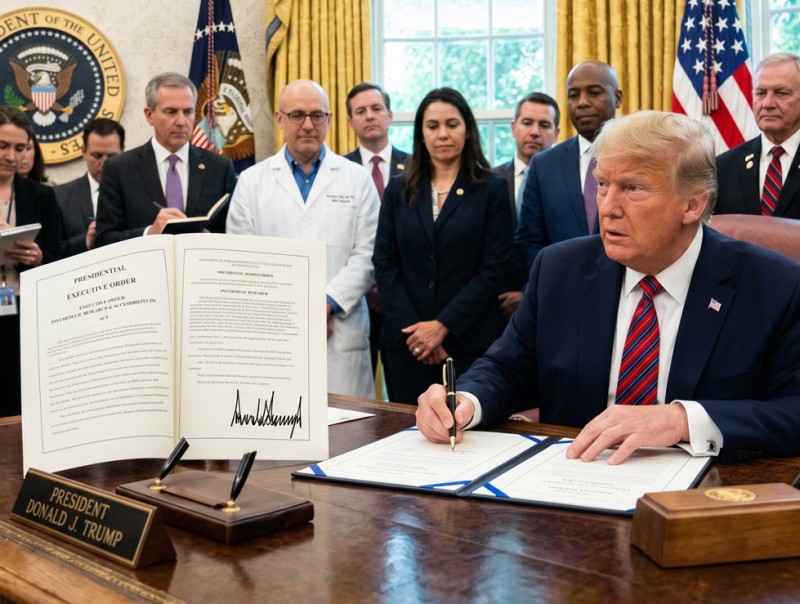
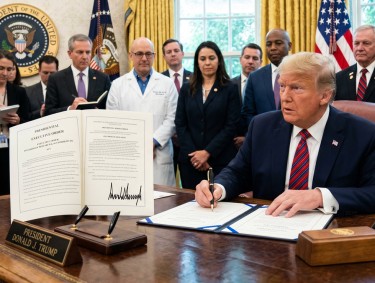
On April 18, 2026, Donald Trump signed an executive order in the Oval Office surrounded by RFK Jr., Dr. Oz, Joe Rogan, and a former Navy SEAL. He joked about wanting some ibogaine himself. The press had a field day. Advocates declared victory. Critics called it theater.
I want to do something different and actually figure out what happened, what it means, and what it won't do.
What the Order Actually Says
Per the White House's own fact sheet, the executive order does several things. It directs the FDA Commissioner to issue National Priority Vouchers to psychedelic drugs that have already received Breakthrough Therapy designation, which is meant to speed up the review process. It directs the DEA and other agencies to reduce barriers to research. It allocates $50 million through ARPA-H to fund federal-state research partnerships. And it directs the Attorney General to initiate rescheduling reviews for compounds that successfully complete Phase 3 clinical trials and receive FDA approval.
That last sentence is the one most people glossed over, and it's the most important one to understand.
The order does not legalize psychedelics. Psilocybin, ibogaine, MDMA, and LSD all remain Schedule I controlled substances under the Controlled Substances Act as of today. Possession is still a federal crime. Nothing changed for you personally unless you are a veteran or seriously ill patient who might qualify for a clinical trial.
This is a research and acceleration order. The distinction matters.
What Changed and What Didn't
The FDA announced it will issue national priority vouchers for three psychedelics, which the agency's commissioner said could speed approval reviews significantly, potentially within weeks for the review process itself, though full approval timelines remain years away. This is genuinely new: the FDA has never before offered to fast-track any psychedelic. That matters.
Stanford University already conducted a small study finding that ibogaine, combined with magnesium to reduce cardiac risk, showed meaningful improvements in PTSD, anxiety, and depression in veterans with traumatic brain injury. The trial enrolled 30 veterans and had no placebo group, which limits its conclusions but provides signal worth following. Johns Hopkins and Harvard are conducting trials of their own.
A 2025 study published in the Journal of the American Medical Association found that a single dose of LSD reduced anxiety and depression for months. Psilocybin has enough Phase 2 data that the FDA already designated it a Breakthrough Therapy. The science on these compounds is not speculative at this point. It's early, but it's real.
The Honest Concerns
Harvard Law's Petrie-Flom Center put out a sharp analysis almost immediately after the signing. Legal scholars note that presidents cannot compel rescheduling of a controlled substance, that power rests with the DEA and is governed by statute. An executive order can direct priorities and allocate resources, but it cannot override the legal framework of the CSA. The rescheduling provision in the order is essentially an instruction to start a process, not an instruction that produces an outcome.
Ibogaine is also the most politically popular psychedelic in this order, largely because of its veteran advocates, and it carries the most serious safety profile of the group. The compound is linked to cardiac arrhythmias and has been associated with more than 30 deaths in the medical literature, according to the Multidisciplinary Association for Psychedelic Studies. The FDA has historically resisted ibogaine research specifically because of cardiac concerns. Speeding up that review without adequate safety infrastructure is a real risk, not a theoretical one.
There is also the question of what happens if the FDA approval process doesn't move as fast as the political announcement implies. Executive orders can be reversed by the next administration. The $50 million in ARPA-H funding comes from existing appropriations, which means it competes with other already-committed research priorities. Clinic operators like Tom Feegel of Beond Ibogaine were clear that the order's real-world impact won't be immediate: insurance won't cover these treatments, they remain off-label, and costs run $15,000-$20,000 per session at clinics currently operating in Mexico.
Is This Theater?
Partially. The optics of having Joe Rogan in the Oval Office while Trump jokes about wanting hallucinogens is peak 2026 absurdism. The administration is clearly doing some culture-war positioning here, framing psychedelics as a veterans issue to insulate it from the usual conservative drug-war backlash.
But "partially theater" means it is also partially real. The Priority Vouchers are real. The $50 million is real, however modest. The FDA's stated intention to fast-track three psychedelics is real and unprecedented. The signal to Republican governors and state legislatures that this issue has federal cover, as MAPS co-executive director Ismail Lourido Ali noted, is real. The stigma problem for Schedule I research has been that no one wanted to touch it politically. That changed on April 18.
Trump says and does a lot of things publicly that don't survive contact with his next press conference. I hold that view firmly. This administration has been willing to reverse course on policy it announced loudly with cameras present. So the question isn't whether the order is good policy. The question is whether the institutional momentum it creates outlasts the political moment.
The Real World Stakes
Over 14 million American adults live with serious mental illness. Veterans suicide rates remain devastating. The existing pharmaceutical toolkit for depression, PTSD, and addiction has real limitations: SSRIs take weeks to work, have inconsistent response rates, and often require lifetime use. The opioid crisis demonstrates clearly what happens when we treat addiction primarily as a law enforcement problem rather than a medical one.
If psilocybin or ibogaine or MDMA-assisted therapy can genuinely reduce PTSD symptoms, interrupt opioid addiction, or alleviate treatment-resistant depression, then obstructing their research path is not caution. It is harm. People have been suffering and dying from conditions these compounds might treat, while the government has classified them as having no medical value.
Trump's order doesn't solve that. But it points in the right direction, and right now, pointing in the right direction with $50 million and FDA priority vouchers attached is more than we had a week ago.
Watch the follow-through. That's where this story will actually be written.
ARE PSYCHEDELICS CANNABIS 2.0? READ ON...