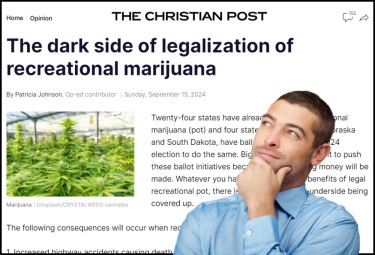


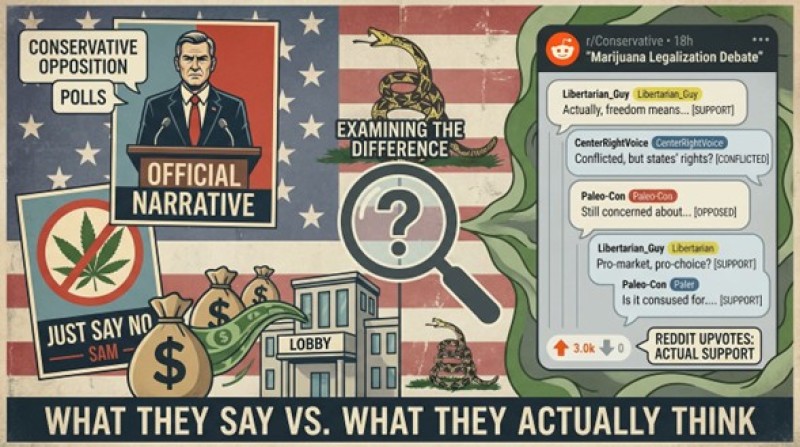
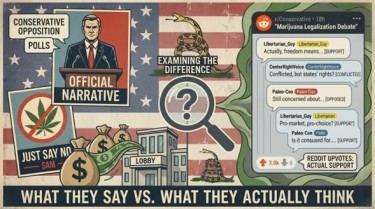
If you only paid attention to conservative politicians, lobbying groups, and official party platforms, you'd think cannabis legalization was a non-starter among conservatives. You'd think the entire right wing was united in opposition, clutching their pearls about moral decay and societal collapse.
But here's the thing about official narratives: they're often bought and paid for.
Organizations like Smart Approaches to Marijuana (SAM) pour millions into lobbying. Pharmaceutical companies fund "research" and "parent groups" that oppose legalization. Law enforcement associations push back to protect drug war budgets. These voices dominate the official conservative stance on cannabis.
But what do actual conservatives think when you strip away the lobbyist money and political posturing?
I decided to find out by diving into a Reddit thread on r/AskConservatives titled "Do any conservatives here oppose legalizing cannabis and why?" The responses were illuminating—not because they showed unanimous support for legalization, but because they revealed something much more interesting: genuine nuance, thoughtful debate, and perspectives shaped by lived experience rather than corporate talking points.
This isn't a scientific survey. This is one thread, self-selected respondents, Reddit-specific demographics. But it offers something polls and political statements can't: unfiltered conservative thought on cannabis, free from the influence of lobbyists and party discipline.
Let's examine five representative comments that capture the range of conservative opinion on cannabis legalization.
Comment 1: The Libertarian Conservative - "Tear the Bandaid Off"
User: Buzz407 (Right Libertarian - Conservative)
"No. That is a bandaid that needs to be torn off cleanly instead of screwing around to see how to maximize profits. The 'Debate' is on behalf of the alcohol lobby, not science."
Analysis:
This comment cuts straight to the heart of conservative frustration with cannabis prohibition: it's not about science or public health—it's about protecting entrenched corporate interests.
The libertarian-conservative position is crystal clear here: legalize, period. No half-measures, no Schedule III corporate giveaways, no drawn-out debates designed to figure out how to maximize government and industry profits while maintaining prohibition-lite.
The reference to the alcohol lobby is particularly astute. This commenter recognizes that opposition to cannabis legalization often comes from industries that see it as competition, not from genuine public health concerns.
Key Conservative Principles at Play:
-
Free market competition (let cannabis compete with alcohol on merit)
-
Limited government (stop wasting resources on prohibition)
-
Anti-cronyism (reject corporate lobbying dictating policy)
-
Evidence-based policy (follow science, not special interests)
This represents a significant strain of conservative thought that's often ignored in mainstream coverage: libertarian-leaning conservatives who see prohibition as government overreach and crony capitalism.
Comment 2: The Pragmatic Conservative - "Regulate It Like Alcohol"
User: ShardofGold (Center-right Conservative)
"Just regulate it like tobacco and alcohol. Weed acts like both those things and yet it's the only one still taboo and illegal for some ignorant or stupid reasons. The first president to do this and pardon anyone with a sentence over smoking it will be remembered very fondly by the country. It's an easy win and I'm shocked no one has taken it yet."
Analysis:
This is the pragmatic conservative position: cannabis isn't that different from already-legal substances, so treat it consistently.
Note the language: "ignorant or stupid reasons." This isn't someone who thinks cannabis is harmless—they're simply pointing out the logical inconsistency of alcohol being legal while cannabis remains prohibited.
The political calculation here is also interesting: this commenter recognizes that cannabis legalization is broadly popular and represents an "easy win" for any president willing to take it. The fact that no president has done so despite the political upside suggests they're more beholden to lobbying interests than public opinion.
Key Conservative Principles at Play:
-
Consistency in policy (treat similar substances similarly)
-
Criminal justice reform (pardon non-violent offenders)
-
Political pragmatism (recognize popular will)
-
Limited government scope (don't prohibit what you allow for alcohol)
This represents mainstream center-right conservatism that's evolved on cannabis based on evidence and experience. They're not cannabis enthusiasts—they just recognize prohibition doesn't make sense.
Comment 3: The Conflicted Conservative - "Split on the Issue"
User: KW5625 (Conservatarian)
"I'm split on the issue. I fully accept that it is a poor use of society's resources to lock someone in jail over a joint, and that people should be free to choose what they put inside their own bodies... At the same time drugs are a major societal problem. Marijuana, like alcohol, is a depressant that impairs judgment, reduces reaction time, coordination, and alters mood. People should not have unlimited free-range to use it whenever they wish especially when they are driving vehicles, operating machinery, or holding positions of trust where people's lives are on the line... such as doctors, construction workers, pilots, and bus drivers. Simply decriminalizing it or regulating it as loosely as alcohol is not a viable solution, but it's at least a starting point to expand from."
Analysis:
This comment captures the genuine internal conflict many conservatives feel about cannabis legalization. It's honest, thoughtful, and reveals the tension between competing conservative values.
On one hand: personal freedom, limited government, efficient resource use. On the other hand: public safety concerns, societal order, responsible governance.
What's notable is that even this conflicted conservative acknowledges that prohibition is a waste of resources and that bodily autonomy matters. Their concerns aren't about whether adults should be allowed to use cannabis—they're about how to manage a legal cannabis market responsibly.
The comparison to alcohol is key here. This commenter implicitly accepts that if we can manage alcohol (a more dangerous substance) through regulation, we can do the same with cannabis. Their concern is that we do it right, not that we don't do it at all.
Key Conservative Principles at Play:
-
Personal freedom vs. public safety (ongoing tension)
-
Efficient resource allocation (don't waste money on prohibition)
-
Responsible regulation (if legal, do it properly)
-
Practical concern for public welfare
This represents thoughtful conservatives wrestling with how to balance liberty and safety. They're not reflexively pro- or anti-legalization—they're trying to think through the actual implications.
Comment 4: The Traditionalist Opposition - "It's Destructive"
User: Cool_Cartographer_39 (Rightwing)
"Yes, I oppose it. Because MJ is more dangerous and destructive than people realize, and I personally think medical use is being used as a back door tactic to legalization for destruction of critical thinking. My mom was a FDA researcher and neurologist who battled Keith Stroup, Peter Bourne, NORML and other groups in the late 70s, and was advisor to Reagan's press secretary Lyn Nofzinger in messaging on the war on drugs in the 80s"
Analysis:
Here's the traditional conservative opposition to cannabis legalization, but note what it's based on: family history and personal belief rather than current evidence.
This commenter's opposition is rooted in their mother's work during the height of drug war propaganda in the 1970s-80s. That's not dismissive—family experience shapes perspective. But it's worth noting that this view comes from the Reagan-era War on Drugs messaging that even many conservatives now acknowledge was flawed.
The claim that medical cannabis is a "back door tactic" has some historical truth—medical programs did help normalize cannabis use and pave the way for recreational legalization. But framing this as "destruction of critical thinking" reveals the generational divide in conservative cannabis perspectives.
What's significant about this comment in the broader thread: It's the minority position, even among conservatives. Most responses lean toward legalization or at least decriminalization.
Key Conservative Principles at Play:
-
Traditional values (Reagan-era drug war perspective)
-
Skepticism of change (medical programs as slippery slope)
-
Concern about societal harm
-
Deference to authority (FDA, medical establishment)
This represents old-guard conservatism that hasn't updated based on decades of evidence from legal states. It's becoming less common among conservatives, particularly younger ones.
Comment 5: The Radical Decriminalizer - "Treat It Like Tomatoes"
User: 3X_Cat (Conservative)
"I oppose legalizing it. Instead I'm for decriminalizing it and it being treated by government like any other crop... Decriminalization means that government would treat this plant like a rose bush or a tomato plant. Both are sold in stores and tomatoes are sold in markets... To be regulated means to make the same. I don't want government to make it all the same. In fact, I don't want the government to have any say in it whatsoever. How does government regulate okra or tomatoes? That's how much regulation I want."
Analysis:
This is the most radical pro-cannabis position in the thread, and it comes from a self-identified conservative.
This commenter doesn't just want legalization—they want complete deregulation. No taxes. No licensing. No government involvement at all. Treat cannabis like any garden vegetable.
Their reasoning is pure small-government conservatism: "We're a free country of individuals not a collective ruled by a king or a group of kings."
What makes this particularly interesting is the rejection of the "legalize and tax" model. This conservative recognizes that government-controlled legalization can become corporate-controlled legalization, with small growers and users locked out by licensing requirements and compliance costs.
This is more radical than most cannabis advocates' positions. Most legalization supporters accept taxation and regulation. This conservative wants neither.
Key Conservative Principles at Play:
-
Maximum individual liberty
-
Minimal government intervention
-
Anti-taxation
-
Property rights (you can grow what you want on your land)
-
Anti-corporatism (reject big business-friendly regulation)
This represents libertarian conservatism taken to its logical conclusion on cannabis: if it's a plant, government has no business regulating it at all.
What This Thread Reveals About Conservative Cannabis Sentiment
Looking across these five comments (and the broader thread), several patterns emerge:
1. There's No Monolithic Conservative Position
Conservatives range from full prohibition support to radical deregulation, with most falling somewhere in the middle favoring legalization with reasonable regulation.
2. The Trajectory Is Toward Acceptance
Even conflicted conservatives acknowledge prohibition is a waste of resources. The debate is shifting from "whether" to "how" to legalize.
3. Conservative Principles Support Legalization
Personal freedom, limited government, efficient resource use, criminal justice reform, anti-cronyism—these core conservative values align with ending prohibition.
4. Experience Matters More Than Ideology
Conservatives in legal states (Colorado mentioned explicitly) have adjusted their views based on real-world evidence. Society didn't collapse. Life went on.
5. The Opposition Is Generationally Rooted
The strongest prohibition support comes from those connected to Reagan-era drug war messaging. Younger and libertarian-leaning conservatives are more supportive.
6. Enforcement Concerns Are Real But Solvable
The Colorado conservative's concern about DUI enforcement is legitimate—but it's an argument for better policy, not continued prohibition.
7. Consistency Matters
Multiple comments point out the hypocrisy of legal alcohol but illegal cannabis. Conservatives value logical consistency in law.
Why Official Conservative Positions Don't Match Grassroots Opinion
So if conservative voters are increasingly supportive of cannabis legalization, why do official conservative positions remain hostile?
Follow the money:
-
Pharmaceutical lobbying: Billions in donations to conservative politicians who oppose legalization
-
Private prison industry: Campaign contributions to maintain drug war arrests
-
Law enforcement associations: Lobbying to protect federal funding tied to drug enforcement
-
Alcohol industry: Protecting market share by opposing competition
The disconnect between grassroots conservatives and their supposed representatives is massive. Conservative voters have evolved based on evidence. Conservative politicians remain beholden to donors whose profits depend on prohibition.
The Sticky Bottom Line: Conservatives Are More Reasonable Than Their Politicians
Here's what this Reddit thread reveals: When you strip away lobbyist money and political posturing, actual conservatives are far more reasonable about cannabis than official conservative positions suggest.
They're not unanimous—some still oppose legalization. But even opposition is often rooted in genuine concerns about implementation rather than reflexive "drugs are bad" thinking.
The libertarian streak in American conservatism is strong. Personal freedom matters. Limited government matters. Wasting resources on prohibition of a substance safer than alcohol offends conservative principles of efficiency and consistency.
Most importantly: conservatives remember what prohibition costs.
They remember the waste. The hypocrisy. The government overreach. The ruined lives over non-violent offenses. The empowered cartels. The lost tax revenue.
That's why conservative support for legalization has grown steadily over the past decade. Not because conservatives suddenly love cannabis, but because they've rediscovered that prohibition is expensive, ineffective, and inconsistent with limited government principles.
The official conservative position on cannabis doesn't represent conservative voters. It represents conservative donors—pharmaceutical companies, private prisons, and law enforcement lobbies who profit from prohibition.
The grassroots conservative position? Increasingly: legalize it, regulate it reasonably, and move on to actual problems.
This analysis is subjective and based on a single Reddit thread. But it reveals something polls and political statements can't: the nuanced, evolving, genuine conservative perspective on cannabis when money and party discipline aren't dictating the conversation.
And that perspective is far more supportive of legalization than most people realize.
The question is: when will conservative politicians catch up to their own voters?
Based on the money flowing into their campaigns from prohibition-dependent industries, probably not anytime soon.
But the shift is happening. One conversation at a time. One conservative recognizing prohibition's failures at a time. One libertarian-leaning voter demanding consistency at a time.
Belief evolves with experience. And conservatives have had over a decade of experience with legal cannabis proving the sky doesn't fall.
The official talking points haven't caught up yet. But the people have.
And eventually, in a democracy, that matters more than lobbyist money.
At least, that's what we keep telling ourselves.
CHRISTIAN CONSERVATIVES ON WEED, READ ON...