
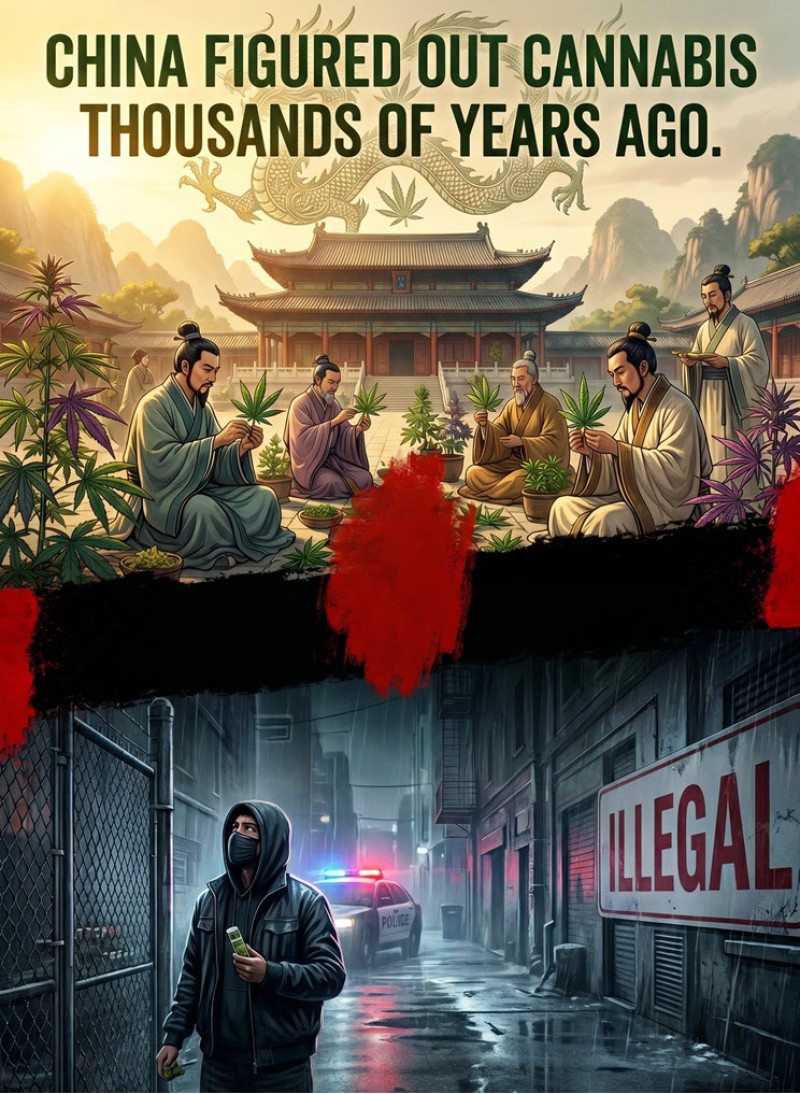
New archaeological research from Shandong confirms cannabis was fundamental to human civilization — and we spent the 20th century pretending otherwise
Chinese researchers at Shandong University just published a study in the Journal of Archaeological Science that does something straightforward: it tells the truth about cannabis's place in human history. Using phytolith analysis — the study of microscopic plant silica structures found in soil — the team examined 132 samples from two Late Neolithic settlements in the Shandong province. What they found was not marginal or incidental. Cannabis was one of the five grains.
The five grains. Alongside rice, millet, barley, and soybean. The foundational crops of the ancient Eurasian agricultural economy. Cannabis was not a curiosity or a ritual plant in these settlements. It was food. It was fiber. It was processed and consumed at the household level, embedded in the daily fabric of life for thousands of years before a twentieth-century bureaucrat in Washington decided it had no accepted medical use.
What the Archaeology Actually Shows
The numbers from the study are worth sitting with. At the Beitaishang site, cannabis phytoliths appeared in 22 of 32 samples from the Longshan period — 68.8 percent. At Qianzhongzitou, they appeared in 47 of 65 Longshan samples (72.3 percent) and 16 of 31 Yueshi samples (51.6 percent). These were not ritual deposits or elite burials. They were ash pits, floors, and building foundations — the physical residue of people eating, working, and living.
The research team, which included affiliations with China's Ministry of Education and the Institute of Cultural Relics and Archaeology of Shandong Province, concluded that by the Late Neolithic period, cannabis 'had become a core crop in northern China, primarily used for food or fiber' and that 'cannabis processing and consumption were deeply integrated into the daily lives of the inhabitants, making it an indispensable component of their agricultural subsistence.'
The word indispensable. Not optional. Not tolerated. Indispensable.
This Is Not News to Anyone Who Has Looked
This finding does not arrive in a vacuum. A 2023 paper in the European Journal of Chemistry traced cannabis through thousands of years of human contact, documenting its role as a source of fiber, nutrition, medicine, spirituality, and pleasure. A 2020 study identified cannabis resin on an altar in a biblical shrine built around 750 BCE — evidence that psychoactive cannabis was used in ritual contexts in ancient Israel. The plant's relationship with humanity predates every modern legal framework by millennia.
The Shandong research specifically distinguishes between the fiber-type cannabis documented in these Neolithic settlements and the psychoactive varieties found in Bronze Age Xinjiang tombs, which were associated with burial and ritual use. The point is not that ancient Chinese farmers were getting high at breakfast. The point is that cannabis — in all its forms and applications — has been woven into human civilization at a foundational level for longer than recorded history reaches.
The Absurdity of Schedule I in Historical Context
Schedule I of the Controlled Substances Act requires that a substance have 'no currently accepted medical use' and a 'high potential for abuse.' Congress placed cannabis there in 1970. In the fifty-plus years since, every major scientific and archaeological inquiry into the plant has pushed in the opposite direction.
We have endocannabinoid systems. They are named after the plant, because researchers discovered them while studying cannabis. The human body has receptor networks specifically responsive to cannabis compounds, distributed throughout the brain and immune system, involved in pain regulation, appetite, memory, and stress response. That is not a drug with no accepted medical use. That is a compound class interacting with a fundamental biological system.
And now we have Neolithic settlements in Shandong confirming that our Homo sapiens ancestors, before writing, before the wheel reached its full potential, before most of the civilizations we study in history class existed — those people knew cannabis was indispensable. They processed it in their homes. They stored it in their foundations. They built their agricultural subsistence around it.
The Irony of Chinese Research, Chinese Policy
There is a sharp edge to this story worth acknowledging. The study's authors noted that their focus on fiber-type cannabis reflects the fact that 'drug-type cannabis is strictly regulated in most countries due to its psychoactive compounds.' One of the researchers, Yong Ge, told Marijuana Moment that the team 'stands against the abusive use of cannabis as a drug,' adding: 'In this regard, we are fully aligned with China's stance on drug control.'
China's cannabis policies are severe. In 2024, the country tightened regulations on CBD. Psychoactive cannabis remains strictly prohibited. So the researchers who uncovered archaeological proof that cannabis was a foundational Chinese crop did so while the country they work in maintains some of the harshest cannabis laws on earth. The history says one thing. The law says another.
That tension is not unique to China. The United States federal government funded a study showing the American public wants cannabis descheduled, then descheduled it for 5% of the market. The pattern holds.
What We Owe the Plant
I think about this sometimes. A plant that fed people, clothed them, healed them, and connected them to something larger than daily survival for thousands of years — that plant spent most of the twentieth century criminalized. People went to prison for it. Lives got derailed. Research stalled for decades because the federal classification made rigorous study functionally impossible.
And now, slowly, the archaeology catches up to what growers, patients, and practitioners have known for generations. Cannabis is not an aberration. It is not a social problem that crept into human culture. It is a crop. It is medicine. It is fiber and food and sacrament. The Neolithic settlements in Shandong did not need the DEA's permission to figure that out. Neither did the rest of human history.
The question for the present moment is whether the laws we live under will eventually reflect the record our species has actually left behind. That record is unambiguous. Cannabis was indispensable. Our current legal framework simply pretends otherwise, and it has been pretending for roughly a hundred years.
The evidence keeps building. At some point the pretending has to stop.
CANNABIS AS AN ANCIENT PLANT, READ ON...