
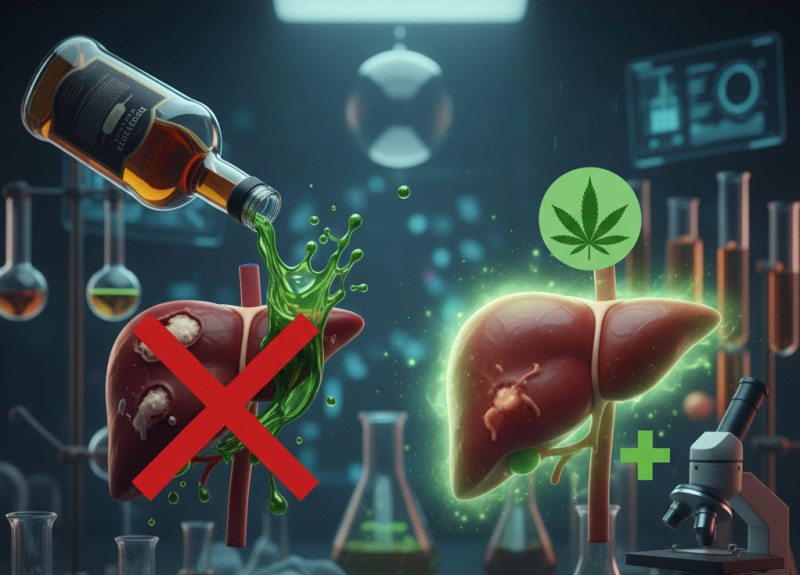
Alcohol is one of the top most toxic substances out there for the human liver.
It is so damaging and detrimental to our overall health, especially for the liver, yet it’s completely legal and so accessible. Too accessible, in fact.
Not many people know that the liver actually converts the alcohol we drink into poison; the process wherein the liver breaks down ethanol through enzymes results in acetaldehyde, which is even more poisonous than alcohol itself. In addition, alcohol consumption results in serious oxidative stress that damages cells, and alcohol use also causes fat accumulation in the liver. These are just some of the many ways that alcoho use triggers liver disease.
On the other hand, cannabis shows contrasting effects on the human body. There are studies proving that cannabis reduces alcohol intake, regulates inflammatory pathways, and can help manage or treat liver disease. Many people are even switching up alcohol for weed, simply because pot is safer and much healthier for the human body.
But now, there are studies showing that cannabis use has been associated with a reduced occurrence of alcohol-induced liver disease.
In fact, a recent study which was published in the journal, Liver International, discusses how researchers at Virginia Commonwealth University analyzed the incidence of alcohol-associated liver disease (ALD) for a cohort of 66,228 patients over the course of 12 years (2010-2022). They found that the individuals who consumed cannabis alongside alcohol had 40% less of an incidence in developing alcohol-associated liver disease, compared to those who didn’t.
Additionally, the patients were divided into three groups: those with alcohol use disroder, cannabis users who weren’t showing signs of dependence, and patients who didn’t use cannabis at all. The patients were observed for three years after the first diagnosis, for the purpose of understanding who eventually developed alcohol-related liver disease or suffered from liver failure, or even died later on.
“Cannabis use was associated with a 40 percent hazard reduction in the composite ALD, including alcohol-associated steatosis, fibrosis, and cirrhosis, as well as a 17 percent reduction in hepatic decompensation, and a 14 percent reduction in all-cause mortality,” reported the researchers.
“The observed protective association of cannabis was consistent across the ALD spectrum, even among patients with lower cardiometabolic risk profiles,” reads the study. “Furthermore, the inclusion of both positive and negative control outcomes strengthens the internal validity of the findings,” it said.
These results suggest that cannabis compounds may actually have a protective benefit for the liver.
Cannabis May Protect The Liver
However, this isn’t the first time that scientists have found protective qualities in cannabis for the liver. After all, cannabinoids interact with the endocannabinoid system to influence many important processes and functions in the body, including liver health.
That said, we do need more research to understand more about what cannabis can and can’t do when it comes to liver health. “Cannabis may have protective properties, but we still don’t know exactly how much, what form or what might be safe or effective. The goal isn’t to promote cannabis use, but to understand which parts of it might hold promise as medicine,” explains Butros Fakhoury, MD, from the VCU Health hospital, and an author of the study.
Cannabis Protects Against Fatty Liver Disease
Fatty liver disease is one of the liver diseases that prolonged alcohol consumption can cause. Since alcohol is toxic, the liver prioritizes metabolizing it once ingested, causing a disruption to normal fat metabolism.
As a result, the liver accumulates fat, and it also results in fatty acid oxidation. Since fat accumulates inside the liver cells, this leads to alcohol-associated fatty liver disease, also known as hepatic steatosis.
Science shows that cannabis can also help reduce the risk of fatty liver disease. According to the results of a 2023 study conducted by Chinese researchers on 2,622 adults, cannabis users are less likely to develop abnormal fat retention in the liver or liver steatosis. According to the investigators, current and former cannabis consumers had a lower incidence of liver steatosis compared to those in the cohort who never consumed cannabis in the past.
“In this nationally representative sample, current marijuana use is inversely associated with steatosis…” they said. “Further studies are required to confirm these results longitudinally, and investigations into marijuana compounds and their biological effects are promising for treating and preventing fatty liver disease.”
CONCLUSION
In conversations about cannabis use and public health, there is an increasing amount of evidence pointing to cannabis as a safer, healthier alternative to alcohol. This is especially true when it comes to liver health.
Alcohol plays a significant role in driving liver disease including liver cancer, but alcohol consumption remains normalized in our society. On the other hand, cannabis has no link to liver toxicity and research shows it can even mitigate the harms of alcohol on the liver. This alone should prompt critical re-evaluations of how we treat cannabis as a substance.
Cannabis is a viable harm-reduction tool for alcohol, and can contribute to overall better health and a reduction in chronic disease. If we, as a whole, want better health outcomes with a reversal in drug policy, all roads lead to (responsible) cannabis use: this substance deserves more recognition in a culture that is still dominated by alcohol consumption.
CANNABIS FOR LIVER DISEASE, READ ON...