

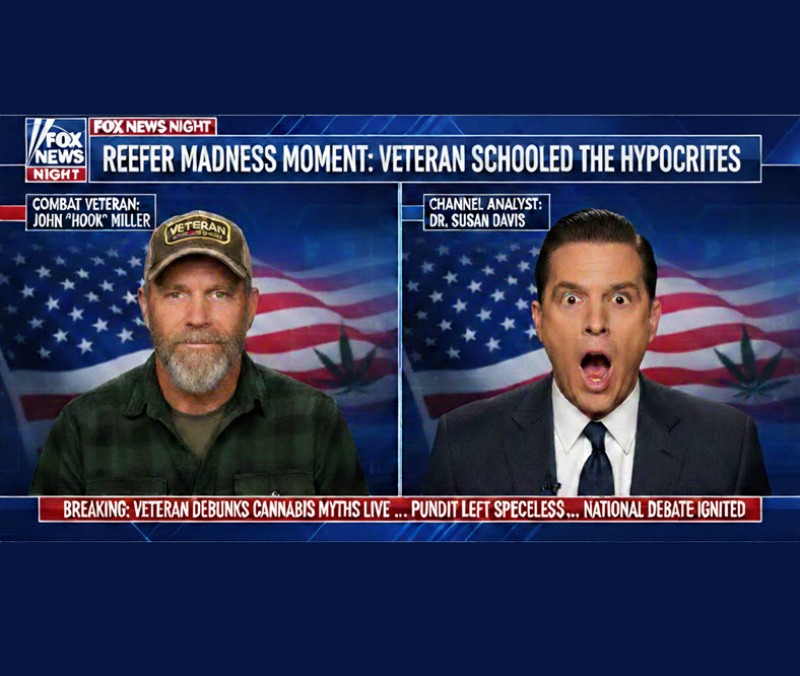
There are moments in media that cut through the bullshit so cleanly, you can actually hear the narrative collapse in real-time. Combat veteran Staff Sergeant (Ret.) Johnny "Joey" Jones just delivered one of those moments on Fox News—and the network's desperate attempt to spin it back into prohibitionist talking points was almost as revealing as Jones' truth bombs.
Let me break down what actually happened here, because buried in this exchange is everything wrong with America's approach to cannabis policy, media hypocrisy, and the pharmaceutical-industrial complex's stranglehold on rational discourse.
What the Veteran Actually Said (And Why It Matters)
Jones opened with the kind of moral clarity that only comes from someone who's seen actual suffering:
"This society is meddling in hypocrisy in a way that makes me furious. I don't smoke weed. I don't drink beer or alcohol. But to be in a place where I can sit and watch alcohol commercials on TV and hear someone preach at me about how bad weed is? No. Take that on somewhere else."
Notice what he's doing here: he's establishing credibility by removing personal stake. He doesn't use either substance. This isn't about defending his own choices—it's about calling out systemic hypocrisy.
Then he drops the medicinal bomb:
"On the medicinal side, it absolutely works. It works so well for so many veterans I know."
This is anecdotal evidence, sure. But when a combat veteran tells you that cannabis is keeping his brothers and sisters alive—keeping them from eating a bullet or drowning in VA-prescribed opioids—maybe we should fucking listen.
The Decriminalization vs. Legalization Distinction
Here's where Jones demonstrates a deeper understanding of drug policy than most politicians and media pundits combined:
"We didn't legalize marijuana. We decriminalized the use of marijuana. So it's unregulated. We're not looking at it and studying it and saying, at what level of THC does it have the effect we're looking for? At what level of THC does it have a negative effect by and large that we should try to take out of our society? That's the problem. We've put so much emphasis on keeping it illegal at the federal level that we've neutered our ability to actually regulate it."
This is exactly correct. The federal prohibition doesn't protect public health—it prevents public health research. We can't study optimal THC levels, we can't establish evidence-based dosing protocols, we can't conduct large-scale clinical trials, because the federal government has classified cannabis as more dangerous than methamphetamine and fentanyl.
That's not policy. That's ideological obstruction.
The SSRI Comparison Nobody Wants to Acknowledge
Then Jones goes for the throat:
"In a society, in an industry in this country, where we have no problem with SSRIs, with Zoloft or Prozac or Lexapro, you know, I'm not beating up on these medicines, but for God's sake, I can sit here and watch somebody become a zombie on that stuff."
He's being diplomatic here. Let me be less diplomatic:
SSRIs are prescribed like candy in this country, despite evidence that their efficacy barely exceeds placebo in many cases, despite withdrawal syndromes that can last months or years, despite black-box warnings about suicidal ideation in young people, and despite the fact that we still don't fully understand how they work.
But we have no problem with that. We advertise them on television between segments about the "dangers" of cannabis. The cognitive dissonance is breathtaking.
The Alcohol Hypocrisy: The Big One
"We have no problem discussing how bad marijuana is, but don't attack alcohol because that's a part of our culture. Well, you know what? People get behind the wheel drinking every day and kill people. It happens every single day. And I'd much rather smell weed on the side of the street than liquor on someone's breath trying to talk to me."
Here are the numbers Jones is too polite to cite:
-
Alcohol kills approximately 140,000 Americans annually
-
Cannabis kills zero
-
Alcohol is involved in 40% of violent crimes
-
Cannabis is involved in watching Lord of the Rings extended editions and eating too many Doritos
The cultural acceptance argument is particularly absurd when you examine it. Cannabis has been used by humans for at least 12,000 years—roughly the same timeline as alcohol fermentation. Both substances have archaeological evidence dating back to the immediate post-ice-age period, when humans were figuring out agriculture and civilization.
The idea that alcohol gets a pass because it's "part of our culture" while cannabis doesn't is pure arbitrary prohibition. Both are ancient. Both are deeply embedded in human history. The only difference is which industries profit from which narrative.
The Deep History: Why This Matters
Here's something that should fundamentally change how we think about cannabis prohibition: the archaeological evidence suggests that humans didn't "discover" fermentation or cannabis use in the last 13,000 years—we rediscovered them after a catastrophic climate event.
The Younger Dryas period (approximately 12,800 to 11,600 years ago) was an abrupt return to ice age conditions, possibly triggered by a comet impact. When the world warmed up again, we see the "sudden" appearance of agriculture, fermentation, and cannabis domestication almost immediately.
The "Beer Before Bread" hypothesis suggests that hunter-gatherers were brewing long before they were settled farmers. The oldest direct evidence of beer dates to 13,000 years ago in Israel's Raqefet Cave—before pottery, before permanent agriculture.
Cannabis was domesticated almost immediately as the world warmed up after the ice age. By the time we see the first organized societies, both cannabis and alcohol were already deeply embedded in burial rites and spiritual practice—suggesting their use was already "ancient" to the people of that time.
What does this mean? It means cannabis and alcohol share the same cultural timeline. The idea that one is acceptable and the other isn't has nothing to do with history, tradition, or safety—and everything to do with which industries control the narrative in 2026.
The Fox Anchor's Lie: "Not Proven Medically"
Here's where Dr. Marc Siegel tries to salvage the prohibitionist position:
"You know, your argument just speaks to why president Trump made it schedule 3 instead of schedule 1 because it's gonna make it easier to study. Some critics say you should've gone to schedule 2, which is in between because it's not proven medically."
This is a lie.
Not an opinion. Not a difference in interpretation. A flat-out, demonstrable falsehood.
The United States government holds Patent No. 6630507, titled "Cannabinoids as antioxidants and neuroprotectants." This patent, awarded to the Department of Health and Human Services in 2003, explicitly claims that cannabinoids have therapeutic utility as antioxidants and neuroprotectants for treating neurodegenerative diseases.
Let me repeat that: the federal government has a patent claiming medical efficacy for cannabis while simultaneously classifying it as having "no accepted medical use."
That's not policy contradiction. That's institutional fraud.
Beyond the patent, we have:
-
Randomized controlled trials showing efficacy in pediatric epilepsy (leading to FDA approval of Epidiolex)
-
Meta-analyses demonstrating effectiveness for chronic pain, nausea, and spasticity
-
Registry data from Israel, the UK, and Australia showing clinical benefits across multiple conditions
-
Mechanistic research establishing how cannabinoids interact with the endocannabinoid system
To say cannabis has "not proven medically" in 2026 is to ignore two decades of peer-reviewed research. It's either willful ignorance or deliberate disinformation.
The Schedule III Shell Game
Moving cannabis to Schedule III isn't about "making it easier to study." That's the propaganda version.
Here's what Schedule III actually accomplishes:
It maintains federal prohibition while giving pharmaceutical companies the regulatory framework to develop synthetic cannabinoids and patented formulations.
It preserves the criminal justice infrastructure that employs hundreds of thousands of people in law enforcement, prisons, and the legal system.
It protects pharmaceutical market share by ensuring that whole-plant cannabis remains expensive, heavily taxed, and difficult to access while synthetic alternatives get FDA approval and insurance coverage.
Schedule III is a compromise that serves institutional interests—not patients, not veterans, not public health.
Full descheduling is the only policy that makes sense if we're actually concerned about research, access, and harm reduction. But that would require acknowledging that cannabis was never supposed to be scheduled in the first place—and that 87 years of prohibition was a policy disaster built on racism, corporate protectionism, and moral panic.
The Veteran vs. The System
What makes this Fox News moment so powerful is the contrast between Jones' moral clarity and the institutional doublespeak trying to contain it.
Jones is speaking from lived experience. He's seen veterans self-medicate with cannabis instead of eating a bottle of VA-prescribed benzos. He's watched friends choose between functional life with cannabis or zombie existence on SSRIs and antipsychotics. He's tired of watching alcohol companies advertise during the same broadcasts that demonize a safer alternative.
Dr. Siegel is speaking from institutional script. He has to maintain the fiction that Schedule III is progress, that medical evidence is still lacking, that the current system makes sense.
One of them is telling the truth. The other is protecting a narrative that serves pharmaceutical profits and prohibitionist ideology.
The Hypocrisy Standard: Apply It Universally or Not At All
Jones' final point deserves emphasis:
"If we legalize at the federal level the recreational use of marijuana, then we could regulate it. And then we can make sure the THC levels are consistent and below a point that it becomes some of these problems."
Fine. Let's accept that framework. Let's regulate cannabis with extreme scrutiny, establish potency caps, require extensive testing, demand long-term safety studies.
But then apply that same standard to alcohol and prescription medications.
If we're going to regulate THC content in cannabis, we should regulate alcohol content in beverages. No more 95% Everclear. No more Four Loko. Potency caps across the board.
If we're going to require long-term safety studies for cannabis, we should require them for SSRIs that have been on the market for decades without clear understanding of mechanism or long-term cognitive effects.
If we're going to worry about cannabis commercialization and marketing to vulnerable populations, we should ban pharmaceutical advertising entirely—like every other developed nation except New Zealand has already done.
But we don't do that. Because the scrutiny isn't about safety—it's about protecting established industries from competition.
The Sticky Bottom Line
Staff Sergeant Johnny "Joey" Jones just did something remarkable: he cut through decades of propaganda in two minutes on national television. He called out the hypocrisy, identified the regulatory failure, compared cannabis to more dangerous legal substances, and advocated for evidence-based policy.
And the network anchor's response was to lie about medical efficacy and spin Schedule III as progress.
That exchange tells you everything you need to know about American drug policy in 2026. We have veterans begging for access to medicine that works. We have pharmaceutical companies and alcohol producers funding the opposition. We have media outlets repeating prohibitionist talking points that contradict their own government's patents.
And we have a system that would rather maintain profitable prohibition than admit it was wrong for 87 years.
Jones is right: we're meddling in hypocrisy in a way that should make everyone furious. Cannabis and alcohol share the same 12,000-year cultural timeline. The federal government holds patents on cannabinoid medical efficacy while claiming it has none. Veterans are dying because we'd rather protect pharmaceutical profits than provide effective medicine.
The veteran told the truth. The system lied in response.
At some point, we need to decide whether we're going to listen to the people who actually use these medicines and live with the consequences, or whether we're going to keep deferring to institutions that profit from maintaining the status quo.
I know which side I'm on. And so does Staff Sergeant Jones.
CANNABIS AS A SCHEDULE 3 DRUG, READ ON...
CANNABIS AS A SCHEDULE 3 DRUG, ITS A TRAP SAYS CONGRESSMAN!