

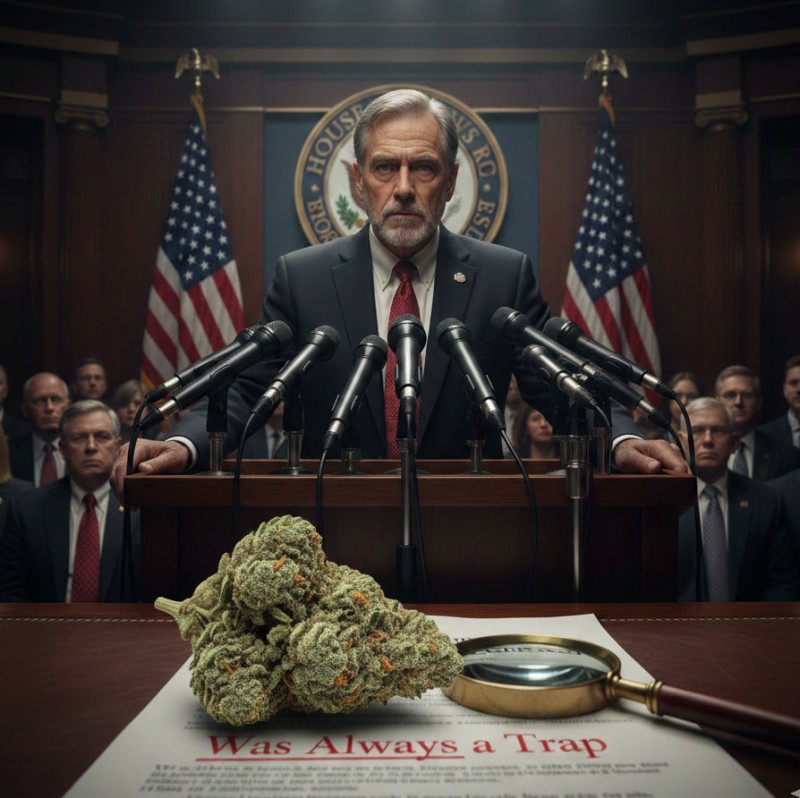
Schedule III Was Always a Trap: Congressman Says the Quiet Part Out Loud
I'm not going to say "I told you so."
Wait, yes I am. I told you so.
When the Biden administration announced its plan to move marijuana from Schedule I to Schedule III, the entire cannabis reform movement erupted in celebration. Headlines proclaimed it a "historic shift." Advocates called it "progress." Politicians patted themselves on the back for their "bold action."
Meanwhile, I was sitting here screaming into the void: this is a trap.
Now, thanks to Republican Congressman Andy Harris of Maryland, we have confirmation straight from the source. The quiet part has been said out loud. And it's exactly as cynical and calculated as we feared.
What Harris Actually Said
At a recent town hall meeting, Harris—who chairs the House Freedom Caucus and has been a consistent opponent of cannabis legalization—made a rather remarkable statement about the rescheduling process:
The Justice Department should take "about 20 years" to reschedule marijuana.
Twenty. Years.
Let that sink in for a moment.
He didn't say "we need careful consideration." He didn't say "the science needs more time." He said the administrative process should be deliberately stretched out for two decades—roughly the length of time it takes a child born today to become an adult.
This isn't about caution or prudence or evidence-based policymaking. This is about obstruction as strategy.
Harris is openly admitting what prohibitionists have understood from the beginning: rescheduling is a bureaucratic black hole designed to create the appearance of progress while ensuring that nothing fundamentally changes.
Why Schedule III Was Never the Solution
Let's revisit what Schedule III actually means, because the mainstream media coverage has been breathtakingly superficial.
Moving cannabis to Schedule III does not legalize marijuana federally. It does not end prohibition. It does not expunge criminal records. It does not stop federal prosecution of cannabis businesses or users.
Here's what Schedule III actually accomplishes:
1. Tax Benefits for Cannabis Companies
Schedule III allows cannabis businesses to take normal business deductions under Section 280E of the tax code. This is significant for the industry's bottom line, but it does nothing for the millions of Americans who've been arrested, incarcerated, or had their lives destroyed by prohibition.
2. Pharmaceutical Control
Schedule III substances require FDA approval for medical use. This means that while pharmaceutical companies can develop synthetic cannabinoids and bring them to market through the regulatory process, the plant itself remains in legal limbo—too restricted for general use, but accessible enough for corporations to profit.
3. Research Barriers Remain
Despite claims that rescheduling would facilitate research, Schedule III substances still face significant regulatory hurdles. Researchers need DEA licenses, institutional review board approvals, and extensive documentation. The barriers are lower than Schedule I, but they're still substantial enough to limit independent research.
4. State-Legal Markets Stay Illegal Federally
Nothing about Schedule III changes the fact that state-legal cannabis businesses are violating federal law. Banking restrictions continue. Interstate commerce remains prohibited. Federal prosecution remains possible, even if unlikely.
Schedule III is prohibition with a corporate-friendly face. It's legalization for Pfizer, not for people.
The Political Calculus: Distraction as Strategy
Harris's 20-year timeline reveals the true purpose of the rescheduling process: to kill momentum for actual legalization by creating the illusion of progress.
Think about the political dynamics at play:
When Biden announced the rescheduling review, reform advocates had genuine momentum. Public support for legalization was at all-time highs—approaching 70% in most polls. States were legalizing at a rapid pace. The conversation was shifting from "whether" to "how" and "when."
The rescheduling announcement sucked all the oxygen out of that momentum. Suddenly, the conversation became about administrative processes, DEA review periods, public comment windows, and regulatory timelines. The urgency disappeared. The pressure dissipated.
And that was exactly the point.
By routing marijuana reform through the most bureaucratic, time-consuming, politically insulated process imaginable, the administration ensured that actual legalization—the kind that requires Congress to act—could be indefinitely postponed.
Harris is just saying the quiet part out loud: the goal isn't to reform policy. The goal is to delay reform until political conditions change or public attention moves on.
Why Congress Won't Act (Unless We Force Them)
Here's the uncomfortable truth: Congress has no intention of legalizing marijuana through legislation unless they're forced to do so.
Why? Because the current situation serves too many powerful interests:
Big Pharma wants to maintain monopoly control over cannabinoid-based medicines while keeping natural cannabis restricted enough that it can't compete with their patented products.
The Alcohol Industry doesn't want a legal competitor that's safer, less addictive, and doesn't kill 140,000 Americans annually.
The Prison-Industrial Complex depends on drug war funding, asset forfeiture, and a steady stream of bodies to fill private prisons and justify law enforcement budgets.
The DOJ and DEA need the drug war to justify their budgets, their authority, and their existence.
As long as marijuana reform can be shunted into administrative processes controlled by these same agencies and influenced by these same industries, nothing will fundamentally change.
Congressional action is the only path to actual legalization. And congressional action requires political pressure so intense that maintaining prohibition becomes more costly than ending it.
The Real Target: The Controlled Substances Act Itself
But here's where I'm going to get really crazy—or really honest, depending on your perspective.
The problem isn't just marijuana prohibition. The problem is the Controlled Substances Act itself.
The CSA, passed in 1970, is a fundamentally corrupt document. It's the legislative foundation of the drug war, and it's been used for over 50 years to justify:
-
Mass incarceration of millions of Americans, disproportionately people of color
-
Militarization of domestic law enforcement
-
Erosion of Fourth Amendment protections against unreasonable search and seizure
-
Civil asset forfeiture that operates as legalized theft
-
Destruction of communities and families
-
Enrichment of cartels and organized crime
-
Obstruction of legitimate medical research
-
Corporate capture of drug policy for pharmaceutical profit
The scheduling system at the heart of the CSA gives unelected bureaucrats at the DEA and FDA the power to decide which substances Americans can use, research, or prescribe—with virtually no accountability, transparency, or scientific rigor.
This is not how drug policy should work in a free society.
The CSA needs to be dismantled entirely. Not reformed. Not tweaked. Dissolved.
Replace it with a public health framework that treats substance use as a medical and social issue, not a criminal one. Regulate drugs like we regulate other potentially harmful but legal substances—through consumer protection laws, product safety standards, and evidence-based harm reduction.
Return bodily autonomy to individuals. Restore the right of people to make their own decisions about consciousness alteration, medical treatment, and personal risk tolerance.
What Needs to Happen Now
The rescheduling charade has revealed the truth: we cannot reform our way out of prohibition by working within the system that created and profits from prohibition.
Here's what needs to happen:
1. Congress Must Act
Forget rescheduling. Forget administrative processes. Force Congress to vote on descheduling marijuana entirely—removing it from the Controlled Substances Act completely.
Make every representative go on record. Make them explain to their constituents why they're voting to maintain a policy that's destroyed millions of lives while accomplishing none of its stated goals.
2. State-Level Nullification
States should continue legalizing and implementing robust markets regardless of federal policy. Create such a massive disconnect between federal law and on-the-ground reality that federal enforcement becomes politically and practically impossible.
3. Pressure Campaign
Target pharmaceutical companies, alcohol producers, and politicians who profit from prohibition. Make their financial ties public. Make their hypocrisy visible. Make supporting prohibition toxic enough that the political calculation flips.
4. Demand CSA Reform
Don't stop at marijuana. The entire Controlled Substances Act is unconstitutional, unscientific, and morally indefensible. Demand comprehensive drug policy reform that treats substance use as a health issue, not a criminal one.
The Liberty Argument They Don't Want You Making
Here's the argument that terrifies prohibitionists more than any other:
You own your body. You own your consciousness. The government has no legitimate authority to criminalize what you choose to put in your own body, consume with your own mind, or experience with your own consciousness.
This isn't about whether drugs are "good" or "safe" or "beneficial." It's about whether you have the fundamental right to bodily autonomy and cognitive liberty.
The same government that claims you have the right to refuse medical treatment, to make your own reproductive choices, to practice your religion freely—that same government claims it can imprison you for decades for possessing a plant.
That's not legitimate governance. That's tyranny with a badge.
The Controlled Substances Act doesn't protect public health. It doesn't reduce addiction. It doesn't make communities safer. It creates a massive black market, enriches violent cartels, corrupts law enforcement, and destroys lives by the millions.
And it does all of this while pharmaceutical companies profit from legal drugs that are objectively more dangerous than most of the substances on the controlled list.
The system is working exactly as designed—just not for you.
The Sticky Bottom Line
Congressman Andy Harris just told you exactly what Schedule III rescheduling is: a 20-year stalling tactic designed to run out the clock on marijuana legalization.
He said the quiet part out loud, and we should thank him for the honesty.
This isn't about science. It isn't about safety. It isn't about protecting children or public health or any of the other rhetorical bullshit they've been feeding us for 87 years.
It's about control. It's about profit. It's about maintaining a system that serves powerful interests at the expense of individual liberty.
Schedule III was always a trap. It was designed to look like progress while ensuring nothing changes. And it will continue to serve that purpose for as long as we allow it to.
The only path forward is through Congress. The only solution is descheduling—or better yet, dissolving the CSA entirely.
It's time to crank up the pressure. It's time to force representatives to vote on the record. It's time to make prohibition more politically costly than legalization.
It's time to take back your liberty. You deserve it.
Not in 20 years. Not after endless bureaucratic review. Not when the DEA decides you've waited long enough.
Now.
WHAT DOES SCHEDULE 3 ACTUALLY MEAN? READ ON...