
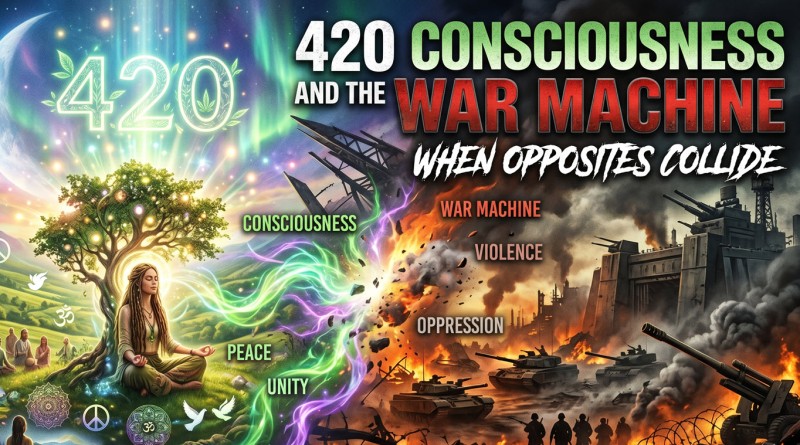
420 Consciousness and the War Machine
Every April 20th, somewhere between the smell of smoke and the echo of Bob Marley drifting from a Bluetooth speaker, a quiet act of cultural defiance plays out. Most people call it a holiday. I call it a reminder. A reminder that the same plant governments spent 50-plus years criminalizing, demonizing, and weaponizing against their own citizens still exists. Still grows. Still brings people together. That has always been the problem.
420 traces its roots to 1971 — the same year Richard Nixon declared his War on Drugs. The term started as slang among a group of California high schoolers, the "Waldos," who met at 4:20 PM to search for a rumored abandoned cannabis crop. It spread through Grateful Dead circles and eventually became a global shorthand for cannabis culture. But the more historically significant event of 1971 wasn't a group of teens meeting after school. It was a president deciding that peace, contentment, and anti-war sentiment were threats to the state — and that the easiest way to neutralize them was to criminalize the plant most associated with them.
Nixon's aide John Ehrlichman later admitted what most people already suspected: the War on Drugs was political warfare. "We knew we couldn't make it illegal to be either against the war or Black," Ehrlichman told journalist Dan Baum in 1994, "but by getting the public to associate the hippies with marijuana and Blacks with heroin, and then criminalizing both heavily, we could disrupt those communities. We could arrest their leaders, raid their homes, break up their meetings, and vilify them night after night on the evening news." That's not a conspiracy theory. That's a confession.
Cannabis has always carried a spiritual charge that makes the powerful uncomfortable. Rastafarians consider it a sacrament — a tool for connecting with Jah, for communal reasoning, for clarity. The counterculture adopted it for similar reasons: it dissolved the walls between people, slowed the machine down, and made you question why you were inside the machine in the first place. That is not a useful quality in a citizen you need to send to war.
Nixon and Trump: The Rhyming Pattern
History doesn't repeat exactly, but sometimes it rhymes so closely you'd swear someone copy-pasted the script. Nixon and Trump share a remarkable catalog of similarities that go well beyond political style.
-
Enemies lists: Nixon's White House Counsel John Dean compiled an official "opponents list" in 1971 with the explicit goal of using "the available federal machinery to screw our political enemies" — targeting journalists, academics, Black lawmakers, and anti-war activists. Trump, during both terms, maintained functionally identical lists, stripping security clearances from critics, directing DOJ investigations against political opponents, and having allies publish their own versions of enemy catalogs (see Kash Patel's "Government Gangsters").
-
War on the press: Nixon's team wiretapped journalists, conducted FBI investigations of reporters, and used Spiro Agnew as a public attack dog against the media. Trump took the same posture publicly, labeling the press "the enemy of the American People" — a phrase that historian Carl Bernstein called potentially more dangerous than Nixon's private war on journalism.
-
Weaponizing federal agencies: Nixon used the IRS to audit his enemies. Trump directed investigations, firings, and legal pressure against perceived opponents across the DOJ, FBI, and State Department.
-
Illegal wiretapping and surveillance: Nixon authorized wiretaps on journalists and government officials with no legal basis. Post-2016 Trump administration surveillance controversies drew direct comparisons from legal scholars.
-
Using war and foreign policy as domestic cover: Nixon prolonged the Vietnam War past the 1968 election through back-channel negotiations with the South Vietnamese government — prioritizing his electoral position over American lives. The pattern of using foreign conflict as a political instrument did not die with him.
The parallels aren't perfect. Nixon, for all his paranoia, still believed American institutions were larger than himself and resigned rather than drag the country through an impeachment. Trump inverted that entirely, treating the presidency as an instrument of personal power. The evolution from Nixon to Trump is less a comparison of two men and more a warning about what happens when the guardrails corrode.
The War Machine Wants Your Children
Here we are in 2026, and a conflict that was supposed to wrap up in six weeks is entering its seventh with no visible exit strategy. The Strait of Hormuz — through which roughly 20-21% of the world's oil flows — is now effectively a choke point in a standoff that benefits defense contractors, arms dealers, and oil speculators while regular people pay the price at the pump and at the grave.
Pete Hegseth and others in the current administration have called Iran "the number one sponsor of global terror." It's a clean line. It fits on a bumper sticker. It also collapses under scrutiny.
Iran's proxy network is real and documented. Its funding of Hamas, Hezbollah, Palestinian Islamic Jihad, the Houthis in Yemen, and Shia militias in Iraq is not in dispute. The U.S. State Department has designated Iran a state sponsor of terrorism since 1984, and the IRGC's Quds Force is the primary mechanism. Iran provides an estimated $100 million annually to Palestinian militant groups alone according to State Department reports. These are facts.
But let's run the full ledger before awarding anyone the title.
The United States, through Operation Cyclone (1979-1989), funneled over $3 billion to Afghan Mujahideen fighters — the most expensive covert CIA operation ever undertaken. The program escalated from $20-30 million per year in 1980 to $630 million per year by 1987. Four of the seven Mujahideen factions receiving U.S. funds held Islamic fundamentalist beliefs. Among the figures who rose through the networks the CIA armed and trained: Jalaluddin Haqqani (Haqqani Network), Mullah Omar (Taliban), and the broader ecosystem that produced al-Qaeda. One of the Mujahideen commanders the U.S. funded, Gulbuddin Hekmatyar, received an estimated $600 million in CIA money and later ordered the shelling of Kabul in 1994, killing approximately 25,000 civilians.
Then there are the Contras in Nicaragua, the Saudi connection to Wahhabi extremism enabled by decades of U.S. alliance, the 2003 Iraq invasion that destabilized an entire region and created the power vacuum ISIS filled, the regime-change operations across Latin America, Africa, and the Middle East that left failed states and mass casualties behind. The Iran-Contra affair — in which the Reagan administration illegally sold weapons to Iran and diverted the proceeds to fund Nicaraguan rebels — is not ancient history. It's a matter of Congressional record.
None of this is to defend Iran's dirty hands. Its support for armed groups that target civilians is real. The point is that "Iran is the world's number one state sponsor of terrorism" is a U.S. government designation applied by U.S. officials using U.S.-defined criteria. It is not a neutral measurement. It is a political label that exempts the labeler from the same accounting.
A genuine note on Hezbollah: the group was formed in 1982 in direct response to Israel's invasion of Lebanon, with founding support from Iran. It has committed acts of terrorism. It has also functioned as a political party and social service provider for Lebanon's Shia population, won seats in parliament, and fought back Israeli incursions — which is why many in the region classify it as a resistance movement rather than a terror organization. Reasonable people can disagree about where that line sits. What's not reasonable is treating a 40-year-old complex political and military organization as if it's interchangeable with ISIS. They are not the same thing, and flattening that distinction serves the war machine, not the truth.
420 in 2026: The Beginning of Something
Nixon used the War on Drugs to dismantle the anti-war movement. Cannabis criminalization was not about public health. It was about disabling the cultural infrastructure of dissent — the people who questioned why young Americans were dying in Vietnamese jungles for reasons that made less sense the longer you examined them.
Now the bodies are being needed again. The military has already loosened cannabis testing requirements for recruitment — a policy shift that occurred alongside automatic selective service registration and the largest military pay increase in history. Those who were paying attention wrote about it at the time. You can read the tea leaves.
420 in 2026 sits at an intersection. It can remain a holiday — a day of smoke, music, and camaraderie. Or it can become something with a sharper edge. The anti-Vietnam protests didn't begin with marches on Washington. They began with people in living rooms, on campuses, and in parks deciding that the official story didn't add up. That the sacrifice being demanded wasn't worth the stated purpose.
The narrative is broken right now, and everybody knows it. We want to destroy a nuclear program we already destroyed last year. We want to save a people we are also bombing. We want freedom for a region whose resources we want to control. The logic doesn't hold, and no amount of cable news can paper over the contradiction.
Cannabis has always been the plant that makes you slow down and ask: wait, why are we doing this again? That question used to frighten governments enough to criminalize the answer. Maybe it still does. Maybe that's exactly the right question to be asking in April of 2026.
Pass it around. Think clearly. And for the love of whatever you hold sacred — question the war.
THE LURE OF CANNABIS CULTURE, READ ON...