
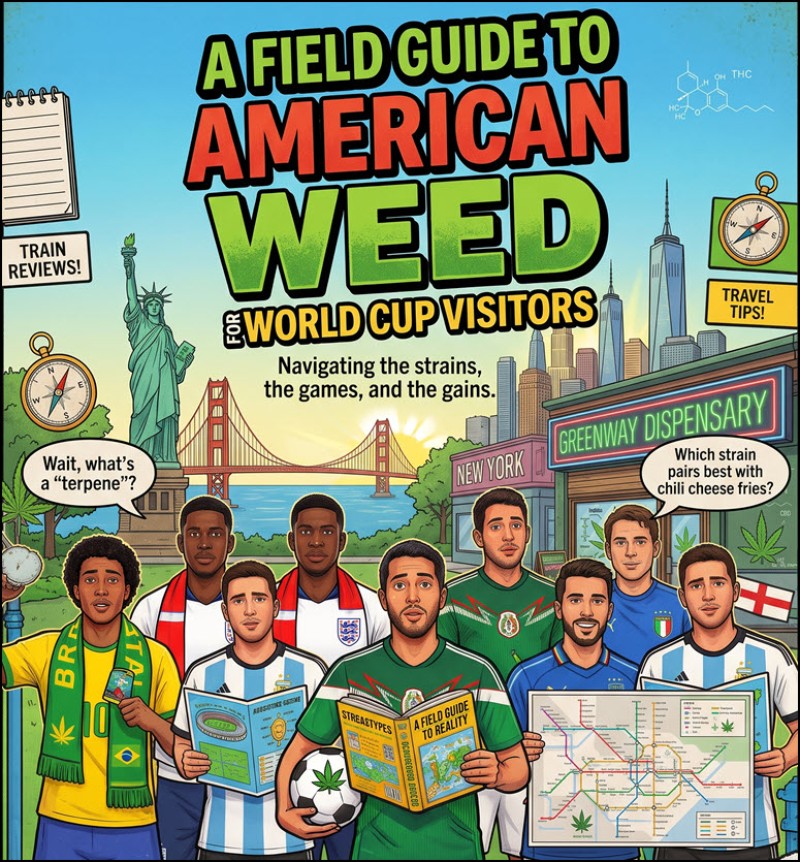
The Washington State Department of Health just published a health advisory for FIFA World Cup visitors. It includes the standard warnings: start low, go slow, don’t drive, don’t mix with alcohol, edibles can take three hours and last up to 24. It is responsible, accurate, and completely inadequate for anyone who has never encountered what’s on dispensary shelves here.
So let me fill in what the health department politely left out.
If you are visiting from outside the United States and you plan to try cannabis while you’re here, you are not walking into a familiar experience with a slightly stronger version of what you already know. You are walking into a different category of product. The American legal cannabis market has spent fifteen years in open competition, with every cultivator, extractor, and brand racing to push potency, quality, and variety further than anyone else on earth. The result is a product landscape that has no real parallel anywhere cannabis is commonly consumed.
This is meant to help you navigate it without ending up on a couch in a hotel room wondering if you’re dying. You’re not. But you might feel like it if you go in unprepared.
First, Understand What the Numbers Actually Mean
In most countries where cannabis exists in some form, whether tolerated, gray-market, or outright illegal, what people consume is roughly 10% THC or below in flower form. European herbal cannabis averaged around 10.6% THC as of the most recent public health monitoring data. Much of what circulates internationally in hash or compressed resin form varies widely, but the baseline experience most international consumers carry in their heads corresponds to a fundamentally different potency range than what American dispensaries stock.
In the U.S. legal market, flower now averages 22 to 28% THC across most states, with typical products testing around 25%. That is more than double the European average. And that’s just flower.
The concentrates category is a different planet entirely. Wax, shatter, budder, live resin, and rosin — the dabbable extracts that fill an entire section of every dispensary — test between 60% and 90% THC. Distillate, used in vape cartridges and edibles, routinely hits 85 to 95%. THCA diamonds, the crystalline extract sitting at the premium end, can reach 99% pure THCA. One hit from a dab rig loaded with shatter delivers more THC in a single breath than most international visitors have consumed in an entire session at home.
This isn’t a moral judgment. It’s a calibration problem. The experience you are expecting and the experience you are about to have are not the same thing, and assuming otherwise is where things go sideways.
Treat It Like a Psychedelic, Because at These Doses It Is
Cannabis at the potency levels common in American dispensaries activates psychedelic-adjacent territory that most casual consumers have never visited. The dissociation, time distortion, sensory amplification, and acute anxiety that can come from overconsumption of high-THC cannabis are not meaningfully different, in character if not in duration, from a mild psychedelic experience. The mechanism is different. The phenomenology overlaps considerably.
This means the rules that experienced psychedelic users follow apply here. Set and setting matter. Your mental state going into the session shapes what comes out of it. Your environment determines whether you feel safe or whether your nervous system spends two hours looking for an exit.
Don’t consume in a loud, crowded, unfamiliar public space if you haven’t done this before or don’t have a functioning tolerance. Don’t consume when you’re anxious, stressed, or sleep-deprived. Don’t consume alone in a hotel room in a foreign country with nowhere comfortable to land if the experience gets intense. Have a person around who is either sober or at least more calibrated to the product than you are. Make sure you have water, food, something familiar, a place to sit or lie down, and no pressing obligations for the next several hours.
This is not excessive caution. This is basic risk management for a substance that, at these potency levels, commands the same respect you’d give anything capable of temporarily reorganizing your sense of time and self.
The Start Low and Go Slow Rule Is Not a Suggestion
The Washington State Department of Health said it. Every dispensary budtender will say it. I’m saying it here because it is the single most important piece of practical information for a first-time visitor to an American cannabis market.
One small hit. Wait fifteen minutes. Assess. Then decide whether to take another.
Most overconsumption experiences that end in emergency room visits or acute panic attacks follow the same script: someone was unfamiliar with the potency, assumed their existing tolerance translated, took a normal-sized amount for them, and then got hit with three or four times what they expected. The compounding error is usually that they took more before the first dose fully expressed itself, because cannabis doesn’t always hit immediately and the temptation to fill that gap is real.
Edibles are the worst offender. The health department’s warning that edibles can take up to three hours to peak and may last 24 hours is not hyperbole. First-time edible consumers who eat a full 10mg serving, feel nothing after 45 minutes, and eat another are the ones who end up horizontal and overwhelmed at hour three. Standard Washington State serving sizes are capped at 10mg THC per serving. Start with half of one serving — 5mg — and give it two to three hours before even considering more. At 10mg you will feel something. At 20mg you will feel a lot. At 40mg you will have a story you either love or hate.
Do Not Take Dabs as a First Experience
I want to be direct about this because concentrates are everywhere in American dispensaries and they look approachable. Small jars of amber material. Tiny amounts. How bad could it be?
Very bad, for the uninitiated.
A single dab from a 70% THC live rosin is not comparable to a hit from a joint. The THC delivery is immediate, the dose is enormous relative to anything flower-based, and the effects arrive faster than most first-timers expect to manage them. Even experienced flower consumers report that their first dab hit differently from anything they had encountered before.
If you want to try concentrates, do it in the right context. Be in a place where you are comfortable, seated, and have nowhere to be. Have someone experienced nearby. Use a small amount — what the Washington State Liquor and Cannabis Board describes as a rice-grain-sized portion, which actually means a literal rice grain, not a rough approximation of one. The effects will arrive within seconds and will be considerably stronger than the flower you may have smoked earlier in the day. Respect that and proceed accordingly.
The dab rig experience is also physically unfamiliar if you’ve never used one. A butane torch heats a quartz nail to operating temperature. You place the concentrate on the hot surface, cap it, and inhale through the rig. Done wrong, you either burn the concentrate at too high a temperature and produce a harsh, unpleasant hit, or you’re not prepared for the intensity of what happens next. Electric dab rigs solve the torch problem and allow temperature control, which reduces the margin for error. If someone offers you a dab and you want to try it, ask for an electric rig and low temperature if that’s an option.
Legal but Not Everywhere
Recreational cannabis is legal for adults 21 and older in Washington, California, Colorado, Oregon, Nevada, and a majority of U.S. states. Legal status does not mean unrestricted use anywhere you feel like it. Public consumption is illegal in Washington. You cannot smoke in a park, on a stadium concourse, on a sidewalk, or in most outdoor public spaces. Hotels prohibit it on their premises in most cases, though this varies. You cannot carry cannabis across state lines, which means anything you buy in Seattle stays in Seattle. You cannot bring it onto federal property, which includes airports, national parks, and any federally-owned building.
The practical advice: consume where you have been explicitly told it is permitted, or in a private space you control. Do not assume outdoor spaces are fine. Do not assume a discreet location makes it legal.
This Will Ruin Other Weed for You
I say this from personal experience and I say it without apology. Once you smoke California or Washington flower at its best — a properly grown, well-cured, terpene-rich cultivar from a craft producer — you will spend the rest of your life comparing everything else to it. The aroma, the flavor, the complexity of effect, the cleanness of the experience are genuinely different from what most of the world produces. This is not chauvinism. It is a consequence of fifteen years of legal market competition under full sunlight, with cultivators free to optimize genetics, growing methods, and processing techniques without the constraints of prohibition.
The best dispensary flower in California or Washington is not the same product category as what most of the world calls good weed. It sits closer to what single-origin craft beer is to mass-market lager, or what a fresh-roasted specialty coffee is to gas station coffee. The underlying plant is the same. What has been done with it is not.
Buy flower if you want to understand what the American market produces at its best. Ask a budtender at any dispensary what they’re personally excited about. Budtenders in legal states know the product well and most are genuinely happy to help a visitor navigate the options rather than just upsell the most expensive thing on the shelf.
The Food Warning
The Washington State health guide covered cannabis. I’ll add something they didn’t. The United States food supply is genuinely more processed, sweeter, saltier, and heavier than most of what you eat elsewhere in the world. This is not an insult. It is a documented structural feature of a food system built around mass production, corn syrup, and shelf stability. Your digestive system may have opinions about this within the first 48 hours.
Cannabis helps. The anti-nausea and appetite-regulation properties of THC are medically documented and entirely real. A light session before navigating American portion sizes and ingredient lists is not the worst strategy. Just account for the fact that munchies plus American supermarket abundance is a combination that has ended many evenings in ways their participants did not intend.
Welcome to the United States. The weed is remarkable. Go slow, stay somewhere comfortable, and enjoy it.
Sources
The Marijuana Herald — Washington Health Department Warns World Cup Visitors About Strong Marijuana Products (June 19, 2026): https://themarijuanaherald.com/2026/06/washington-health-department-warns-world-cup-visitors-about-strong-marijuana-products/
Washington State Liquor and Cannabis Board — Understanding THC Concentration and Potency: https://lcb.wa.gov/education/understanding_thc_concentration_and_potency
Headset — Tracking Potency: The Data Behind Cannabis’s Rising THC Levels (July 2025 data): https://www.headset.io/blog/tracking-potency-the-data-behind-cannabiss-rising-thc-levels
American Psychological Association Monitor — The Changing Marijuana Landscape (June 2025): https://www.apa.org/monitor/2025/06/marijuana-potency-policy-risk
PubMed Central — Public health monitoring of cannabis use in Europe: prevalence of use, cannabis potency, and treatment rates (European Archives): https://pmc.ncbi.nlm.nih.gov/articles/PMC8589728/
Frontiers in Public Health — A 10-year trend in cannabis potency (2013-2022) in different geographical regions of the United States (2024): https://www.frontiersin.org/journals/public-health/articles/10.3389/fpubh.2024.1442522/full
ACS Laboratory — Cannabis Concentrates Guide: THC Oils, Hash, Wax, Shatter & Dabs (2026): https://www.acslab.com/retail/cannabis-concentrates-guide
NIDA University of Mississippi Potency Monitoring Program — average THC content rose from 3.96% in 1995 to 16.14% in 2022
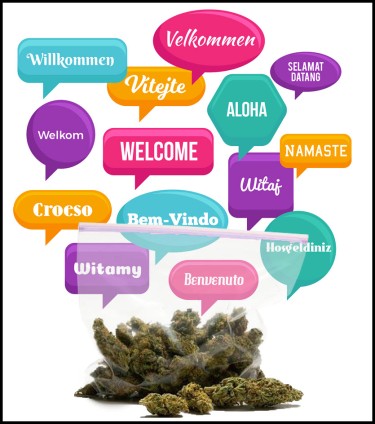
HOW TO ORDER WEED IN OTHER LANGUAGES, READ ON...