
Remember when they told you that smoking a joint killed a cop in Colombia?
That was the propaganda line two decades ago—your personal cannabis consumption was directly funding cartel violence. If you bought weed, you were complicit in murder, corruption, and destabilization.
It was bullshit then, and it's bullshit now. But let's accept their logic for a moment and apply it consistently.
If buying cartel weed makes you complicit in violence, what does buying cartel avocados make you?
Because here's the uncomfortable truth: your avocado toast is probably funding more cartel violence than a joint ever did.
Michoacán, Mexico produces 80% of Mexico's avocados. Mexico produces 45% of the world's avocados. And Michoacán is entirely controlled by drug cartels.
The Jalisco New Generation Cartel and Knights Templar Cartel don't just extort the avocado industry—they run it. They control packing houses, distribution networks, and export logistics. They extort 10-15% of farmers' revenue (roughly $150 million annually). They murder activists who oppose deforestation. They assassinate officials who try to regulate.
In 2019, the US banned avocado imports from Michoacán after a USDA inspector was threatened at gunpoint. The ban lasted one week before economic pressure forced them to back down.
The cartels won.
So if the prohibitionist logic holds—if consumer purchases fund violence—then every millennial posting #plantbased avocado toast on Instagram is directly funding organizations that murder people, destroy forests, drain aquifers, and corrupt governments.
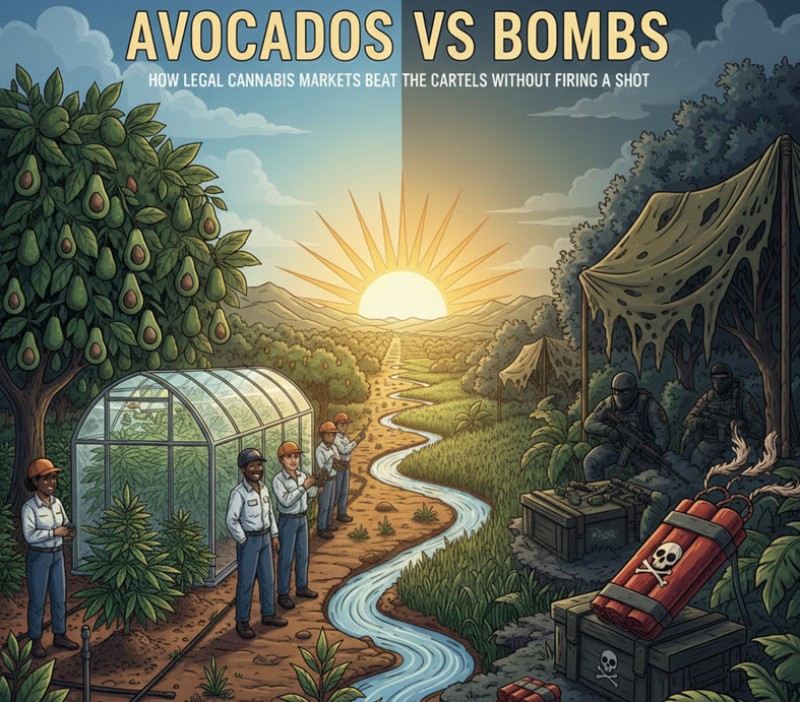
But here's what's fascinating: nobody's proposing we bomb Michoacán's avocado farms or launch a "War on Avocados."
And that's exactly the point. Because there's a better way to fight cartels than bombs and prohibition.
It's called free markets. Competition. Economic dilution.
Today we're going to talk about how farmers in Michoacán are actually beating cartels—not with military intervention, but with armed self-defense and legitimate commerce. And how this exact model could solve the drug problem without a single drone strike.
The Avocado Cartel: A Case Study in Prohibition Economics
Let's establish the facts about Michoacán's avocado industry because the details matter.
The Cartel Control:
-
Jalisco New Generation Cartel (CJNG) and Knights Templar run operations
-
10-15% extortion rate on all avocado revenue (~$150M annually)
-
Control over packing houses, distribution, export logistics
-
Murder of environmental activists opposing deforestation
-
Assassination of local officials attempting regulation
-
Armed threats against US agricultural inspectors
The Environmental Devastation:
-
Each kilogram of avocados requires 272 gallons of water
-
Illegal river diversion, unauthorized wells, aquifer drainage
-
Mexico loses 1,700 acres of forest daily—avocado expansion is major driver
-
Century-old pine/fir forests cleared for plantations that deplete soil in 20 years
-
Zero enforcement because cartels control local government
The Economics:
-
Massive US demand for avocados creates massive profit opportunity
-
Limited legal competition due to geography/climate
-
Prohibition on other crops (like cannabis) concentrates cartel focus
-
Extortion becomes sustainable income stream
Sound familiar? This is identical to the drug trade economics that prohibition creates.
High demand + artificially restricted supply + lack of legal alternatives = massive profits for whoever controls the illegal/quasi-legal market.
But Here's What the Original Tweet Missed
Two responses to that viral avocado thread revealed something crucial—something that completely changes the narrative and provides the roadmap for fighting cartels.
Response #1 (from ranch visitor): "I just had some Mexicans from Michoacán stop by. Long time friends. They tell me that is no longer the case. Military is at packaging and sorting plants. Farmers are not paying."
Response #2 (from actual farmer): "There are regions in Michoacán such as Tancítaro (Avocado Capital of the World), Nahuatzen, or Cherán that are self-defense organized communities formed by avocado farmers actively defending their territories from cartels. Where do you think they get the funds to fight? From the US market purchasing their agricultural produce."
This is the solution. Right here.
Not military invasion. Not prohibition. Not "War on Avocados."
Armed farmers defending legitimate businesses and using profits from legal trade to fund their own defense.
Let me break down why this matters.
The Tancítaro Model: Armed Commerce Beats Unarmed Prohibition
Tancítaro, Cherán, and Nahuatzen represent a different approach to cartel resistance—one that actually works.
What they did:
-
Organized community self-defense forces (autodefensas)
-
Protected their own farms and packing facilities
-
Maintained legitimate business operations
-
Used profits from legal avocado sales to fund security
-
Created transparent supply chains
-
Worked with international buyers who wanted cartel-free products
The results:
-
Cartels largely expelled from these specific regions
-
Farmers keeping 100% of their revenue
-
Continued access to US markets
-
Environmental regulations actually enforced
-
Community control restored
This is the model. Armed legitimate business defending itself from criminal extortion while operating in legal markets.
The key components:
-
Legal market access (US buying their avocados)
-
Legitimate profit (funding their own defense)
-
Community organization (collective security)
-
Transparency (buyers knowing which farms are cartel-free)
Notice what's not part of this model:
-
US military intervention
-
Drone strikes
-
Decades-long occupation
-
Billions in foreign military aid
They're using economics and self-defense to beat cartels. And it's working.
Now Apply This Model to Cannabis
Here's where it gets really interesting.
If armed farmers can defend legitimate avocado operations from cartels using profits from legal sales, why can't we do the same with cannabis?
The current model (prohibition):
-
Cannabis illegal federally and in many states
-
Massive demand creates black market
-
Cartels profit billions annually
-
Prohibition prevents legal competition
-
Military "solutions" fail repeatedly
-
Violence continues indefinitely
The Tancítaro model applied to cannabis:
-
Full legalization enables legal growing
-
Legal farms in Mexico/US compete with cartels
-
Farmers use profits for security/defense
-
Transparent supply chains (like "cartel-free avocados")
-
Consumers choose legal over illegal
-
Cartel revenue streams dry up
It's the exact same principle: legitimate armed commerce outcompeting criminal operations.
The Economics of Dilution vs. The Economics of Prohibition
Prohibition creates artificial scarcity. Scarcity drives up prices. High prices create massive profit margins. Massive margins attract cartels.
Legalization does the opposite—it floods the market.
When you enable thousands of legal farmers to compete, several things happen:
1. Prices drop (competition drives efficiency) 2. Profit margins shrink (can't charge premium for illegal risk) 3. Quality improves (legal businesses compete on quality) 4. Cartels can't compete (legal operations are more efficient)
You're not "beating" cartels through violence. You're making their business model obsolete.
Think about it:
Cartel cannabis operation costs:
-
Bribes to officials
-
Armed security against rivals and police
-
Smuggling expenses
-
Loss to seizures
-
Laundering money
-
Operating in secrecy (inefficiency)
Legal cannabis operation costs:
-
Licensing fees
-
Taxes
-
Standard security
-
No smuggling needed
-
Legal banking
-
Operational efficiency
Legal operations are cheaper to run and can undercut cartel prices while still being profitable.
Add in the fact that legal consumers prefer legal products (testing, quality control, convenience, no legal risk), and cartels lose on every front.
This is how you kill cartels—you outcompete them economically.
What If We Treated Drugs Like Avocados?
Let's run this thought experiment:
Current Reality:
-
Avocados are legal
-
Some cartel involvement but legal competition exists
-
Farmers can defend legal operations
-
US doesn't ban avocados despite cartel connection
-
Solution is transparency and supporting clean supply chains
What if we treated cannabis the same way?
-
Fully legal federally and internationally
-
Some criminal involvement initially
-
Legal farmers defend their operations
-
Government doesn't ban cannabis because cartels also grow it
-
Consumers support transparent, legitimate supply chains
Or all drugs?
What if heroin/cocaine/meth were treated as legal agricultural products with:
-
Licensed production facilities
-
Quality control and testing
-
Transparent supply chains
-
Legal distribution networks
-
Taxation and regulation
The economic result is predictable: cartels lose their monopoly, prices stabilize, violence decreases, consumers get safer products.
Portugal and Switzerland have already proven this model works for hard drugs. Legal/regulated access reduces deaths, disease, crime—and cartel power.
The Prohibition Propaganda Falls Apart
Remember that "smoking a joint kills a cop" propaganda?
The logic was: Your drug money funds cartel violence, therefore you're responsible.
But if we apply that consistently:
Your avocado toast funds cartel violence. Your smartphone requires minerals from conflict zones. Your chocolate probably involved child labor. Your fast fashion funds sweatshops.
Everything under capitalism involves some form of exploitation or violence in the supply chain.
The difference is: with avocados, we don't ban them—we support legitimate alternatives and fight for ethical supply chains.
Why don't we do the same with drugs?
The prohibitionist answer is: "Because drugs are inherently harmful."
But avocados require 272 gallons of water per kilogram in drought-stricken regions. They drive deforestation. They're environmentally harmful.
Alcohol causes 140,000+ deaths annually in the US. Tobacco causes 480,000+. They're medically harmful.
Harm isn't the criteria for prohibition. Control is.
Alcohol and tobacco are legal because those industries won the political battle. Cannabis and psychedelics are illegal because they lost the political battle.
It's not about safety. It never was.
The Path Forward: Economic Warfare, Not Actual Warfare
The solution to cartel violence isn't more military intervention. We've tried that. For decades. It doesn't work.
The solution is economic:
1. Full legalization domestically and internationally
-
Cannabis, coca, poppies—treat them like agricultural products
-
Licensed farming with quality control
-
Transparent supply chains
2. Enable legal competition
-
Small farmers in Mexico, Colombia, Afghanistan can grow legally
-
Export to legal markets globally
-
Compete with cartels on price and quality
3. Support self-defense
-
Legal farmers form autodefensas like Tancítaro
-
Defend their operations from criminal extortion
-
Use legal profits to fund security
4. Consumer transparency
-
"Cartel-free" certification like fair trade coffee
-
Supply chain transparency
-
Consumers choose legal/ethical products
5. Let economics do the work
-
Legal operations undercut cartel prices
-
Consumers prefer legal (safety, convenience, quality)
-
Cartel revenue streams dry up
-
Criminal organizations wither
You don't bomb your way out of economics. You can't.
Cartels exist because prohibition creates artificially high profit margins. Remove prohibition, remove the margins, remove the cartels.
The Sticky Bottom Line: Stop Bombing, Start Competing
The avocado situation in Michoacán proves something crucial: armed legitimate commerce beats criminal extortion when legal markets exist.
Farmers in Tancítaro didn't need US military intervention. They needed:
-
Access to legal markets
-
Ability to defend themselves
-
Transparent supply chains
-
Consumer support for legitimate products
They're winning against cartels using economic competition and self-defense.
We can do the same with drugs.
Stop trying to bomb cartels out of existence. You can't. They'll just reorganize elsewhere. Hydra effect, every single time.
Stop criminalizing farmers and consumers. You're just ensuring cartels maintain their monopoly.
Start enabling legal competition. Thousands of legal farmers will outcompete cartels through volume, quality, and efficiency.
Start supporting self-defense. Let legal operations protect themselves from criminal extortion.
Let economics solve the problem violence can't.
Every dollar spent on legal cannabis is a dollar cartels don't get. Every legal avocado from Tancítaro is revenue the Knights Templar lose. Every legal farm defended by armed farmers is territory cartels can't control.
This is how you beat cartels: you overgrow them, outpace them, dilute their profit margins until their business model collapses.
Not every problem needs carpet bombing. Some problems need free markets, property rights, and the Second Amendment.
The avocado farmers of Michoacán are showing us the way. Time we paid attention.
CUTTING THE CARTELS DOWN, READ ON...