

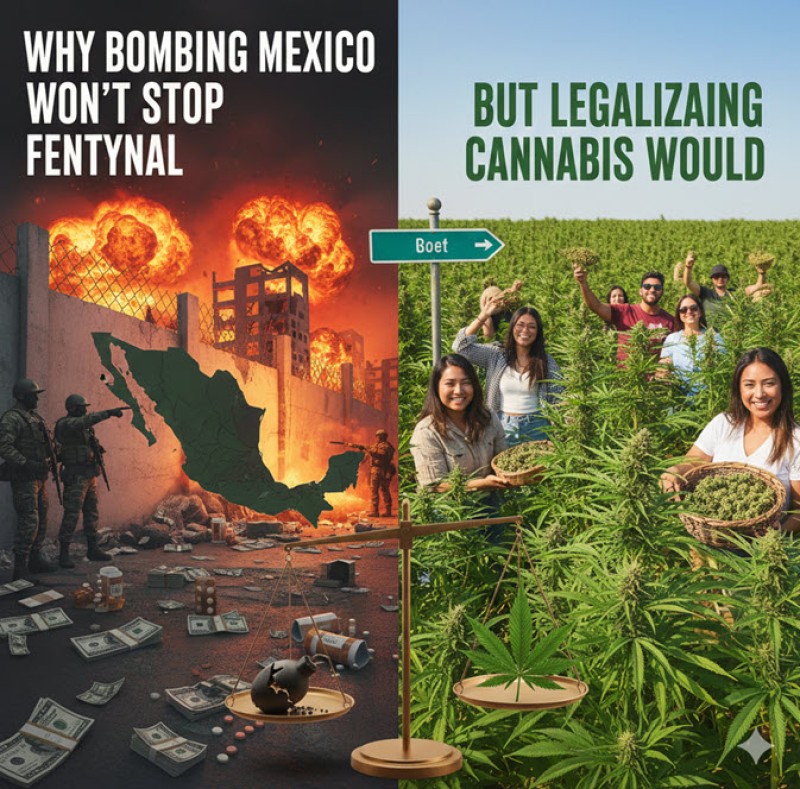
War Boners vs. Common Sense: Why Bombing Mexico Won't Stop Fentanyl (But Legalization Would)
There's a disturbing amount of noise on Twitter right now about the U.S. conducting military strikes in Mexico against drug cartels. Americans who've apparently learned nothing from history are cheering for drone strikes, Special Forces operations, and full-scale military intervention as the "solution" to the fentanyl crisis.
Let me be very clear: This is possibly the dumbest fucking idea in a timeline already overflowing with dumb fucking ideas.
And I say this as someone who's been covering drug policy for decades, who's watched this exact playbook fail spectacularly in Colombia, Panama, Afghanistan, and Mexico itself in 2006. Every. Single. Time.
The pattern is always the same: Big military operation. Lots of explosions. Dead cartel leaders. Media celebrates. Politicians claim victory. And then, six months later, the drugs are flowing again—often in greater quantities, from more violent cartels, and with deadlier consequences.
Because here's what the war cheerleaders don't understand (or refuse to acknowledge): You cannot bomb away a market force. You cannot militarily eliminate demand. And you absolutely cannot kill your way out of a public health crisis.
But you know what would actually work? What would save lives, defund cartels, and cost less money while generating revenue?
Legalizing and regulating all drugs.
I know, I know. That sounds radical. It sounds scary. It sounds like I'm some kind of anarchist lunatic who wants to see America drowning in drugs.
But hear me out. Because unlike military intervention—which has a 100% failure rate over five decades—this approach is backed by math, evidence, and basic economic principles that even a stoned teenager can understand.
Why Military Intervention Will Fail (Again)
Let's start with why the "bomb the cartels" approach is doomed from the start.
The Hydra Effect
Every time you kill a cartel leader or destroy a drug operation, you don't eliminate the organization—you fragment it. What was one cartel becomes three smaller, more violent cartels fighting for territory and market share.
Mexico learned this the hard way in 2006 when President Felipe Calderón launched his militarized drug war. The result? Over 350,000 deaths, more than 100,000 disappearances, and cartels that are more powerful, more violent, and more diversified than ever before.
The Sinaloa Cartel split into factions. The Zetas emerged as a hyper-violent paramilitary force. The Gulf Cartel fractured into pieces. And through it all, drugs kept flowing north while the violence spiraled out of control.
That's what happens when you apply military solutions to market problems.
The Profit Motive Doesn't Care About Your Missiles
Here's Economics 101: As long as there's demand and prohibition, there will be supply. The profit margins on illegal drugs are so astronomical that no amount of interdiction can make the business unprofitable.
Consider: Pharmaceutical fentanyl costs about $0.50 per dose to manufacture. Street fentanyl sells for $5-20 per dose. That's a 1,000-4,000% markup.
You could intercept 90% of shipments (which is impossible, by the way), and the cartels would still make obscene profits on the remaining 10%. The economics are simply too compelling.
Bombing labs doesn't matter when you can build a new lab for $50,000 and recoup that investment in a week. Killing chemists doesn't matter when you can train new ones in a month. Destroying poppy fields doesn't matter when fentanyl is synthetic and doesn't require crops.
Prohibition creates profit. Profit attracts criminals. Violence is the business model.
The Humanitarian Nightmare
Let's talk about what military intervention actually means for the people living in affected areas:
Civilian casualties: Drone strikes and military operations are not precise. People die. Lots of people who have nothing to do with cartels.
Displacement: Communities get caught in crossfire. Families flee. Refugee crises emerge.
Infrastructure destruction: Bombing doesn't discriminate between drug labs and hospitals, schools, or homes built nearby.
Sovereignty violations: The U.S. bombing Mexico without a formal declaration of war is, you know, an act of war. That tends to complicate diplomatic relations and create long-term resentment.
Escalation risk: What happens when cartels retaliate by attacking U.S. interests? Do we invade Mexico? How does that end?
The human cost of this approach is staggering. And for what? To feel like we're "doing something" while the drugs keep flowing anyway?
Historical Precedent: It Never Works
Don't take my word for it. Look at the evidence:
Colombia (Plan Colombia, 2000-2016): $10+ billion spent, thousands dead. Cocaine production? Back to pre-intervention levels.
Afghanistan (2001-2021): Two decades of military presence. Opium production? Increased by 400% during U.S. occupation.
Mexico (2006-2012): Calderón's militarized approach. Drug trafficking? Continued unabated. Violence? Exploded.
Panama (1989): U.S. invasion to capture Noriega. Drug trafficking through Panama? Resumed immediately under new management.
The pattern is undeniable: Military intervention against drug trafficking has a 100% failure rate.
Yet here we are, watching people on Twitter demand we try the same thing again, expecting different results. You know what that's called? Insanity. Or maybe just really profitable for defense contractors.
The Actual Solution: Full Legalization and Regulation
Now let's talk about what would actually work. And I'm not talking about half-measures like Schedule III or limited medical programs. I'm talking about full legalization and regulation of all drugs, with a tiered approach based on harm potential.
The Financial Reality
The current U.S. drug control budget is approximately $46 billion annually. That's money spent on interdiction, law enforcement, courts, prisons, and international operations.
What does that $46 billion buy us?
-
Over 100,000 overdose deaths per year
-
Mass incarceration of non-violent offenders
-
Empowered cartels earning $150+ billion annually
-
Contaminated drug supply (hello, fentanyl)
-
Tens of thousands of deaths in producer countries
-
Zero measurable reduction in drug availability
That is the worst ROI in human history.
Now, let's look at what a regulated market would cost:
Estimated Annual Regulatory Costs
Federal Oversight (FDA-style agency): $5-8 billion
-
Clinical safety standards
-
Manufacturer licensing
-
Import/export controls
-
Post-market surveillance
State Retail Licensing & Enforcement: $2-4 billion
-
Business licensing (based on mature cannabis markets scaled nationally)
-
Compliance monitoring
-
Quality audits
-
Retail enforcement
Production & Quality Control: $1-2 billion
-
Government testing laboratories
-
Purity verification
-
Preventing adulteration (no fentanyl in the legal supply)
-
Regular product testing
Prevention & Education: $10-15 billion
-
Massive harm reduction campaigns
-
Age-appropriate drug education (that's actually honest)
-
Special focus on developing brains (under 25)
-
Treatment program funding
Total estimated regulatory cost: $18-29 billion annually
That's already cheaper than prohibition. But wait—there's more!
The "Safe Zone" Model for Dangerous Opioids
For truly dangerous drugs like heroin and fentanyl, we implement a public health model based on the successful Swiss and Portuguese systems:
Pharmaceutical-grade heroin/fentanyl provided free in medical settings:
-
Eliminates black market demand
-
Prevents overdose deaths (medical supervision, pure products)
-
Connects users with treatment services
-
Costs approximately $2-3 billion for raw materials (1 million users)
Safe consumption sites: $5-7 billion annually
-
Medical staffing
-
Facilities in major cities
-
Overdose prevention
-
Disease prevention (HIV, Hepatitis C)
Net benefit: These costs are offset by massive reductions in:
-
Emergency room visits (currently billions annually)
-
Ambulance calls
-
Infectious disease treatment
-
Crime reduction
-
Criminal justice costs
The Revenue Side
While we're spending less on the system, we're also generating substantial revenue:
Retail sales taxes (cannabis, psychedelics, MDMA): $46.7-58 billion annually
-
Taxed similarly to alcohol/tobacco
-
25+ age restriction (when brain is fully developed)
-
Lower initial revenue than 21+ age limit, but significant long-term savings in mental health costs
Criminal justice savings: $41.3 billion annually
-
Reduced police costs
-
Reduced court costs
-
Reduced incarceration costs
-
Reduced probation/parole costs
The Net Fiscal Impact
Let's do the math:
Current prohibition model:
-
Cost: $46 billion
-
Revenue: $0
-
Overdose deaths: 100,000+
-
Incarcerated: Hundreds of thousands
-
Cartel revenue: $150 billion
Proposed regulation model:
-
Cost: $25 billion (regulation + safe zones)
-
Revenue: $50 billion (taxes)
-
Savings: $41 billion (criminal justice)
-
Net gain: $66 billion annually
That's a $112 billion swing from the current system. Per year.
What could we do with an extra $66 billion annually?
Redirecting Resources to Actual Crime
Here's where it gets really interesting. The U.S. currently spends about $560 million annually on anti-human trafficking efforts. Meanwhile, we spend $46 billion trying to stop people from using drugs.
Let that sink in. We spend 82 times more money fighting drugs than fighting human trafficking.
Human trafficking is a $150 billion global industry. An estimated 40 million people worldwide are trapped in modern slavery. In the U.S. alone, hundreds of thousands of people—disproportionately women and children—are bought and sold.
But we're more concerned about adults choosing to consume psychoactive substances than we are about children being sold for sex or forced labor.
That is a crime against humanity.
Under a legalized and regulated drug model, we could:
-
Increase anti-trafficking funding 100-fold (from $560M to $56 billion)
-
Collapse cartel revenue streams (no drug money means no trafficking money)
-
Free up law enforcement to focus on actual victims
-
Build comprehensive survivor support systems
-
Fund prevention programs globally
-
Prosecute traffickers with resources that actually match the crime's severity
Imagine DEA agents, Border Patrol resources, and federal prosecutors redirected from cannabis busts to trafficking investigations. Imagine the impact of $50+ billion annually focused on identifying and protecting trafficking victims instead of chasing drug users.
That would save lives. Real lives. Children's lives.
The Tiered Approach: How It Would Work
Not all drugs are created equal. A sensible regulatory framework acknowledges this:
Tier 1: General Public Access (25+)
-
Cannabis
-
Psilocybin mushrooms
-
LSD
-
MDMA
-
Mescaline
Model: Retail sales similar to alcohol, with:
-
Age verification (25+)
-
Purity testing
-
Accurate labeling
-
Tax revenue generation
-
No advertising restrictions aimed at youth
Tier 2: Medical Supervision (Any Age with Doctor)
-
Ketamine
-
GHB (medical formulation)
-
Methamphetamine (pharmaceutical grade, like current Desoxyn)
-
Cocaine (pharmaceutical grade)
Model: Prescription access with:
-
Doctor oversight
-
Pharmacy dispensing
-
Medical record keeping
-
No criminal penalties for possession with valid prescription
Tier 3: Controlled Medical Distribution (Public Health Model)
-
Heroin (diamorphine)
-
Fentanyl
-
Synthetic opioids
Model: Free provision in designated safe zones with:
-
Medical supervision
-
On-site consumption only
-
Treatment services available but not mandatory
-
Disease prevention (clean needles, testing)
-
Overdose prevention (Narcan, medical staff)
The goal isn't to encourage use—it's to prevent death, eliminate the black market, and treat addiction as a health issue rather than a criminal justice problem.
Why This Approach Actually Works
This isn't theoretical. We have evidence:
Portugal (2001-Present):
-
Decriminalized all drugs
-
Treated addiction as health issue
-
Results: 95% reduction in overdose deaths, 50% reduction in drug-related HIV infections, drug use rates among youth declined
Switzerland (1994-Present):
-
Heroin-assisted treatment program
-
Free pharmaceutical heroin in medical settings
-
Results: Crime reduction, overdose prevention, 60% of participants eventually entering abstinence treatment
Netherlands (1976-Present):
-
Cannabis tolerance policy
-
Separation of soft and hard drug markets
-
Results: Lower cannabis use rates than U.S., lower rates of problematic drug use
Vancouver, Canada (2003-Present):
-
Safe injection site (Insite)
-
Medical supervision, clean supplies
-
Results: 35% reduction in overdose deaths in surrounding area, increased treatment uptake, no increase in drug use
The evidence is overwhelming: Treating drugs as a public health issue rather than a criminal justice issue saves lives and costs less money.
The Sticky Bottom Line: Choose Sanity Over War
So here we are, at a crossroads. Again.
On one side, we have the war cheerleaders demanding military intervention in Mexico. Bombs. Drones. Special Forces. The same approach that's failed for fifty years but makes defense contractors rich and gives politicians something to thump their chests about.
This approach will cost billions, kill thousands (mostly civilians), violate Mexican sovereignty, create diplomatic crises, fragment cartels into more violent factions, and accomplish absolutely nothing in terms of reducing drug availability or overdose deaths.
On the other side, we have a rational, evidence-based approach: Legalize, regulate, tax, treat. Eliminate the black market by eliminating prohibition. Defund cartels by removing their primary revenue source. Save lives by ensuring pure products and medical supervision. Generate revenue instead of wasting money. Redirect resources to actual crimes like human trafficking.
This approach would:
-
Save over $40 billion in criminal justice costs
-
Generate over $50 billion in tax revenue
-
Prevent tens of thousands of overdose deaths annually
-
Collapse cartel revenue streams
-
Free up massive resources for fighting actual crime
-
Reduce incarceration of non-violent offenders
-
Improve public health outcomes
-
Respect bodily autonomy and personal freedom
The choice couldn't be clearer.
But we won't choose the rational approach. You know why? Because it doesn't satisfy the American addiction to war. It doesn't let politicians look "tough on crime." It doesn't generate campaign donations from defense contractors and private prison corporations. It doesn't give law enforcement agencies justification for their bloated budgets.
Most importantly, it doesn't protect pharmaceutical company profits. Big Pharma loses billions when people can access safer, cheaper alternatives to their products. And Big Pharma owns too many politicians for legalization to happen without a fight.
So instead, we'll probably watch the U.S. bomb Mexico, kill a bunch of people, accomplish nothing, and then act surprised when the drugs keep flowing and the violence increases.
Because that's what we do. We choose war over wisdom. We choose profit over people. We choose the illusion of action over actual solutions.
The War on Drugs is a crime against humanity. Full stop.
We prioritize stopping adults from consuming psychoactive substances over stopping traffickers from stealing humans and selling them for parts, pleasure, or profit. We spend 82 times more money chasing drug users than protecting trafficking victims.
That is our choice. That is what we've decided matters.
So here's my message to the war-hungry Americans cheering for strikes on Mexico:
Stop with the fucking war boners.
There's a better way. It costs less. It saves more lives. It's backed by evidence and basic economics. It treats addiction as a health issue instead of a moral failing. It respects personal autonomy while protecting public health. It defunds criminals while funding treatment.
It's called legalization. It's called regulation. It's called treating adults like adults and addicts like patients.
It works. We know it works. We have decades of evidence from multiple countries proving it works.
But it requires something America seems incapable of: admitting we were wrong about prohibition and choosing a different path.
So we'll probably blow shit up in Mexico instead. Because explosions are more American than common sense.
Prove me wrong. I'd love to be wrong about this.
But fifty years of drug war history says I'm not.
Legalize all drugs. Regulate them. Tax them. Treat addiction. Fight actual crime.
It's really that simple. If only we had the courage to try it.
THE US GOVERNMENT ON FENTANYL, READ ON..