

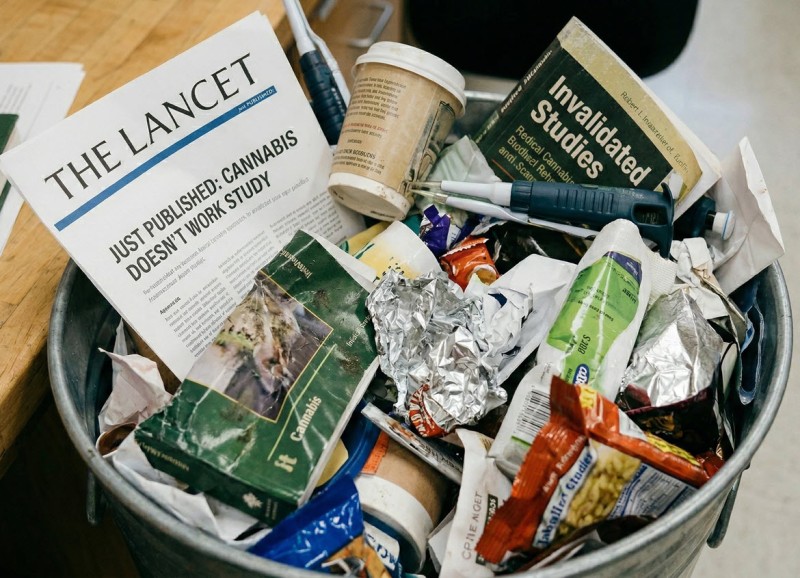
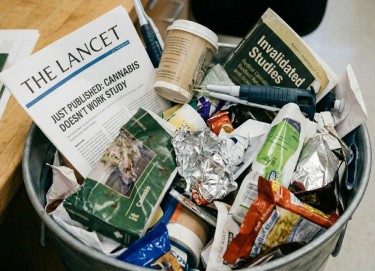
The Lancet Just Published a "Cannabis Doesn't Work" Study — Let's Talk About Why That's Garbage
A new meta-analysis dropped in The Lancet Psychiatry this month, and the NY Post ran it like a sports score: "Weed Rarely Justified to Treat Anxiety, Depression." Headlines got picked up, amplified, shared. The narrative machine did its thing.
I read the study. Let's talk about what it actually says, what it conveniently omits, and who's standing behind it.
What the study claims
Researchers at the University of Sydney's Matilda Centre reviewed 54 randomized controlled trials spanning 45 years, concluding there is no evidence that cannabis effectively treats anxiety, PTSD, or depression. ScienceDaily Lead author Dr. Jack Wilson packaged it as a public health concern: the widespread medical approval of cannabis for mental health, he says, might be "doing more harm than good."
The study is being called the largest of its kind. Fifty-four RCTs. Forty-five years of data. Sounds comprehensive. Here's the problem — and it's a structural one, not a nitpick.
The research pool is contaminated by design
A 2020 analysis published in Science documented the built-in bias of cannabis research being forced by funding to concentrate on harms rather than benefits. Science This wasn't a fringe critique. It was peer-reviewed and published in one of the most prestigious scientific journals in the world.
Here's the number that matters: between 2000 and 2018, U.S. research on cannabis harms received 20 times more funding than research on cannabis therapeutics. NIDA spent over $1 billion in that period, with a heavily slanted focus on cannabis abuse, misuse, and negative effects. CannaMD
Twenty times. Not slightly more. Not double. Twenty times.
Out of all NIDA-directed funding, only 16.5 percent supported investigations into the therapeutic properties of cannabinoids. Cannabis Tech
So when the Lancet team searched databases for RCTs treating mental disorders with cannabis as the primary treatment, they found a sparse pool — and then concluded the sparse pool means cannabis doesn't work. That conclusion is circular. You can't run a rigorous trial with plant material you can barely access, in the doses people actually use, then fault the plant for the absence of results.
The Mississippi Monopoly problem
This one doesn't make the headlines but it explains everything about why the RCT pool is thin. Under U.S. federal law, a single farm at the University of Mississippi was, for decades, the only institution licensed to grow cannabis for research purposes. Researchers have complained for years that the product is low-potency, dried and stored for long periods — sometimes years — at -20 degrees Celsius, irradiated to kill mold, resulting in a powdery substance not representative of what patients actually consume. CannaMD
Researchers cannot study legal market products on campuses and must rely on NIDA-approved suppliers with limited formulations that are not representative of products available on the legal market. PubMed Central
The Lancet study pulls from RCTs. Most of those RCTs were conducted using research-grade cannabis that bears no resemblance to the chemotype, terpene profile, or potency of what real patients use. You're essentially running a clinical trial on beer and using the results to evaluate whiskey. Then calling it "the largest study ever."
PTSD: where the study really falls apart
The claim that cannabis shows no benefit for PTSD is where I lose patience with this paper entirely.
A specialized psychiatric trauma unit in Israel has offered medical cannabis to treatment-resistant combat-PTSD veterans since 2015 — patients who remained severely symptomatic despite treatment with many lines of conventional medicine. Frontiers These aren't people who tried cannabis recreationally and reported feeling better. These are clinical patients, tracked with validated instruments, who had already failed everything else the system could offer.
The FDA authorized MAPS — the Multidisciplinary Association for Psychedelic Studies — to proceed with a Phase 2 clinical trial of smoked cannabis for PTSD in over 300 veterans in November 2024. Stars and Stripes The FDA doesn't greenlight a 320-person multi-site RCT for something with zero plausible mechanism. MAPS spent over three years navigating five partial clinical hold letters from the FDA before finally securing clearance. Cannabis Business Times That's not a story of easy access. That's a story of the system making it as difficult as possible to produce the evidence the Lancet study then complains doesn't exist.
Current antidepressant pharmacotherapy for PTSD produces remission rates of only 20 to 30 percent, and research shows that 9 patients must be treated with preferred antidepressants for just 1 to have a response. PubMed Central Those are the drugs already approved and sitting on VA pharmacy shelves. The bar is on the floor, and cannabis still gets treated as the unproven option.
U.S. federal law has made it very difficult to conduct clinical research on cannabis' therapeutic benefits, yet outside the U.S., research has been conducted — including clinical trials in Israel, where a 2012 open pilot study found that medical cannabis was associated with a reduction in PTSD symptoms. Marijuana Policy Project
The absence of trials is not the same as evidence of no effect. It is evidence of no permission.
Know your authors
The study comes out of the University of Sydney's Matilda Centre and the University of Queensland, funded by the National Health and Medical Research Council (NHMRC) of Australia. PubMed
Senior author Wayne Hall is worth examining. Hall has been a WHO expert adviser since 1993, advising on the health effects of cannabis use, and in 2014 published a major review concluding that cannabis approximately doubles crash risk when driving impaired. Wikipedia His career output is not neutral on this question. His publication record skews heavily toward cannabis risk documentation, cannabis dependence, and addiction.
Hall has advised the WHO on cannabis health effects (2016-2023), reviewed evidence on medical cannabis uses for the Australian government (2017-2018), and served as a member of the Australian Advisory Council on the Medical Uses of Cannabis (2017-2020). PubMed
That's not disqualifying. But it establishes an institutional posture. This is a researcher whose career has been built largely on cataloguing cannabis risks. The study reflects that orientation — it uses the RCT framework as the sole admissible evidence standard, which conveniently excludes the majority of real-world observational data that doesn't fit the method.
The real tell: what they found useful
Here's what's genuinely revealing. The study couldn't find evidence cannabis treats anxiety, depression, or PTSD as a primary medicine. But not a single randomized controlled trial has ever been conducted on cannabis for depression — despite depression being among the most common reasons people use medical cannabis. Refresh Psychiatry
Zero trials. So the conclusion on depression isn't "cannabis doesn't work for depression." The honest conclusion is "we've never properly studied it." Those are not the same statement, but the headlines treat them identically.
Meanwhile, tucked inside the findings, the study did find something it could endorse: the routine use of medicinal cannabis could be doing more harm than good by worsening mental health outcomes, including a greater risk of developing cannabis use disorder. ScienceDaily
Cannabis Use Disorder. The one diagnosis that justifies pharmaceutical intervention, billing codes, clinical programs, and treatment revenue. Funny how that finding made it through.
The bigger picture
This is tobacco research methodology applied to cannabis. The tobacco industry ran this exact playbook for decades: fund studies that create doubt, publish in credible journals, generate headlines, shape policy. The goal was never truth. The goal was the appearance of scientific uncertainty to delay regulatory action.
One researcher noted in Science: "Like tobacco-industry funded research on the effects of smoking, DEA-funded research on the effects of historically illicit drugs must be regarded with extreme skepticism." Science
The Lancet study didn't take DEA money directly. But it drew from a pool of RCTs that was itself shaped by 45 years of funding that overwhelmingly asked how cannabis harms people rather than how it helps them. The bias isn't in this paper specifically. The bias is upstream, baked into every study they reviewed.
You can publish a rigorous meta-analysis of rigged data and still be technically correct about your methodology. The problem is the input, not the math.
The Sticky Bottom Line
Twenty-seven percent of Americans aged 16 to 65 report using cannabis medically. Half of them say they use it for mental health symptoms. These are not deluded people inventing effects that don't exist. They are people whose endocannabinoid systems responded to a plant in ways that made their lives more manageable — and who, by the way, weren't offered great alternatives by a pharmaceutical industry that achieves a 20-30% remission rate on its best PTSD drugs while causing liver strain, dependency, and sexual dysfunction as standard side effects.
The Lancet study tells us one true thing: we don't have enough rigorous, well-designed, real-world clinical trials on whole-plant cannabis for mental health. That is accurate. But that gap was manufactured over 45 years of deliberate underfunding, regulatory obstruction, and a research apparatus designed from the start to prove a plant guilty.
Declaring insufficient evidence and declaring no evidence are different statements. The New York Post doesn't make that distinction. The Lancet study barely does.
We should demand better science. We should also be clear about why we don't have it yet.
Sources: Wilson et al., The Lancet Psychiatry, March 2026 (DOI: 10.1016/S2215-0366(26)00015-5); Hudson cannabis funding analysis, Science, September 2020 (DOI: 10.1126/science.369.6508.1155); Nacasch et al., Frontiers in Psychiatry, 2023; MAPS MJP2 FDA clearance announcement, November 2024; Stars and Stripes FDA veterans PTSD trial reporting, November 2024; NIDA funding history via multiple NIH/PMC sources.
CANNABIS FOR DEPRESSION, READ ON...