
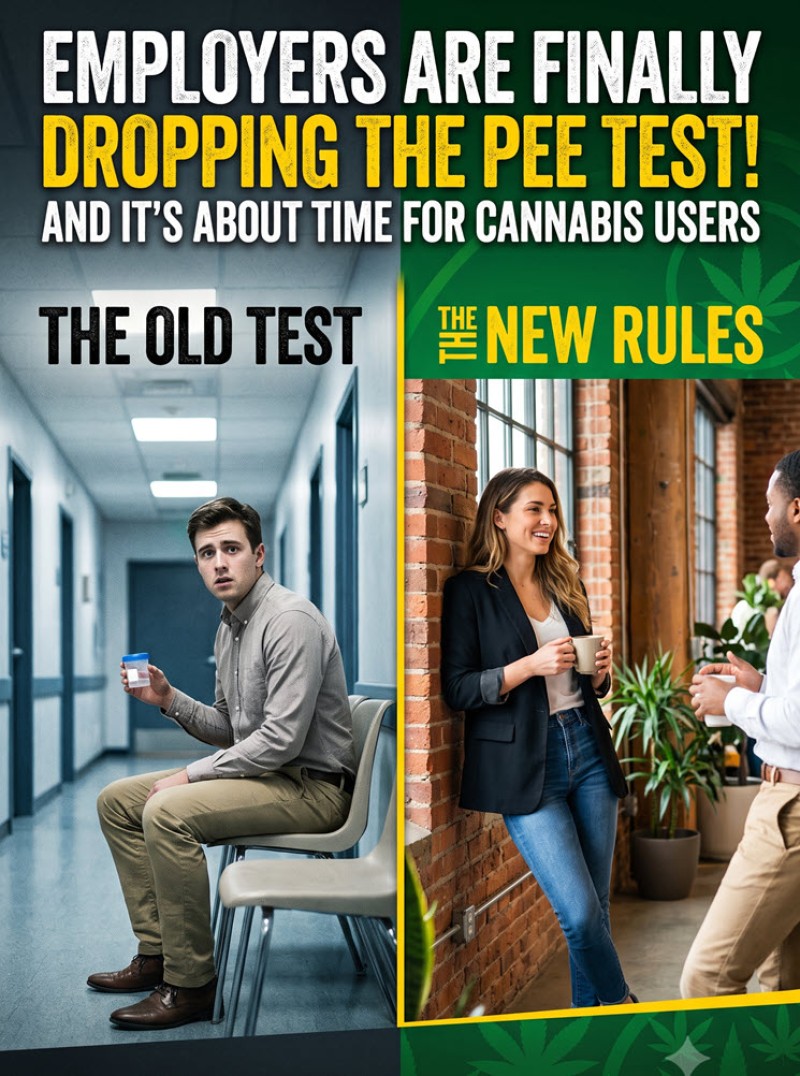
There’s a specific kind of American ritual that’s always struck me as bizarre when you actually think about it: showing up for a job interview, getting the offer, and then being handed a plastic cup and directed to a bathroom so a stranger can verify what you did with your own body on your own time, weeks ago, in your own home. We’ve normalized it so thoroughly that it barely registers as strange. It is strange. And it looks like a meaningful chunk of American employers have finally noticed.
The Numbers
A recent survey of nearly 1,000 employers, reported by the Wall Street Journal and covered by NORML, found that about half no longer screen job applicants for cannabis before hiring. The reason employers gave most often wasn’t a philosophical awakening about bodily autonomy — it was simpler and more honest than that: they wanted a bigger applicant pool. Turns out that when you disqualify a huge swath of otherwise-qualified candidates over something with zero bearing on job performance, you shrink your own hiring options. Who knew.
NORML’s Deputy Director Paul Armentano called pre-hire cannabis screening a holdover from a bygone era, and he’s not wrong. These policies are invasive, they’re discriminatory in effect if not always in intent, and they don’t actually make anyone’s workplace safer. They just punish people for lifestyle choices made entirely outside of work hours. Armentano pointed to research showing that off-hours cannabis consumers perform no differently than their coworkers — plenty of whom drink alcohol on their own time without anyone testing their liver enzymes before extending a job offer — and that cannabis use doesn’t correlate with increased workplace safety risk.
Why Urine Tests Were Always a Scam
Here’s the part that should make anyone paying attention genuinely angry: standard urinalysis, the dominant workplace testing method, doesn’t measure impairment. It measures the presence of carboxy-THC, an inert metabolite that has nothing to do with whether you’re high right now. That metabolite is fat-soluble, which means it can sit in your system and show up on a test for days, weeks, or — for regular consumers — months after the last time THC actually did anything to your brain. Meanwhile, the acute effects of cannabis wear off within hours, and studies on next-day cognitive performance show no measurable difference between cannabis consumers and controls.
So for decades, the entire architecture of workplace cannabis testing has been built on a metric that can’t distinguish between “smoked a joint on the way to the interview” and “consumed cannabis for chronic pain seven weekends ago and hasn’t touched it since.” It was never actually testing for impairment. It was testing for whether you’d ever touched the plant, full stop, regardless of legality in your state or relevance to your job. That’s not workplace safety. That’s a loyalty oath dressed up in a lab coat.
A handful of jurisdictions have caught up to this reality faster than the rest of the country. The District of Columbia, California, Connecticut, Minnesota, Montana, New Jersey, New York, and Rhode Island have all passed laws limiting employers’ ability to fire or refuse to hire someone based solely on a positive THC metabolite test, when that person isn’t actually impaired on the job. NORML has been pushing performance-based alternatives — tools like DRUID or Predictive Safety’s AlertMeter, which test actual cognitive and motor function in the moment rather than digging through your urine for chemical breadcrumbs of your personal life. That’s the right instrument for the actual question employers claim to care about: can this person do the job safely, right now. Not: did this person ever, at any point, use a substance that’s legal in most of the country.
Whose Business Is It, Anyway
I want to zoom out from the legal mechanics for a second, because I think the underlying question is simpler than the policy debate makes it sound. If what you do at your own house, on your own time, doesn’t affect your ability to do your job, why does your employer get a vote on it?
An employer isn’t your parent. They’re not your probation officer. They’re a party you’ve entered into a transactional agreement with: you provide labor and output, they provide compensation. That’s the whole contract. The moment an employer starts dictating what you can put in your body during the hours you don’t belong to them, they’ve stepped outside that contract and into something closer to guardianship — and nobody signed up to be an adult ward of their employer.
Now, I’ll draw a real distinction here, because I don’t think this argument survives contact with every profession unchanged. There are jobs where the margin for error is thin enough that impairment risk genuinely can’t be tolerated on the clock — surgeons mid-operation, airline pilots, heavy machinery operators, anyone whose momentary lapse could kill someone else. For those roles, real-time fitness-for-duty testing makes sense, and frankly should be more rigorous, not less — testing what matters (current impairment) instead of what doesn’t (whether THC metabolites are floating around from three weeks ago). But for the overwhelming majority of American jobs — office work, retail, food service, remote knowledge work — the idea that an employer needs veto power over your off-hours cannabis use is a relic that never had a coherent safety justification. It had a moral one, dressed up as a safety one, and those are very different things.
Prohibition’s Zombie Limb
This is worth naming directly: the entire drug-testing industry, as a mass-market institution embedded in American hiring, is a downstream artifact of prohibition. It didn’t emerge because employers ran controlled studies proving off-duty cannabis use tanked productivity. It emerged because cannabis was federally illegal, culturally stigmatized, and testing companies had a product to sell to HR departments that wanted to look tough on drugs without doing any actual safety analysis. Once that infrastructure existed — the labs, the compliance consultants, the insurance incentives — it kept running on inertia long after the cultural and legal ground shifted underneath it.
That’s the pattern with prohibition generally: it doesn’t just criminalize a substance, it builds entire industries around policing that criminalization, and those industries develop their own institutional self-interest in prohibition’s survival — which is exactly why the drug-testing industry is one of the parties currently suing to block federal rescheduling. Half of American employers quietly walking away from pre-hire screening isn’t a minor HR trend. It’s a crack in that infrastructure, driven by employers themselves realizing the policy costs them good hires for no measurable safety benefit.
The Sticky Bottom Line
Nobody needs to know what you do at your own house on a Saturday night, provided it doesn’t follow you through the office door on Monday impaired. The employers dropping pre-hire cannabis screening aren’t taking some bold moral stand — they’re just doing math, the same way the cannabis voters in my last piece did math. It turns out that punishing qualified candidates over an outdated, scientifically hollow test is bad for business. I’d like to think that’s a permanent shift rather than a labor-market convenience that reverses the moment hiring gets easier for employers again. Either way, for the millions of people who’ll get a job offer this year without having to pee in a cup first, I’ll take the win.
PASSING A CANNABIS DRUG TEST, READ ON...