

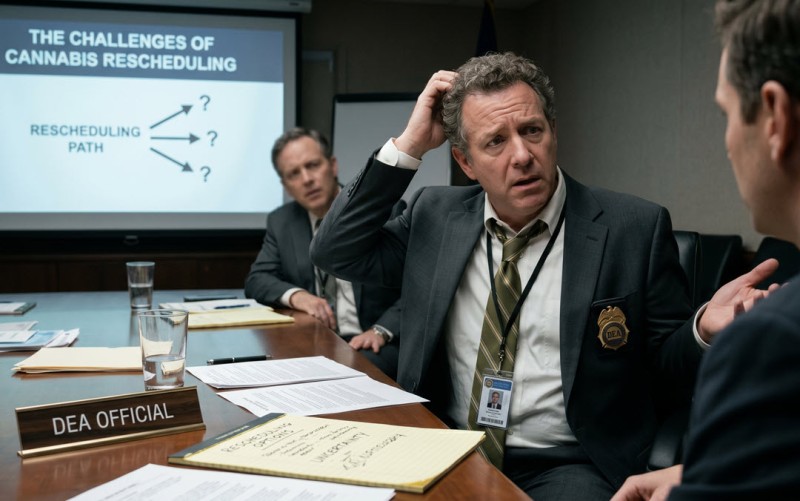
Even the DEA Is Admitting the Scheduling System Is Broken
There's a specific kind of credibility that only comes from the inside. When cannabis advocates say the Controlled Substances Act is a broken instrument of policy failure, it gets filed under "predictable." When a former senior DEA official writes the same thing in a peer-reviewed paper published in Science, it lands differently.
Matthew Lawrence worked in the office of the DEA deputy administrator from 2022 to 2023. He is now at Emory University School of Law. He just coauthored a paper with Columbia Law School's David Pozen arguing that the US drug scheduling system has "fundamental flaws," has done "immense damage," and that the problem isn't where specific drugs are placed within the system — the problem is the system itself. [1]
Read that again slowly. Not "marijuana should be rescheduled." The scheduling framework needs to be replaced.
This is the DEA, from the inside, saying what drug reform advocates have been saying for fifty years. The difference is that this time, it's in Science.
The Hobson's Choice Nobody Talks About
The paper's central insight is one that exposes the structural stupidity baked into the CSA from its beginning. Lawrence and Pozen argue that the scheduling system traps regulators in a binary: overcriminalize drugs through prohibitions that predictably fail, or overcommercialize them through hands-off approaches that leave users exposed to corporate exploitation. [1]
There is no middle lane in the current framework. You're either making someone a criminal or handing the product to industry with minimal guardrails. Cannabis legalization in several states has demonstrated both failure modes simultaneously — brutal criminalization at the federal level running parallel to loosely regulated commercial markets at the state level, with almost no coherent policy connecting them.
The paper calls for what Lawrence and Pozen describe as "capitalism controls" — the regulatory tools that the CSA currently doesn't even contemplate. Advertising restrictions. Potency limits. Pricing policies. Constraints on industry lobbying. Restrictions on additives designed to increase dependence. [1]
These are the tools used to manage tobacco and alcohol, imperfectly but at least acknowledging the actual nature of the problem. None of them exist in the CSA. The Act was designed to criminalize, not regulate, and it shows in every policy outcome the US has produced under it.
The Research Problem Nobody Wanted to Solve
One of the more quietly damning observations in the paper is the feedback loop the scheduling system creates around research. Schedule I classification makes scientific investigation of a substance extraordinarily difficult — restricted access, additional oversight, limited funding pathways. The catch is that the primary justification for Schedule I status is lack of sufficient research demonstrating medical benefit. [1]
The system restricts the research that would justify reclassification, then uses the absence of that research to justify maintaining the restriction.
This is not an oversight. It is a self-perpetuating architecture. Cannabis has been locked in this loop for over fifty years. The endocannabinoid system — the network of receptors throughout the human body that cannabis directly engages — wasn't fully characterized until the 1990s, in part because the primary plant that illuminated it was Schedule I. We spent decades not understanding our own biology because the research was structurally suppressed.
Lawrence and Pozen also flag something reform advocates have consistently raised but that rarely makes it into official policy discussions: the current framework only permits regulators to consider medical benefits when making scheduling decisions. Recreational value, religious use, social benefits, creative impact, the policy benefits of reduced incarceration — none of these factors are legally permissible inputs into a scheduling determination. [1]
Which means that no matter how competently the DEA implements the existing statute, the authors argue, it structurally cannot reach a sensible outcome for a widely used substance like cannabis. The ceiling is built into the floor.
What Replacing the Framework Actually Looks Like
The paper doesn't stop at diagnosis. Lawrence and Pozen propose a new structure with two additional scheduling categories sitting alongside the existing ones.
A "harm reduction schedule" for drugs like heroin and fentanyl — substances where the policy priority should be reducing death and disease, not criminal prosecution. And a "managed market access schedule" where cannabis and psilocybin could be placed, with actual regulatory teeth: potency limits, marketing restrictions, controls on coordinated industry lobbying, restrictions on additives. [1]
This second category is what serious cannabis policy should look like and has never looked like in the US. Not blanket prohibition. Not a commercial free-for-all. Regulated market access with the kind of capitalism controls that acknowledge both the legitimate uses of the substance and the real risks of unchecked commercial incentives.
The paper also suggests that states which have already built regulatory regimes meeting or exceeding federal standards should have those businesses qualify automatically for federal legal status. [1] It's an acknowledgment that the laboratories already exist — Colorado, California, Oregon, and others have been running imperfect but instructive regulatory experiments for over a decade. Federal policy could learn from them instead of continuing to pretend they don't exist.
Why This Matters More Than the Rescheduling Debate
The current political conversation around cannabis is almost entirely consumed by the question of whether marijuana moves from Schedule I to Schedule III. That debate has dragged on through the Biden administration, survived into Trump's second term via executive order, and remains unresolved.
Lawrence and Pozen's paper reframes the entire conversation. Schedule III versus Schedule I is a rearrangement of deck chairs on a ship with a structural problem in the hull. As they write directly: "The policy that must change to bring rationality to the regulation of marijuana, along with many other controlled substances, is not the schedule in which marijuana is placed but rather the scheduling system itself." [1]
AOC made a similar point in a recent congressional hearing, arguing that placing cannabis and LSD in the most restrictive category runs counter to the evidence of their medical potential and has produced criminal penalties that demonstrably haven't prevented harm. [1] It's a bipartisan recognition in the sense that the critique now comes from reform advocates, sitting members of Congress, and former DEA officials simultaneously.
The disagreement is no longer whether the CSA is broken. The disagreement is what comes next.
The Obvious Question
If a former DEA insider, a Columbia Law professor, a sitting congresswoman, and decades of empirical evidence from state-level legalization all point to the same structural failure — what exactly is the federal government waiting for?
The answer, as it's been throughout the history of cannabis prohibition, is not scientific. The opioid crisis was a root cause of exactly this framework, Lawrence and Pozen note. The prison population boom was a root cause. The ongoing cannabis mess is a root cause. [1] These are not side effects of bad luck — they are predictable outputs of a system designed around criminal prohibition rather than evidence-based regulation.
The Controlled Substances Act was signed in 1970. It was built on the political priorities of 1970. The country it was designed to manage no longer exists. The science it ignored has since confirmed what it got wrong. The communities it damaged are still paying the cost.
A former DEA official just published a paper in one of the most respected scientific journals on earth saying the system does immense damage and needs to be replaced. At some point, the question stops being whether that's true and starts being who benefits from pretending otherwise.
Reginald Reefer writes about cannabis culture, policy, and the systems that keep failing in the same directions.
Citations: [1] Marijuana Moment — "US System For Classifying Marijuana And Other Drugs Does 'Immense Damage,' Former DEA Senior Official Says," April 7, 2026. https://www.marijuanamoment.net/us-system-for-classifying-marijuana-and-other-drugs-does-immense-damage-former-dea-senior-official-says/ Original paper: Lawrence & Pozen, Science, March 2026. https://www.science.org/doi/10.1126/science.aec5633
THE DEA ON RESCHEDULING, READ ON...