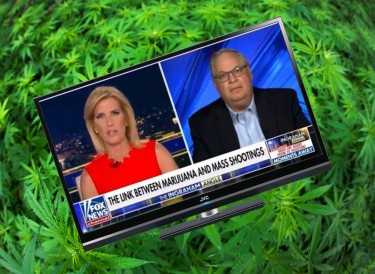


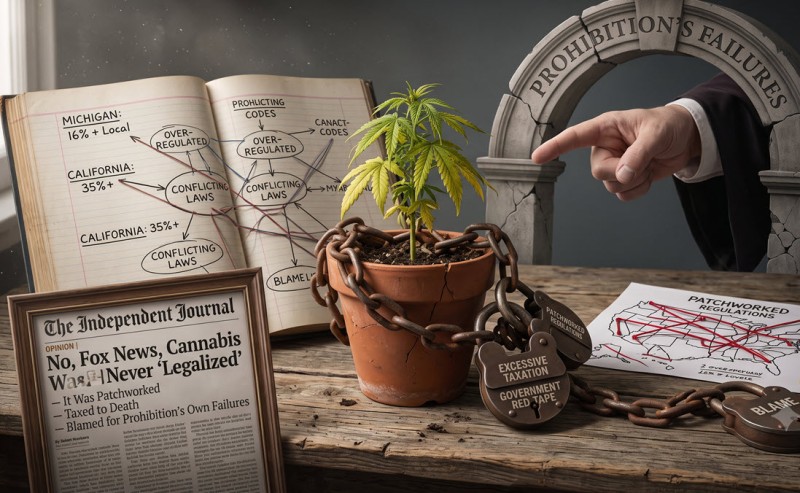
Fox News opinion ran a piece recently from Scott Chipman, vice president of Americans Against Legalizing Marijuana, arguing that legal cannabis "didn't kill the black market, it created a marketing department for it." The evidence: California's legal cannabis sales have declined roughly 11% from 2023 to 2025, illegal dealers are still active, and by some estimates over 60% of the marijuana consumed in California still comes from outside the licensed system. His conclusion: legalization normalized use, expanded demand, and that demand simply flows to the black market anyway. So what, he asks, has legalization actually accomplished?
It's a well-built argument if you only look at California in isolation. It falls apart the moment you zoom out, and I want to walk through exactly why.
Cannabis Has Never Actually Been "Legalized"
Here's the sleight of hand at the center of this whole genre of article: it treats "legalization" as a single, completed national event, then measures its failure against an outcome — total elimination of an illicit market — that no other legal industry has ever achieved either. Alcohol is legal nationwide and still has a black market (moonshine, bootlegged cigarettes, cross-border smuggling for tax arbitrage). Pharmaceuticals are legal and still get diverted. The standard being applied to cannabis is a standard applied to nothing else.
But the deeper problem is geographic. Cannabis in America is legal in 24 states for adult use, legal for medical use in 40, and fully illegal in a shrinking but stubborn handful of others — with federal law still classifying it as Schedule I everywhere. That's not legalization. That's a patchwork with a tax rate stapled on top of it. California stacks cultivation excise taxes, state cannabis excise tax, and local municipal taxes into an effective burden that industry estimates have put as high as 70% at the retail counter in some jurisdictions. When your "legal" product costs nearly double what the guy down the street charges for the same flower with no ID check and no tax, of course the illicit market survives. You didn't out-compete the black market. You built a legal product deliberately priced to lose to it, then acted surprised when it lost.
And zoom out past California's border. Drive from Oregon into Idaho, or from Nevada into Utah, and you cross from a regulated retail environment into a jurisdiction where the same plant is a felony. That discontinuity is a subsidy for interstate trafficking — it creates arbitrage, funnels product from lower-cost legal-grow states into prohibition states, and keeps illicit supply chains healthy on both sides of the line. You cannot blame "legalization" for a black market that legalization was never allowed to fully replace, because it was never given the geographic runway to do so.
The "Normalization" Argument Has the History Backwards
Chipman's piece leans on the idea that legal marijuana industries "normalized" use and "introduced new customers to the drug." This framing requires forgetting that cannabis was already the most widely used illegal drug in America before a single state legalized it. It didn't need a marketing department to become popular — it was popular under total prohibition, generation after generation, going back to a time when hemp and cannabis grew about as unremarkably as tomatoes in American gardens, before the racially charged moral panic that produced the Marihuana Tax Act of 1937 rewrote the plant's reputation. Legalization didn't invent demand. It responded to demand that prohibition spent eighty years failing to suppress.
Fox's Own Newsroom Undercuts the Op-Ed
Here's where the hypocrisy gets almost too easy to point out. The same week this op-ed ran, Fox News Digital published a separate piece — and produced a video — with the headline "Alarming new study shows daily marijuana use passes alcohol, cigarettes." The data comes from SAMHSA's 2025 National Survey on Drug Use and Health: roughly 21.4 million Americans now use cannabis daily or near-daily, edging past the 19.9 million daily cigarette smokers and 17.2 million daily drinkers. Fox's own medical analyst calls this "very disturbing."
Disturbing compared to what, exactly? Alcohol kills roughly 178,000 Americans a year according to CDC estimates. Tobacco kills nearly 480,000. Marijuana has never produced a recorded fatal overdose in the toxicological sense — no lethal dose has ever been established, because there isn't one. Yet Fox runs "ALARMING" in the headline for the plant that has killed approximately nobody, while its other coverage frames the industries responsible for over half a million annual American deaths as background noise. That's not public health journalism. That's picking a favorite vice and defending its turf.
What Legalization Has Actually Given Us
None of this means legal cannabis has been a flawless policy — it hasn't, and I'm not going to pretend otherwise. High-potency products, underage access through unregulated hemp loopholes, and drugged-driving detection are real, unresolved problems. But weigh those against what regulated markets have actually delivered:
-
Billions in new tax revenue redirected from cartels to public budgets — Maryland alone generated over $1 billion in legal sales in its first year of adult-use retail
-
Independently lab-tested products, screened for pesticides, mold, and heavy metals, replacing an entirely unregulated supply
-
Hundreds of thousands of legal jobs in cultivation, retail, testing, and ancillary industries
-
Expungement and record-clearing programs unwinding decades of nonviolent drug convictions
-
Medical access for patients using cannabis to manage pain, seizure disorders, and, for some, as an off-ramp from harder substances and opioids
-
A shrinking pipeline of nonviolent people funneled into the criminal justice system for simple possession
Weigh that against the actual, measurable body count of the alternative. Prohibition doesn't just fail to eliminate a drug market — it makes that market more dangerous by mathematical necessity. Economists and drug policy researchers call it the "iron law of prohibition": when the legal risk of moving a drug is constant regardless of potency, traffickers rationally shift toward the most compact, most potent product they can smuggle. It's why Prohibition-era bootleggers pushed hard liquor instead of beer. It's exactly why fentanyl — fifty to a hundred times stronger than heroin, with a lethal dose measured in milligrams — replaced heroin as the backbone of the illicit opioid market once enforcement intensified. Synthetic opioids are now involved in roughly two-thirds of American overdose deaths. That is prohibition's actual legacy, and it dwarfs anything happening in California's legal cannabis market.
Read the Fine Print on Who's Talking
Scott Chipman isn't a neutral public health voice — he's the vice president of an organization whose entire mission is preventing legalization, full stop. That doesn't make his data wrong, but it means the framing deserves scrutiny, not a free pass. This fight is playing out publicly right now, including prohibition advocates like Kevin Sabet sparring with legalization-side voices on social media in real time. Pay attention to who's funding the "alarming study" headlines and ask what policy outcome they're actually rooting for.
The Sticky Bottom Line
Cannabis has never been legalized in America — it's been legalized in patches, taxed into black-market-friendly price points, and left illegal one state line over. Blaming "legalization" for a black market that half-legalization guaranteed is like blaming a fire department for a fire it was never dispatched to. The real comparison isn't legal cannabis's imperfect markets against some fantasy of a spotless one. It's legal cannabis's actual, documented track record against prohibition's: mass incarceration, zero quality control, and a fentanyl crisis that prohibition's own logic made inevitable. That's not a close call.
FOX NEWS ON CANNABIS, READ ON...