
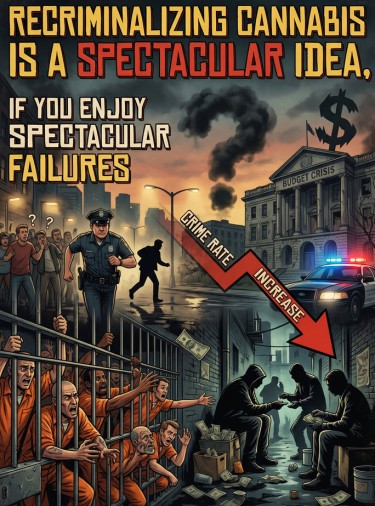
Tyler Cowen published a piece in The Free Press recently asking whether we should recriminalize marijuana. He landed, sensibly, against it. The comment section of his blog filled up with the usual range: suburban homeowners insisting legalization ruined New York City, economists arguing about social norms, at least one guy who seems to think the solution to homelessness is making pot illegal again. The full spectrum of American cannabis discourse, in other words: heated, occasionally intelligent, and mostly beside the actual point.
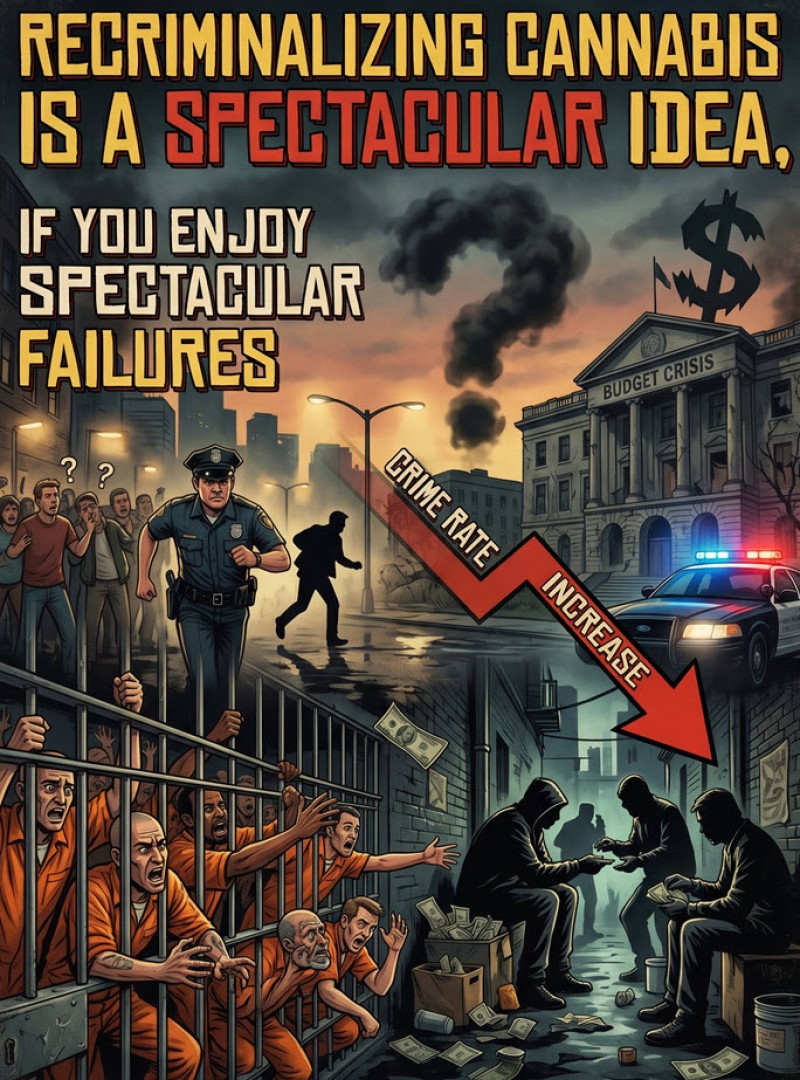
The question of whether to recriminalize cannabis isn't really a policy debate at this point. It's a credibility test. And every institution that would need to execute a recriminalization, every agency that would enforce it, every legislature that would pass it, fails that test so badly that the suggestion should trigger immediate suspicion about the motives of whoever's making it.
The Garden of Eden Problem
Prohibition has one perfect track record: failing. Not sometimes, not in poorly implemented cases. Always. The examples span enough centuries and enough substances that at some point you have to stop calling them data points and start calling them a law of nature. Alcohol prohibition in the United States ran thirteen years and produced the modern organized crime infrastructure. Opium prohibition in 19th century China, enforced with the death penalty, did essentially nothing to control use and handed criminal organizations an enormous economic engine. God himself tried prohibition in the Garden of Eden with a single rule about a single tree, with full omniscient enforcement capacity, and couldn't make it stick. That should tell us something.
Cowen makes this point indirectly when he notes that "paternalism is far less workable than in times past." He's being diplomatic. The government has no credibility on this subject. It built the opioid epidemic by approving, endorsing, and defending OxyContin while its own Drug Enforcement Administration collected royalties on the scheduling system that blocked cannabis research. It classified a plant as having no accepted medical use while synthetic THC mimetics sat in Schedule III, available by prescription. It maintained that classification through fifty years of research that consistently failed to find the apocalyptic harms the classification requires.
The argument for giving this apparatus more power over a substance it has demonstrably lied about for half a century requires a level of institutional faith that I'm not sure anyone can justify with a straight face. One commenter on Cowen's post put it with uncomfortable accuracy: advocating for recriminalization after everything we've watched these agencies do is something like the battered spouse apologizing because her face got in the way of the fist.
The Legitimate Complaints
The frustrations driving the recriminalization conversation are real, and dismissing them wholesale is dishonest. Several commenters in Cowen's thread raised genuine observations. Walking through lower Manhattan and smelling cannabis every thirty feet is a meaningful quality of life issue for people who didn't choose to be around it. Stores selling cannabis from unverified sources in the same density as coffee shops in Amsterdam is a regulatory failure, not a legalization success. THC concentrations that are four to five times higher than flower, delivered through vapes with minimal labeling, represent a product safety gap that a functioning regulatory system would have closed.
One commenter with obvious first-hand experience working with homeless populations made a detailed case that cannabis, while not the cause of homelessness, compounds the barriers to exiting it. He's describing something real. A person managing a cannabis habit that costs two hundred dollars a month has a harder time saving rent than one who doesn't. That's arithmetic, not moral panic.
Another commenter noted that legalization in New York was implemented as a social justice program first, a functional cannabis market second, and the sequencing created an opening for unlicensed operators that the legal market still hasn't closed. That's an accurate description of a policy failure.
These are all real. None of them argue for recriminalization. They argue for better implementation of legalization.
The Patchwork Problem
Here's the thing nobody in this debate will say clearly: legal cannabis has never actually been implemented. What exists is a patchwork of state-level experiments, each one hamstrung by federal prohibition, each one generating a black market because the legal market is taxed and regulated while the illegal market isn't, each one unable to access standard banking services because federal law treats cannabis businesses as criminal enterprises. Researchers can't study it properly because the DEA still classifies it Schedule I. Companies can't operate across state lines. Consumers in legal states are still arrested for violating federal law on federal property.
The debate keeps treating this patchwork as legalization and then judging legalization based on the patchwork's outcomes. That's like studying whether car safety regulations work by examining roads where half the cars have no seatbelt requirement, the other half have state-mandated seatbelts but no enforcement, and the federal government still hasn't decided whether seatbelts are real.
Cannabis legalization in the United States has been captured by competing lobby money. Pharmaceutical interests want scheduling that lets them patent derivatives while keeping the plant illegal. Alcohol distributors want to limit competition. Cannabis companies at the state level want regulations that lock out new entrants. Anti-drug organizations get federal grants tied to prohibition messaging. Every dollar in this fight distorts the policy conversation, and the result is that an honest assessment of what legalization actually does, good and bad, is almost impossible to get from anyone with a financial stake in the answer.
You Can't Arrest Your Way Out of a Drug Problem
The fentanyl crisis should have buried the recriminalization argument on purely empirical grounds. Fentanyl is Schedule I. Its sale and possession carry some of the harshest criminal penalties in federal law. You can buy it in prison. The criminalization of fentanyl has not controlled its spread, its potency, its availability, or its death toll. Over one hundred thousand Americans died from drug overdoses in 2023, the vast majority involving illicit opioids, all of them illegal. The prison population for drug offenses has nearly tripled since 1985. The drugs got cheaper, stronger, and more available.
The argument that making cannabis illegal again would improve social outcomes requires you to believe that the enforcement mechanism producing those fentanyl results would somehow generate different results for cannabis. You'd need to explain why the same DEA, the same court system, the same prison infrastructure, the same police departments that watched the opioid epidemic grow from a pharmaceutical marketing campaign into a national crisis would handle cannabis recriminalization more competently. That explanation doesn't exist.
The Conversation We're Not Having
The real problem isn't legalization versus criminalization. It's that drug policy in the United States has never been built on honest premises. It was built on Harry Anslinger's racism, pharmaceutical industry lobbying, Nixon's desire to criminalize anti-war protesters, and fifty years of institutional momentum that none of the relevant agencies have any interest in disrupting.
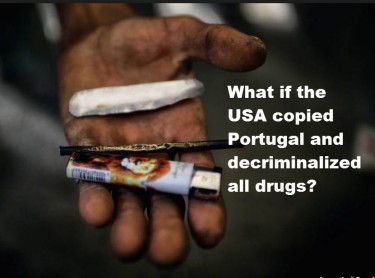
What we need is decentralized, unrestricted research on all drugs, including cannabis, conducted by institutions that aren't funded by entities with a financial stake in the conclusions. We need frameworks that treat drug use as a public health question rather than a criminal one, frameworks built by people who've read the Portuguese decriminalization data, the Swiss heroin-assisted treatment outcomes, and the Canadian legalization experience without cherry-picking the results that confirm their prior position.
We need to talk honestly about what cannabis does well and where it creates problems, without that conversation being controlled by prohibitionists who need it to be a catastrophe or industry advocates who need it to be a miracle. Neither is accurate. It's a complex plant with a complex pharmacology and a complex set of social effects that a complex society needs to manage thoughtfully, which requires clarity, not more noise from lobbies on both sides.
Cowen closes his piece with an admission: "If you have a better solution, I would love to hear it." That's the honest position of an honest analyst. The answer isn't recriminalization. The answer is doing legalization correctly this time, with federal descheduling that allows real research, real banking access, real interstate commerce, and real regulatory coherence. And with an honest acknowledgment that people consume drugs, that they have always consumed drugs, and that the project of forcing them to stop through criminal enforcement has never once produced the outcomes its architects promised.
Give people a framework that treats them like adults. Give researchers the access they've been denied for fifty years. Give the conversation the honesty it has never had. See what happens. It can't do worse than what we've already tried.
---
Sources: Tyler Cowen, 'Should We Recriminalize Marijuana?' The Free Press via Marginal Revolution (June 2026); DEA drug scheduling historical record; Portugal decriminalization outcomes (Cato Institute, 2009); ONDCP drug overdose statistics 2023; Nixon aide John Ehrlichman interview, Harper's Magazine (2016).
DECRIMINALIZE ALL DRUGS? READ ON..