
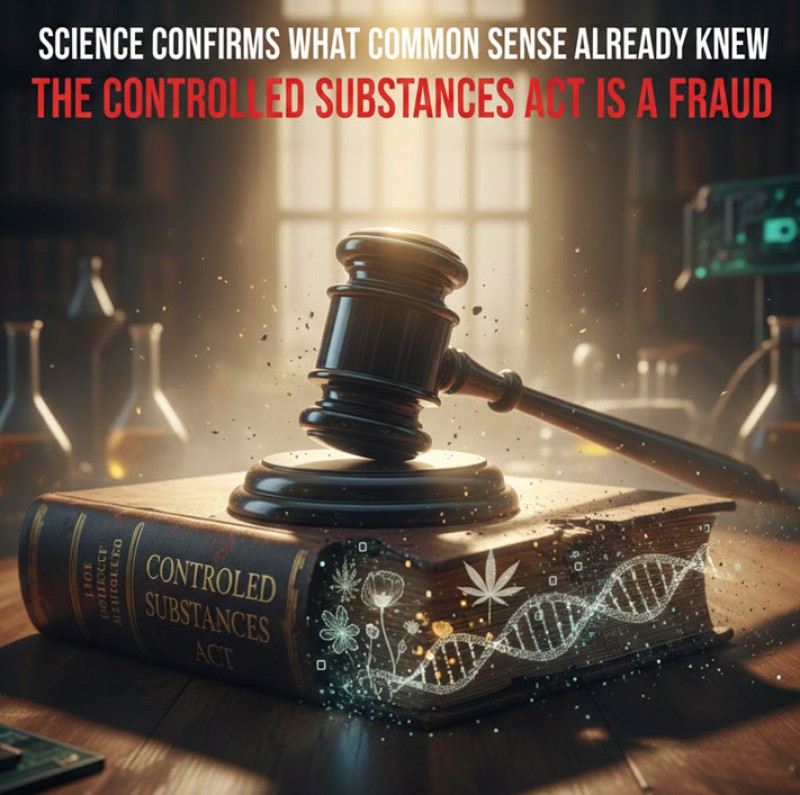
A new study published in Clinical Toxicology has concluded something that anyone with basic reasoning skills figured out decades ago: marijuana's restrictive federal classification isn't supported by science.
I know, I know. Groundbreaking research right there. Next they'll publish a study confirming that water is wet and the sky appears blue.
But sarcasm aside, this matters. Because now we have scientific confirmation—published in a peer-reviewed journal—of what rational people have been screaming into the void for 54 years: the Controlled Substances Act is not based on science. It's based on politics, racism, corporate protection, and authoritarian control.
The study examined cannabis's Schedule I classification under the CSA—reserved for substances with "high potential for abuse," "no currently accepted medical use," and "lack of accepted safety for use under medical supervision." The researchers concluded that cannabis doesn't meet these criteria. At all.
Cannabis has accepted medical uses. It has relatively low abuse potential. It can be used safely under medical supervision.
Schedule I classification is scientifically unjustifiable. Which, again, anyone who's been paying attention already knew. But now it's official.
And if cannabis doesn't belong in Schedule I despite being relatively safe and medically beneficial, then what the hell are LSD, psilocybin, and mescaline doing there?
Let's talk about the elephant in the room: The entire Controlled Substances Act is a fraudulent document masquerading as science-based policy.
Schedule I: Where Science Goes to Die
Let's examine what Schedule I actually contains and compare it to the legal definition's requirements:
Schedule I Definition:
-
High potential for abuse
-
No currently accepted medical use in treatment in the United States
-
Lack of accepted safety for use under medical supervision
Schedule I Substances:
-
Cannabis
-
LSD
-
Mescaline
-
MDMA
-
DMT
-
Ibogaine
Now let's look at the actual science:
Cannabis
Medical uses: Pain management, PTSD, epilepsy, nausea, appetite stimulation, inflammation, anxiety, sleep disorders, glaucoma—the list goes on.
Abuse potential: Lower than alcohol, tobacco, and many prescription medications. Approximately 9% dependency rate.
Safety profile: No lethal dose. Impossible to fatally overdose. Safer than aspirin by multiple metrics.
Schedule I justification: None. Zero. This is a joke.
Psilocybin
Medical uses: Treatment-resistant depression, end-of-life anxiety, PTSD, addiction treatment (alcohol, tobacco, opioids), cluster headaches, OCD.
Abuse potential: Extremely low. The experience itself creates natural intervals between use. Tolerance develops rapidly, making frequent use ineffective and undesirable.
Safety profile: Physiologically very safe. No known lethal dose. Primary risks are psychological (bad trips) which are mitigated by proper set and setting.
Recent research: Johns Hopkins, Imperial College London, MAPS—multiple institutions conducting FDA-approved trials showing remarkable efficacy. Some of the most promising mental health research in decades.
Schedule I justification: Nonexistent.
LSD
Medical uses: Similar to psilocybin—PTSD, depression, anxiety, addiction treatment, end-of-life care, cluster headaches. Microdosing shows promise for creativity and focus.
Abuse potential: Very low. Like psilocybin, tolerance develops quickly. The intensity of the experience naturally limits frequent use. Any psychonaut will tell you—you don't casually take LSD every day. The experience demands respect and integration time.
Safety profile: Physiologically safe. No lethal dose (though psychological risks exist with improper use).
Schedule I justification: "Because the CIA used it in MKUltra and Timothy Leary scared Richard Nixon" is not scientific justification.
Mescaline
Medical uses: Depression, PTSD, addiction treatment, spiritual and psychological integration. Used ceremonially by indigenous cultures for thousands of years.
Abuse potential: Low. Long duration (12+ hours) and intensity create natural spacing between uses.
Safety profile: Generally safe physiologically, though some contraindications exist.
Schedule I justification: Indigenous people have been using it safely for millennia, but sure, let's make it illegal because... reasons.
MDMA
Medical uses: PTSD treatment (currently in Phase 3 FDA trials with remarkable success rates), couples therapy, end-of-life anxiety, social anxiety.
Abuse potential: Moderate, but lower than alcohol or many prescription medications. The intense experience and neurotransmitter depletion naturally limit frequent use.
Safety profile: Relatively safe in pure form with proper dosing. Most MDMA-related deaths involve adulteration, excessive doses, or dehydration—problems created by prohibition.
Schedule I justification: It was popular at raves in the 1980s, therefore it must be as dangerous as heroin?
The Pattern Is Clear: Schedule I Is Political, Not Scientific
Look at what these substances have in common:
1. They can't be easily monetized by pharmaceutical companies because many occur naturally or are simple to synthesize.
2. They create experiences that challenge established narratives about consciousness, identity, and societal structures.
3. They were associated with counterculture movements that challenged authority in the 1960s-70s.
4. They show remarkable medical potential that threatens pharmaceutical profit models based on chronic medication.
Now look at what they DON'T have in common:
1. High abuse potential (most have very low abuse rates)
2. Lack of medical use (extensive evidence of medical benefits)
3. Inability to be used safely (generally safe when used properly)
The Schedule I classification is a lie. A deliberate, politically motivated lie that has nothing to do with protecting public health and everything to do with protecting corporate profits and social control.
Why These Drugs Are Really Illegal
Let's be honest about what's happening here. The reasons these substances remain Schedule I have nothing to do with danger and everything to do with control and profit.
Reason #1: Pharmaceutical Control
Pharma can't monetize what you can grow in your backyard or synthesize in a basic lab.
Psilocybin mushrooms? Grow naturally. You can cultivate them at home with minimal equipment.
Mescaline? Peyote and San Pedro cacti. Again, natural plants.
Cannabis? A weed that grows almost anywhere.
Even LSD and MDMA, while requiring synthesis, are relatively simple to produce compared to modern pharmaceuticals.
Compare this to pharmaceutical business models:
-
Antidepressants: Take daily for years. Patent-protected. Profitable.
-
Psilocybin therapy: Maybe 2-3 sessions total. Can grow your own. Not profitable.
-
Anxiety medications: Daily use, often for life. Patent-protected. Profitable.
-
MDMA therapy: Limited sessions with long-lasting results. Not profitable.
-
Opioid painkillers: Daily use, highly addictive, patent-protected. Extremely profitable.
-
Cannabis: Natural plant, impossible to patent, reduces opioid use. Not profitable for pharma.
The pattern is undeniable: substances that can't be monopolized must remain illegal so pharmaceutical companies can continue profiting from inferior alternatives.
Why treat depression with a few psilocybin sessions when you can sell SSRIs for decades? Why let people grow cannabis when you can sell them patented synthetic cannabinoids? Why cure PTSD with MDMA therapy when you can sell benzos and antidepressants indefinitely?
This is the Controlled Substances Act working exactly as intended—not as public health policy, but as pharmaceutical industry protection.
Reason #2: Narrative Control and Social Engineering
Here's the part that makes authoritarians nervous: psychedelics have a nasty habit of making people question everything.
When someone has a genuine psychedelic experience—particularly after age 25 when the brain is fully developed—something shifts. Not always, not for everyone, but often enough to be significant.
People report:
-
Dissolving of ego boundaries
-
Recognition of interconnectedness
-
Questioning of social conditioning
-
Reduced attachment to tribal identities
-
Increased empathy and compassion
-
Perspective on the arbitrary nature of social hierarchies
-
Direct experience of unity consciousness
Now imagine you're trying to maintain a system based on:
-
National divisions ("Us vs. Them")
-
Racial divisions (keep people fighting each other)
-
Class divisions (prevent solidarity)
-
Consumerist identity (you are what you buy)
-
Obedience to authority (don't question, just comply)
-
Perpetual warfare (need external enemies)
Psychedelics are fucking kryptonite to this system.
You can't easily convince someone who's experienced ego death and universal interconnectedness that they should hate people from another country. You can't easily sell consumerist identity to someone who's glimpsed the illusory nature of the self.
In a world where social control requires people to believe what they're told and not think for themselves, substances that encourage radical questioning and self-examination are dangerous—not to public health, but to power structures.
This isn't conspiracy theory. This is documented history. John Ehrlichman, Nixon's domestic policy advisor, explicitly stated that the War on Drugs was designed to criminalize and disrupt anti-war activists and Black communities. Timothy Leary's promotion of LSD was seen as a direct threat to social order.
Psychedelics challenge the narrative. That's their real crime.
When you need division to maintain power, unifying psychedelics are like cancer to the body of authoritarianism. When you need obedient workers and consumers, consciousness-expanding substances represent a systemic threat.
That's why they're Schedule I. Not because they're dangerous—because they're dangerous to the wrong people.
The Typical Psychedelic Experience: Not What D.A.R.E. Told You
Let's talk about actual psychedelic use patterns because the propaganda has created wildly inaccurate pictures.
The "I ate 30 acids" guy exists. Sure. There's always someone who goes overboard. But this isn't the norm—it's the exception that proves the rule.
Typical psychedelic use pattern (adults 25+):
First experience: Often transformative. Users report it as one of the most significant experiences of their lives. Not because they hallucinated cool visuals, but because of psychological insights and perspective shifts.
Frequency after first use: Varies widely, but common patterns include:
-
Once and done (the experience provided what was needed)
-
Once or twice a year (seasonal integration work)
-
Occasional use during transitions or challenges
-
Microdosing regimens (1/10th normal dose, sub-perceptual)
Why not more frequent? Because the experience is intense, demands integration time, and tolerance develops rapidly. You don't casually trip on mushrooms like you casually have a beer. The substance itself creates natural spacing.
Abuse potential reality: Very low for most psychedelics because:
-
Tolerance builds within hours
-
The experience is intense and requires mental/emotional processing
-
There's no physical addiction
-
The "high" isn't simple pleasure—it's often challenging work
-
Integration time is necessary for benefits
This is completely different from substances with high abuse potential like alcohol (drink daily, physical addiction, simple reward response) or cocaine (binge patterns, intense cravings, dopamine hijacking).
Yet psychedelics are Schedule I while alcohol is sold in grocery stores.
Make it make sense. Oh wait, you can't. Because it doesn't.
What Real Science-Based Drug Scheduling Would Look Like
If we actually based drug scheduling on scientific criteria—harm potential, addiction risk, medical benefit, safety profile—here's approximately where things would land:
Most Restrictive (High harm, high addiction, low medical benefit):
-
Methamphetamine (except pharmaceutical grade for ADHD)
-
Crack cocaine
-
Fentanyl analogs (except medical use)
-
Synthetic cannabinoids (Spice/K2)
Moderate Restriction (Moderate harm/addiction, medical benefits):
-
Alcohol (if we're being honest)
-
Tobacco (if we're being honest)
-
Prescription opioids
-
Benzodiazepines
-
Stimulants (Adderall, etc.)
Low Restriction (Low harm, low addiction, medical benefits):
-
Cannabis
-
Psilocybin
-
LSD
-
Mescaline
-
MDMA
-
Ibogaine
Minimal/No Restriction (Very low harm, medical/cultural benefits):
-
Kratom
-
Kava
-
Various ethnobotanicals
Notice something? The current CSA has it almost exactly backwards.
The safest substances with the most medical potential are the most restricted. The most dangerous substances (alcohol, tobacco) are completely legal and heavily marketed.
This isn't an accident. This is the system working as designed—protecting profits and power, not people.
The Path Forward: Abolish and Rebuild
The new study confirming that cannabis's Schedule I classification isn't scientifically supported is welcome, but insufficient.
We don't need to reschedule cannabis to Schedule III (a corporate giveaway) or Schedule II (still heavily restricted). We need to abolish the entire Controlled Substances Act and rebuild from scratch based on actual science.
Here's what that should look like:
1. Public, transparent process involving:
-
Independent scientists (not pharma-funded)
-
Medical professionals
-
Addiction specialists
-
Public health experts
-
Civil liberties advocates
-
Indigenous knowledge holders (for traditional medicines)
-
Citizens
2. Evidence-based criteria:
-
Actual abuse/addiction potential (based on data, not assumptions)
-
Documented harms (physiological and social)
-
Medical benefits (if any)
-
Safety profile
-
Cultural/historical use
3. Proportional regulation:
-
Most harmful substances: Most restriction
-
Safest substances: Least restriction
-
Medical benefits considered in classification
-
Personal use vs. distribution treated differently
4. Removal of pharmaceutical industry influence:
-
No lobbying in the process
-
No pharma-funded research considered without transparency
-
Conflicts of interest disqualifying
5. Constitutional protections:
-
Bodily autonomy recognized
-
Religious/spiritual use protected
-
Home cultivation of natural substances protected
-
Medical necessity defenses recognized
This should be a public event. Livestreamed. Open to scrutiny. Based entirely on evidence presented transparently.
Not decided by lawmakers who are bought and paid for by pharmaceutical companies. Not determined by the DEA protecting its own budget. Not influenced by prison industry lobbying or law enforcement funding.
Public. Scientific. Transparent. Democratic.
The Sticky Bottom Line: The Emperor Has No Clothes
The Controlled Substances Act is a 54-year-old fraud that has destroyed millions of lives, wasted trillions of dollars, empowered cartels, prevented medical breakthroughs, and protected pharmaceutical profits at the expense of public health.
And now we have scientific confirmation of what we've always known: it's not based on science.
Cannabis doesn't belong in Schedule I. Psilocybin doesn't belong in Schedule I. LSD doesn't belong in Schedule I. Mescaline doesn't belong in Schedule I. MDMA doesn't belong in Schedule I.
None of these substances meet the criteria for Schedule I classification.
The classifications aren't based on danger—they're based on profit protection and social control.
The study confirming this is important not because it tells us something new, but because it provides scientific ammunition for what common sense has always dictated: the system is a lie.
Now the question is: what do we do with this information?
We demand abolition of the CSA. We demand science-based policy. We demand transparent, democratic processes for drug regulation. We demand bodily autonomy and cognitive liberty as fundamental rights.
We stop pretending that a law written in 1970 by Richard Nixon—a documented racist who explicitly used drug policy as a weapon against political enemies—has any legitimacy whatsoever.
The science is in. The CSA is bullshit. Common sense is vindicated.
Now let's burn this fraudulent system to the ground and build something based on reality, compassion, and actual public health.
The emperor has no clothes. Time to stop pretending otherwise.
THE CASE TO NULLIFY THE CSA, READ ON...