
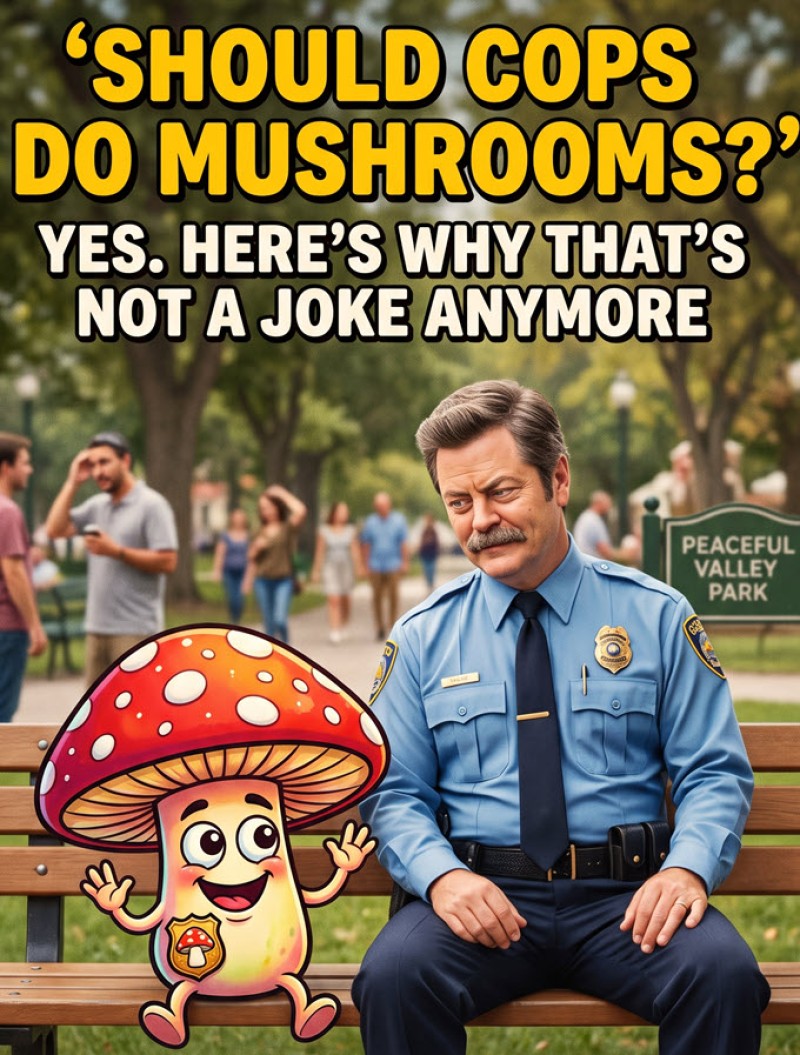
Let me answer the headline question immediately, because I don’t want to bury the lede under a pile of caveats: yes, cops should do mushrooms. So should firefighters, paramedics, prison guards, and — while we’re at it — the prisoners themselves. Not recreationally on shift, obviously. Under medical supervision, as part of a deliberate effort to treat the psychological wreckage that these jobs, and this system, leave behind. Let me explain why I think that’s not a punchline, but a policy position with real evidence behind it.
What Prompted This
A recent Stateline report picked up by Marijuana Moment lays out a wave of state-level action aimed at giving first responders access to cannabis and psychedelic-assisted therapy for PTSD. Jason Cerrano, a retired firefighter and paramedic with more than two decades of experience, put the underlying problem better than most policy papers manage: in fire service, first-responder work, or the military, trauma accumulates gradually until horrifying things start to register as normal. That’s not a metaphor. That’s a description of how chronic trauma exposure actually rewires perception.
Ohio’s Republican Governor Mike DeWine signed a law last month creating a Post-Traumatic Stress Injury Commission to review assistance applications from first responders needing treatment. Maryland went a different route, passing a law — effective this October — that protects firefighters, EMTs, paramedics, and rescue workers from employment discrimination over lawful off-duty medical cannabis use, as long as they’re not impaired on the job. Connecticut expanded a Yale University pilot program studying psilocybin-assisted therapy, opening it beyond veterans and first responders to any eligible state resident 18 or older. And Missouri lawmakers advanced a bill that would let veterans and first responders in approved research studies access psilocybin and ibogaine under medical supervision, though the legislature adjourned in May before it reached the governor’s desk.
That’s four states, four different mechanisms, one shared conclusion: the standard toolkit for treating first-responder trauma isn’t cutting it, and lawmakers across the political spectrum are willing to look somewhere else.
Why This Population Specifically
I think it’s worth being precise about why first responders, prison guards, and incarcerated people belong in the same conversation, even though their circumstances look nothing alike on the surface. What they share is chronic, repeated exposure to death, violence, and human suffering, combined with a system that treats their psychological wellbeing as an afterthought at best. Cops and firefighters run toward the worst days of other people’s lives, over and over, for a career. Prison guards spend decades inside an environment engineered around control and confinement, which is its own slow-drip trauma. And prisoners — often already carrying trauma that contributed to the behavior that got them incarcerated in the first place — get warehoused in a system explicitly built around labor extraction and control, not psychological rehabilitation. That’s not an accident of design. The Thirteenth Amendment abolished slavery “except as a punishment for crime,” a carve-out that still structures how the American penal system treats incarcerated people’s labor to this day. A system with that kind of loophole baked into its founding document was never going to prioritize anyone’s mental health as a first-order concern, and drug offenses have historically been a remarkably convenient on-ramp into that system.
None of that erases the real differences between a decorated paramedic and someone serving time. But all three populations are stuck inside institutions that generate enormous psychological damage and then offer minimal, often punitive, tools for processing it. If psychedelics and cannabis can help any of them, the moral case for withholding that help doesn’t get stronger just because the person wears a badge instead of a jumpsuit, or vice versa.
The Cop-Specific Case
Focus on police for a second, because this is where the public-safety argument gets concrete fast. Untreated PTSD in a population that’s armed, authorized to use force, and operating under chronic stress is not an abstract mental-health statistic — it’s a public-safety variable. An officer who’s accumulated years of unprocessed trauma doesn’t process the next high-stress encounter from a neutral baseline. They process it from a nervous system that’s already primed for threat detection, and that shows up downstream as excessive force, poor de-escalation judgment, and the kind of tragic split-second decisions that end up on the evening news and in wrongful-death settlements.
I don’t think that’s a controversial claim; it’s basically the working theory behind every police reform conversation about implicit bias and use-of-force training, just applied to trauma instead of bias. The system trains officers extensively on tactics and legal use-of-force standards, and comparatively little on processing the cumulative psychological toll of the job itself. Psychedelic-assisted therapy, cannabis for sleep and anxiety management, yoga, breathwork, meditation — none of these are exotic interventions anymore. They’re increasingly mainstream trauma treatments with a growing clinical evidence base, and withholding them from the population most chronically exposed to trauma on the public payroll is, at minimum, an odd policy choice.
What a Centered Cop Looks Like
Here’s the version of this I actually want to imagine: an officer who’s had the tools and the institutional support to process the worst things they’ve seen, rather than suppress them until suppression stops working. Someone who can walk into a tense encounter regulated rather than activated. Someone whose baseline nervous system state lets them read a situation accurately instead of through the lens of accumulated hypervigilance. That’s the difference between a police force — an institution defined by its capacity to compel — and something closer to what most departments claim to aspire to on their recruiting posters: protectors, embedded in and connected to the communities they serve, rather than separated from them by trauma neither side asked for.
I’m not naive about the scale of reform policing actually needs, and psychedelic therapy isn’t a substitute for accountability, better training, or structural change. But it’s a real, evidence-backed piece of the puzzle that’s been almost entirely absent from the police reform conversation, probably because “give cops mushrooms” sounds like a joke until you sit with why departments across red and blue states alike are quietly moving toward exactly that.
The Sticky Bottom Line
The people we ask to run into the worst moments of human experience, on our behalf, on a recurring basis, deserve every legitimate tool available to offload what that work costs them psychologically. That’s true whether they’re wearing a badge, a firefighter’s turnout gear, a corrections uniform, or a prison jumpsuit. Ohio, Maryland, Connecticut, and Missouri all moved on some version of this in the same year, from lawmakers who don’t agree on much else. That’s not a coincidence. That’s what it looks like when the evidence gets loud enough that politics starts to bend around it. A more regulated, less traumatized front line doesn’t just help the people doing that work — it changes what kind of interaction the rest of us get to have with them. That should make it everybody’s problem to care about.
POLICE ON CANNABIS LEGALIZATION, READ ON...