
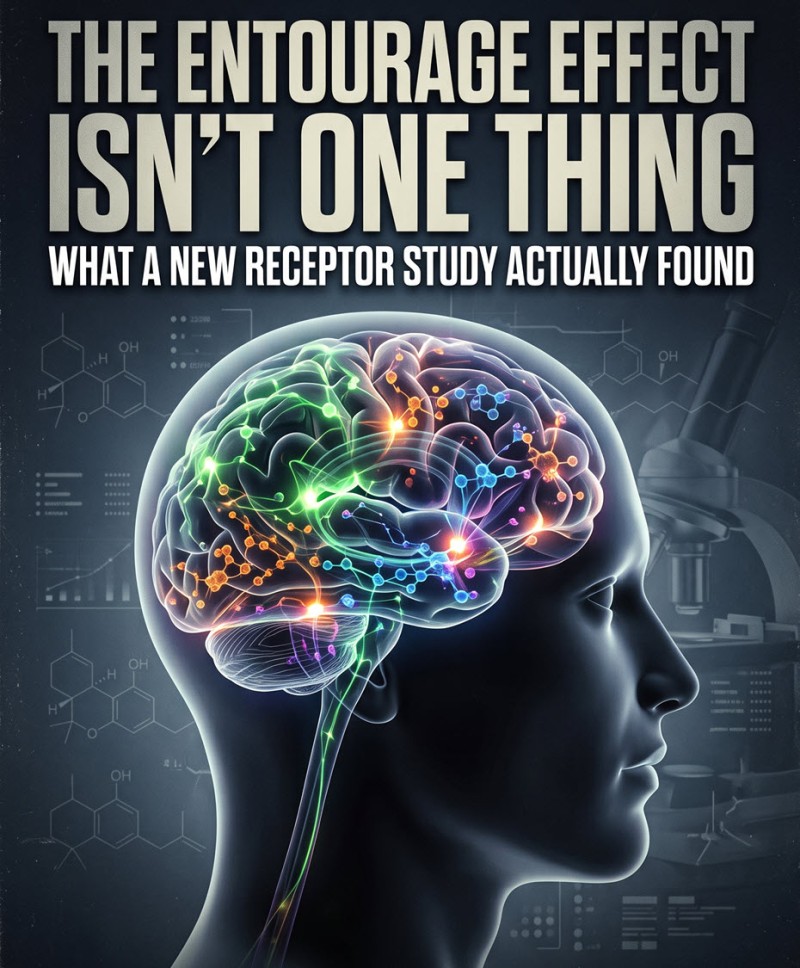
For years, the cannabis world has treated "the entourage effect" like settled science, a comforting shorthand for why whole-plant weed hits different than an isolated THC pill. Terpenes and cannabinoids work together, the story goes, adding up to more than the sum of their parts. It's a nice idea. It's also, according to a new pre-proof study headed for the journal Biochemical Pharmacology, an oversimplification that's been doing a lot of unearned work in how we talk about cannabis.
Researchers at the Open University of Israel set out to test what's actually happening at the receptor level when terpenes and THC show up together, and their findings complicate the tidy version of the entourage effect that's been circulating in dispensary marketing copy for the better part of a decade. The short version: terpenes don't uniformly boost THC's effects. What happens depends on which terpene you're talking about and which cannabinoid receptor it's interacting with.
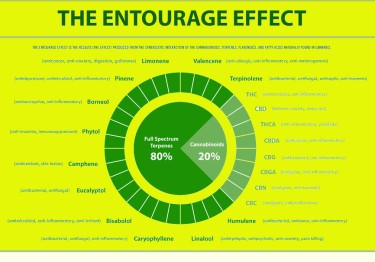
Here's where it gets specific enough to matter. The researchers found that certain terpenes, including borneol, limonene, sabinene, terpineol, alpha-pinene, and ocimene, interact synergistically with THC at CB1 receptors, the receptor type most associated with the psychoactive effects cannabis is known for. A different pair, beta-caryophyllene and linalool, showed synergistic interaction specifically at CB2 receptors, which are more tied to the body's immune and anti-inflammatory responses. Some terpene mixtures activated CB1 receptors in a dose-dependent way, meaning the effect scaled with how much terpene was present, and several of those mixtures measurably enhanced THC's response beyond what THC produced on its own.
The researchers describe cannabis terpenes as capable of acting both as partial orthosteric agonists, meaning they can bind directly to the same active site THC binds to, and as allosteric modulators, meaning they can bind elsewhere on the receptor and change how it responds to THC without occupying THC's own binding spot. That's a mechanistically different story than "terpenes make everything better," and it's a more useful one, because it means formulators could theoretically dial in specific terpene combinations to hit specific receptor behavior rather than tossing in whatever terpene profile smells good and hoping for a synergy bonus.
That's really the headline here, and it's worth sitting with rather than skimming past: the study's authors describe their results as pushing back against "overly broad" earlier interpretations of a single, generalized entourage effect, replacing that idea with what they call a terpene-specific, mechanistically grounded framework instead. In plain terms, there isn't one entourage effect. There are many small, specific interactions, some synergistic, some merely additive, each dependent on the exact molecular cast of characters in the room.
Why should you care, beyond the satisfaction of being able to correct someone at a dinner party? Because this kind of granular receptor mapping is exactly what's needed to move cannabis-based medicine out of the guess-and-check era. Right now, most "full-spectrum" or "whole-plant" products are formulated on vibes, a rough sense that more compounds equals more benefit, without much precision about which compounds are actually doing the therapeutic work. The Open University of Israel team argues their findings support a shift away from generic full-spectrum formulations and toward products deliberately engineered with selected terpenes chosen for specific therapeutic goals, whether that's pain relief, anti-inflammatory action, or something else entirely.
There's a regulatory angle worth flagging too. Because terpenes are already generally recognized as safe, compounds most of us are already ingesting through fruit, herbs, and pine needles without a second thought, the researchers suggest they could offer real advantages over synthetic cannabinoid-receptor modulators from a safety and approval standpoint. If a terpene blend can nudge a receptor toward a specific therapeutic outcome with a safety profile that regulators are already comfortable with, that's a considerably easier path through FDA-style review than an entirely novel synthetic compound would face.
None of this is final. The study is a pre-proof, meaning it hasn't finished the full peer-review and publication cycle yet, and the researchers themselves are careful to flag that receptor-level findings like these still need to be validated in living systems before anyone gets too excited. They're calling for follow-up work using mutagenesis, structural modeling, and allosteric site mapping to nail down exactly how these interactions happen at a molecular level, plus in vivo and clinical studies to confirm whether the synergy observed in these receptor assays actually translates into measurable analgesic, anti-inflammatory, or neuroprotective effects in an actual human body. Receptor binding is necessary but not sufficient. Plenty of compounds look great in a petri dish and do nothing useful once they're inside a person.
This study also doesn't exist in isolation, and it's worth placing it in the pile of research that's been building around this question over the past few years. A 2024 literature review concluded terpenes were plausible "influencers" in cannabinoid therapeutic benefit while admitting the mechanism remained unproven. Another 2024 study in the International Journal of Molecular Sciences described the interaction between phytocannabinoids and biological systems as promising groundwork for novel treatments. A federally funded study that same year found injected terpenes produced pain-marker reductions roughly comparable to a smaller dose of morphine, and that terpenes appeared to boost morphine's own effectiveness when combined, without producing the reward response that makes opioids so addictive. Researchers have even started finding entourage-style effects outside cannabis entirely, with a March study on psilocybin mushrooms showing full-spectrum extract outperforming the synthesized compound alone.
This also reframes something I hear constantly in dispensaries and grow circles: the assumption that a strain's terpene profile alone tells you what it'll do. Terpene percentages get printed on package labels like nutrition facts, as if a high myrcene reading automatically means sedation and a high limonene reading automatically means energy. This study suggests that story is too simple. What matters isn't just which terpenes are present and in what quantity, but which specific receptor each one is interacting with and whether that interaction is synergistic, additive, or effectively neutral. Two strains with similar terpene percentages could behave differently depending on which of those terpenes are actually doing receptor-level work and which are mostly along for the ride, contributing aroma without contributing much pharmacological punch. It's also worth remembering that terpenes aren't even the whole aromatic story. Researchers identified an entirely separate class of compounds, called flavorants, just last year, previously unrecognized contributors to the unique smell of different cannabis varieties that had been getting credited to terpenes by default. The chemistry here keeps getting more complicated the closer anyone actually looks, which is usually a sign that the earlier, simpler story was too good to be entirely true.
Put it all together and a pattern emerges that should reshape how the industry talks about "full-spectrum" as a marketing term. The old pitch, that whole-plant cannabis is automatically superior because it contains everything, was always doing more rhetorical work than scientific work. What this new study suggests instead is more useful and considerably less mystical: specific terpenes do specific things at specific receptors, and the plant's real therapeutic potential is going to come from understanding those specifics well enough to engineer around them, not from vague appeals to nature knowing best.
There's also a consumer education angle worth naming plainly. A lot of marketing built around "the entourage effect" has functioned less like science and more like a vibe, a way to justify a premium price tag on full-spectrum products without much rigor behind the claim. That's not necessarily dishonest, plenty of people in this industry genuinely believe whole-plant products work better because their own experience tells them so, but belief and mechanism are different things, and this study is a reminder that the industry has been operating largely on the former while assuming it had the latter. As more of this receptor-level research gets published, I'd expect at least some of the current full-spectrum marketing language to age about as well as "all natural" did on a cereal box, technically defensible, but doing a lot less explanatory work than the label implies.
I'll take precision over mysticism every time. If this line of research holds up through the clinical studies still ahead of it, the products showing up on dispensary shelves five years from now might actually be formulated around what a given terpene does at a given receptor, rather than what smells good and photographs well on a jar. That's not a less magical version of the entourage effect. It's a more honest one, and honestly, cannabis science could use a lot more of that.
For now, treat this study the way you should treat any pre-proof finding: promising, mechanistically interesting, and not yet a green light to overhaul how you shop for weed. The receptor data is compelling enough that I'd expect follow-up studies within the next couple of years testing whether these specific terpene-THC pairings actually produce measurable differences in human subjects, not just in isolated receptor assays. If they do, expect the formulation side of this industry to start moving away from vague full-spectrum branding and toward something that looks more like actual pharmacology, terpene ratios chosen for a purpose rather than a scent. That's a good direction for cannabis science generally, even if it means retiring a few comforting oversimplifications along the way.
WHAT IS THE ENTOURAGE EFFECT, READ ON...