
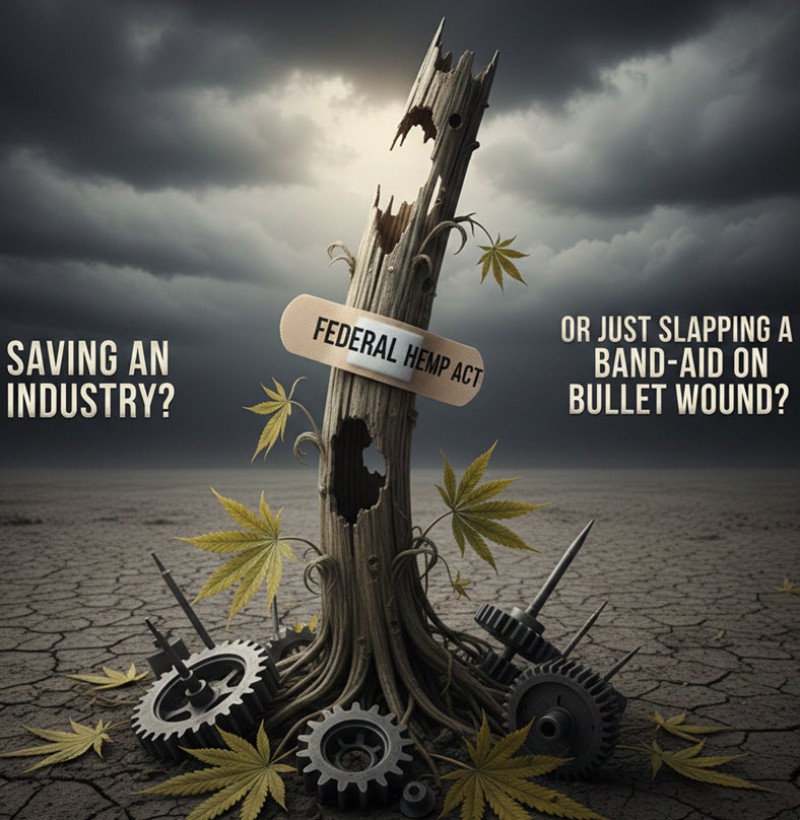
The HEMP Act: Saving an Industry or Slapping a Band-Aid on a Bullet Wound?
Well folks, just when you thought the hemp-derived THC saga couldn't get any messier, Congress decided to throw another curveball into the mix. On January 23, 2026, Representatives Morgan Griffith (R-VA) and Marc Veasey (D-TX) introduced the Hemp Enforcement, Modernization, and Protection (HEMP) Act—a bipartisan attempt to regulate, rather than ban, the consumable hemp market that Trump's spending bill tried to annihilate just weeks earlier.
Before we dive into whether this bill is a lifeline or just another legislative sleight of hand, let's get our bearings on what the hell is happening here.
The Background: How We Got to This Clusterfuck
Since the 2018 Farm Bill, cannabis products containing less than 0.3% delta-9 THC on a dry weight basis have been considered legal hemp. This loophole—intentional or not—spawned a massive unregulated market of "intoxicating hemp" products: Delta-8 THC, Delta-9 gummies, THC-O, HHC, and a whole alphabet soup of cannabinoids that get you high but technically fall outside federal marijuana prohibition.
States have responded chaotically. Some embraced it. Others tried to ban it. Most just watched in confusion as gas stations started selling weed gummies next to the beef jerky.
Then came the December 2025 spending bill that Trump signed. Buried in the text was language that would effectively ban all consumable hemp products containing quantifiable amounts of THC. The definition was set to change from measuring delta-9 THC to measuring total THC—including delta-8, THC-O, and "any other cannabinoids that have similar effects." The kicker? Products would be limited to 0.4 milligrams per container.
Point-four milligrams. That's not a typo. That's basically zero.
This wasn't regulation. This was prohibition with extra steps.
The hemp industry—worth billions and employing tens of thousands—collectively shit itself. Farmers, processors, retailers, and consumers all faced the prospect of an entire market being wiped out within a year.
Enter the HEMP Act.
What the HEMP Act Actually Does
Let's break down what Griffith and Veasey are proposing, because the devil is always in the details.
1. Age Restriction: Adults Only
The bill would allow the sale of consumable hemp products—edibles, beverages, inhalables—to adults 21 and older. This is basic harm reduction and makes sense. No arguments here.
2. Packaging and Labeling Requirements
Products would need:
-
Child-resistant, tamper-proof packaging
-
Labels listing all cannabinoids present
-
QR codes linking to certificates of analysis
Again, this is reasonable. Consumers deserve to know what they're consuming, and keeping products away from kids is non-negotiable.
3. Ingredient Restrictions
Hemp products couldn't contain additives like alcohol, caffeine, tobacco, nicotine, or melatonin—substances that "could interact with cannabinoids or enhance or alter their effects."
This is where things start getting weird. So you can't have a CBD energy drink because of the caffeine? Or a CBD cocktail? The logic here seems to be "let's make hemp products as boring and medicinal as possible so people stop enjoying them."
4. Manufacturing and Testing Requirements
Hemp businesses would need to register their facilities and comply with manufacturing and testing standards. This is standard regulatory framework stuff. Good manufacturing practices (GMP) are important for consumer safety.
5. Cannabinoid Caps: The Big One
This is where the bill either saves the industry or kills it, depending on how you look at it.
The Department of Health and Human Services (HHS) would be tasked with proposing cannabinoid limits within 60 days of enactment. If they fail to implement rules within three years, these default thresholds kick in:
-
Non-intoxicating cannabinoid oral products: Up to 10mg/serving, 50mg/package
-
Inhalable products: Up to 100mg/serving, 500mg/package
-
Topical products: Up to 100mg/serving, 500mg/package
-
Intoxicating cannabinoid products (THC): Up to 5mg/serving, 30mg/package
Let's focus on that last one. Five milligrams per serving. Thirty milligrams per package.
For context, a standard recreational edible in states like Colorado contains 10mg of THC per serving. A package might contain 100mg total. So the HEMP Act is proposing limits that are half the serving size and one-third the package size of what's already considered standard in legal adult-use markets.
This is a massive reduction compared to the earlier discussion draft—which would have been even more restrictive—but it's still severely limiting compared to what's currently available in state-legal markets.
6. FDA Authority and Advisory Committee
The bill would give the FDA authority to mandate recalls and establish a Cannabinoid Hemp Products Advisory Committee to provide recommendations on THC thresholds. It would also require HHS to create and maintain a list of known cannabinoids within one year.
This is basically building out the regulatory infrastructure that should have existed from the start but didn't because the 2018 Farm Bill was written with the assumption that nobody would figure out how to get high off legal hemp.
Surprise.
Is This a Step in the Right Direction?
Let's be objective here. Compared to the outright ban that Trump signed in December, the HEMP Act is unquestionably better. It's the difference between "your entire industry is illegal in one year" and "your entire industry can continue to exist, but with significant restrictions."
But is it good? That depends on what we're comparing it to.
The Positives:
1. It saves the industry from extinction. Thousands of jobs, billions in economic activity, and an entire agricultural sector don't get vaporized by federal prohibition. That's not nothing.
2. It creates a legal framework. Right now, the hemp market exists in a regulatory gray zone. This bill would establish clear rules, consumer protections, and quality standards. That's objectively better than the current Wild West situation.
3. It's bipartisan. In an era of hyper-partisan gridlock, the fact that a Republican from Virginia and a Democrat from Texas can agree on anything related to cannabis is worth noting. This has a better chance of passing than most cannabis bills.
4. It removes the most punitive language. The original spending bill ban would have limited products to 0.4mg per container—effectively zero. The HEMP Act allows 30mg per package for intoxicating products. That's a 75-fold increase.
The Negatives:
1. The limits are still too restrictive. Thirty milligrams per package is laughably small for anyone with tolerance or using cannabis for legitimate medical purposes. This is regulation designed to minimize use, not facilitate safe access.
2. It treats hemp differently than state-legal cannabis. Why should a Delta-9 gummy in Texas be limited to 5mg per serving when a recreational edible in Colorado can contain 10mg? The only difference is the source of the THC—hemp-derived vs. marijuana-derived. This creates an arbitrary and scientifically unsupported distinction.
3. It doesn't address the fundamental problem: federal prohibition. The reason we have this convoluted hemp market in the first place is because cannabis remains federally illegal. The HEMP Act is a patchwork fix that avoids the core issue—deschedule cannabis entirely.
4. It gives HHS immense discretionary power. The bill tasks HHS with proposing cannabinoid limits within 60 days. What if they decide to set even lower limits? The default thresholds only kick in after three years of inaction. In the meantime, HHS could impose whatever restrictions they want.
5. The ingredient restrictions are paternalistic. Banning caffeine or melatonin because they "could interact with cannabinoids" is not based on evidence—it's based on the assumption that consumers are too stupid to make informed choices.
The Industry Response: Grateful, But Wary
Jonathan Miller, general counsel at the U.S. Hemp Roundtable, issued a statement expressing gratitude to Griffith for introducing the bill while noting that "there is much work yet to be done before final passage."
Translation: "Thanks for not killing us, but these limits are still bullshit."
Thomas Winstanley, Executive Vice President of Edibles.com, called the legislation "a meaningful course correction" and praised the bipartisan effort. But even his statement acknowledges that the industry has been "put at risk—not by science, but by misguided rhetoric, fear-based narratives, and competing interests."
He's right. None of this is based on science. There's no evidence that 30mg packages are safer than 100mg packages. There's no public health crisis caused by Delta-8 THC that justifies these restrictions. This is politics—competing interests fighting over market control while using "consumer safety" as a convenient justification.
The Trump Factor: Forced or Complicit?
Let's talk about Trump for a second, because his role in this mess is both crucial and confusing.
Trump signed the spending bill with the hemp ban language in December 2025. Roger Stone—GOP operative and Trump confidant—claimed that Trump was "forced" by Republican lawmakers to sign the bill. A White House spokesperson, however, said Trump specifically supported the prohibition language.
So which is it? Was Trump forced, or did he want this?
Then, in January 2026, Trump issued an executive order directing the rescheduling of marijuana to Schedule III and specifically urged Congress to "examine updating the definition of hemp to ensure that full-spectrum CBD is accessible to patients."
So Trump supports banning intoxicating hemp products but wants to protect CBD access? He supports Schedule III rescheduling (which benefits Big Pharma) but opposes the unregulated hemp market that helps small businesses?
The pattern is clear: Trump supports cannabis policies that benefit corporate interests and federal control, while opposing policies that empower small entrepreneurs and state-level autonomy.
His recent announcement about allowing Medicare beneficiaries to access CBD "under doctor recommendation at no cost" sounds great until you realize it positions CBD as a pharmaceutical product rather than a freely accessible supplement. This is the Big Pharma playbook: regulate, medicalize, monetize.
What Can We Do? The People's Move
If you give a shit about this issue—whether you're a hemp farmer, a consumer, a business owner, or just someone who believes adults should be able to make their own choices—here's what you need to do:
1. Contact Your Representatives
The HEMP Act is currently pending. It's not law yet. Call, email, and write to your representatives and tell them:
-
Support the HEMP Act as a better alternative to the ban, but push for amendments to increase the cannabinoid limits to match state-legal standards (10mg serving, 100mg package minimum)
-
Oppose the outright ban Trump signed
-
Support the Hemp Planting Predictability Act, which would delay the ban by two years to allow for a more thoughtful regulatory compromise
2. Support Organizations Fighting for Hemp Rights
Groups like the U.S. Hemp Roundtable, the Hemp Industries Association, and various state-level hemp associations are doing the legislative heavy lifting. Donate if you can. Share their content. Amplify their message.
3. Educate Others
Most people don't understand the difference between hemp-derived THC and marijuana-derived THC (hint: there isn't one—it's the same molecule). They don't know that the 2018 Farm Bill accidentally created this market. They don't realize that the pending ban affects an entire agricultural sector.
Spread the word. Share articles. Talk to your friends and family. The more people understand what's at stake, the more pressure lawmakers face to do the right thing.
4. Vote
This one's simple. If your representatives support prohibition over regulation, vote them out. If they support the outright ban over the HEMP Act, vote them out. Electoral consequences are the only language politicians fluently speak.
5. Support Local Hemp Businesses
If the federal ban goes into effect and the HEMP Act doesn't pass, these businesses are done. Buy their products now. Support their livelihoods. If they go under, they're not coming back.
The Bigger Picture: Why This Matters
The hemp THC debate is a microcosm of the larger cannabis legalization fight. It exposes the fundamental hypocrisy of our drug laws: a molecule is legal or illegal depending on which plant it comes from, even though it's chemically identical.
It reveals the influence of corporate interests: Big Pharma doesn't want unregulated competition, and they've successfully lobbied for policies that eliminate it.
It demonstrates the disconnect between public will and legislative action: consumers clearly want access to these products (the market is worth billions), yet lawmakers are banning them.
And most importantly, it shows that even when progress is made, it's fragile. The 2018 Farm Bill created a legal hemp market. The 2025 spending bill tried to destroy it. The 2026 HEMP Act might save it—but with so many restrictions that the market becomes unsustainable anyway.
This is why full descheduling is the only real solution. As long as cannabis remains on the Controlled Substances Act, we'll continue to have these absurd debates about whether 5mg or 10mg per serving is the "right" amount for adults to consume. As long as federal prohibition exists, states will remain handcuffed, businesses will operate in legal uncertainty, and patients will face unnecessary barriers to access.
The Sticky Bottom Line
The HEMP Act is a last-ditch effort to save an industry that's been under siege since Trump signed the spending bill ban. It's better than prohibition, but it's still deeply flawed—imposing arbitrary limits, creating unnecessary restrictions, and avoiding the fundamental issue of federal cannabis prohibition.
If you care about this, you need to act. Contact your representatives. Support the HEMP Act, but push for amendments. Demand that lawmakers prioritize science over politics and consumer freedom over corporate control.
Because here's the reality: if the HEMP Act fails and the ban goes into effect, thousands of businesses will close, tens of thousands of jobs will disappear, and billions in economic activity will evaporate. Farmers who planted hemp expecting a legal market will be left holding worthless crops. Consumers who rely on these products for pain, anxiety, or sleep will lose access.
And all of it will be justified with the same tired prohibitionist rhetoric that's been discredited for decades.
We've seen this story before. We know how it ends. The question is whether we're willing to fight back this time—or whether we'll just watch another industry get destroyed by the stroke of a pen.
The move is yours. Make it count.
Data Sourced from Article by Kyle Jaeger @ Marijuana Moment
THE STATES ACT OR THE HEMP ACT, READ ON...
WHY LAW ENFORCMENT IS BACKING THE STATES 2.0 ACT