

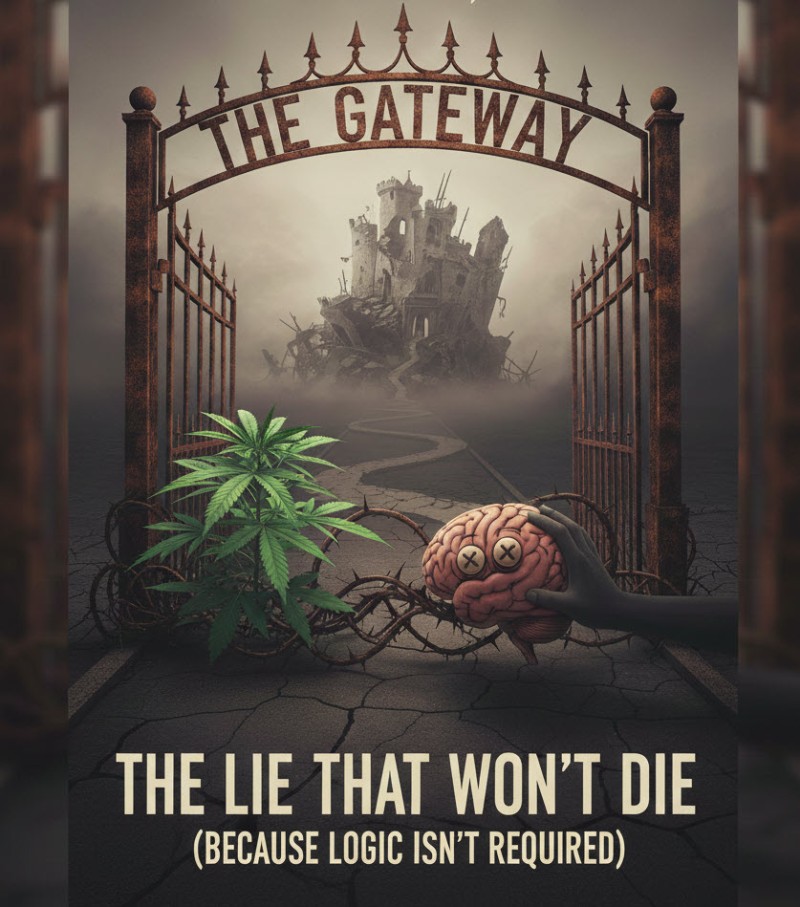
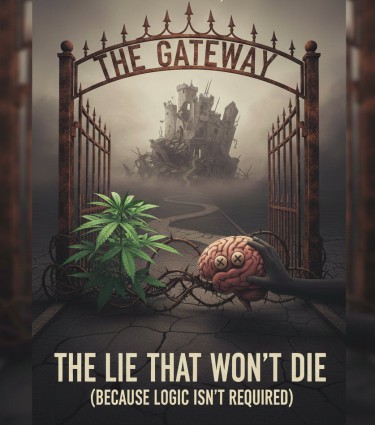
GOP Senator Thom Tillis recently voiced his opposition to Trump's Schedule III rescheduling order, dusting off that old faithful propaganda chestnut: marijuana is a gateway drug. You know, the theory that smoking a joint inevitably leads to shooting heroin in a back alley while your life crumbles around you.
It's 2025, folks. We have literally decades of research debunking this nonsense. We have entire states where cannabis has been legal for over a decade. We have mountains of data showing that the gateway theory is about as scientifically valid as flat earth theory or claiming that vaccines cause autism.
And yet, here we are. Again. Still. Always.
Because facts don't matter when you've got a narrative to protect and corporate donors to please.
But you know what? I'm tired of just pointing to studies and research that prohibitionists ignore anyway. Let's take this gateway theory to its logical conclusion and see what happens. Because if we're going to apply this framework to cannabis, we need to apply it consistently to everything.
Fair is fair, right?
The Gateway Theory: A Brief History of Bad Logic
The gateway theory—also called the "stepping stone hypothesis"—argues that using one drug increases the likelihood of using other, "harder" drugs. It's been a cornerstone of drug war propaganda since the 1950s, gaining particular traction during the "Just Say No" era of the 1980s.
The basic premise goes like this: marijuana is the first illegal drug most people try, and people who use marijuana are statistically more likely to eventually try other drugs, therefore marijuana causes people to use harder drugs.
See the logical leap there? It's correlation posing as causation, dressed up in a lab coat and presented as science.
Here's the thing that prohibitionists always conveniently forget to mention: the vast majority of people who use cannabis never progress to harder drugs. According to the National Institute on Drug Abuse's own data, only about 9% of cannabis users ever try cocaine, and even fewer try heroin or methamphetamine.
That means 91% of cannabis users don't follow the supposed "gateway" path. If marijuana were truly a gateway drug, those numbers would be inverted. Yet somehow, a 9% correlation gets treated as ironclad proof of causation.
By that logic, we should be far more concerned about actual gateways. Like milk. Nearly 100% of heroin users drank milk as children. Ban dairy!
Let's Apply This Logic Consistently, Shall We?
If we're going to claim that cannabis is a gateway drug because some people who use it eventually try other substances, then we need to subject ALL psychoactive substances to the same scrutiny.
And boy, does that get interesting fast.
Coffee: The World's Most Popular Gateway Drug
Let's start with coffee—the world's most widely consumed psychoactive substance. Over 2 billion cups are consumed globally every day. It's a stimulant that directly affects your central nervous system, increases dopamine production, and creates physical dependence with withdrawal symptoms including headaches, fatigue, and irritability.
Coffee is literally everywhere. Children drink it. Your grandmother drinks it. Politicians drink it while pontificating about the dangers of drugs. It's in gas stations, schools, hospitals, churches—you can't escape it.
And here's the kicker: caffeine works on the same reward pathways in the brain that other stimulants do. It increases dopamine, creates tolerance, and leads to dependence. Sound familiar? That's because it's a drug. A legal, socially acceptable, corporate-approved drug, but a drug nonetheless.
So if marijuana is a gateway drug because it's psychoactive and some users eventually try other substances, then coffee is the ultimate gateway drug. After all, nearly 100% of people who use cannabis, cocaine, methamphetamine, or any other substance drank coffee first.
Where's Senator Tillis's press conference demanding we Schedule I coffee? Where's the DEA raid on Starbucks? Where are the concerned parents warning that a cup of joe will lead their kids down a dark path?
Oh right. Starbucks doesn't threaten pharmaceutical profits. My bad.
Sugar: Halloween's Socially Acceptable Cocaine
Now let's talk about sugar—the substance we literally give to children in bulk during Halloween, then wonder why they're bouncing off the walls.
Research has shown that sugar activates the same reward pathways in the brain as cocaine. In fact, studies on rats have demonstrated that sugar can be more addictive than cocaine. When given the choice, rats repeatedly chose sugar over cocaine, even when they were already addicted to cocaine.
Think about that for a second. Sugar beats cocaine in the addiction Olympics.
Sugar causes dopamine release, creates tolerance (you need more to get the same pleasure response), produces withdrawal symptoms, and leads to compulsive consumption despite negative health consequences. That's literally the definition of an addictive substance.
The health impacts are staggering: obesity, diabetes, heart disease, tooth decay, inflammation, and metabolic dysfunction. The CDC estimates that diabetes alone costs the U.S. healthcare system $327 billion annually. Sugar is implicated in over 500,000 deaths per year when you account for obesity-related diseases, diabetes, and cardiovascular issues.
But we don't call it a gateway drug. We call it a treat. We give it to kids by the pound on Halloween. We put it in everything from bread to pasta sauce to "health" foods. The average American consumes 77 grams of sugar per day—more than three times the recommended amount.
If marijuana is a gateway drug, then Halloween is a government-sponsored drug distribution program targeting children. Trick-or-treating is literally teaching kids that consuming psychoactive substances for pleasure is normal and fun.
Where's the moral panic about that? Where are the senators warning that Fun Size Snickers bars are leading our children down a path to harder candies?
Oh right. The sugar lobby is worth billions and contributes heavily to political campaigns. Again, my bad.
Alcohol: The Actual Gateway Nobody Wants to Talk About
Let's get serious for a moment and talk about alcohol—the actual gateway drug that nobody wants to acknowledge.
Research consistently shows that alcohol use precedes marijuana use in the vast majority of cases. According to multiple longitudinal studies, the typical progression for adolescents is: tobacco and alcohol first, then marijuana, then other drugs (if they progress at all, which most don't).
Alcohol is also far more dangerous than cannabis by virtually every metric:
-
Over 140,000 Americans die from alcohol-related causes annually
-
Alcohol is involved in roughly 40% of violent crimes
-
Alcohol causes liver disease, brain damage, cancer, and heart problems
-
Alcohol withdrawal can literally kill you (cannabis withdrawal cannot)
-
Alcohol has a lethal dose (cannabis does not)
-
Alcohol is highly addictive, with about 15% of users developing dependence
Yet alcohol is legal, socially acceptable, advertised during prime time television, and available in virtually every grocery store in America.
If we applied the gateway theory logic to alcohol with the same rigor we apply to cannabis, we would have to ban it immediately. After all, nearly 100% of people who use any illegal drug drank alcohol first. Alcohol is demonstrably more dangerous, more addictive, and more closely correlated with progression to other substances.
But we don't ban alcohol. Why? Because prohibition doesn't work, and we already tried it in the 1920s. It created organized crime, made the product more dangerous, and accomplished nothing except ruining lives and enriching criminals.
Oh, and also because the alcohol industry is worth $250 billion annually and spends millions lobbying to protect its interests.
Starting to see a pattern here?
Tobacco: The Original Gateway Nobody Mentions Anymore
And then there's tobacco—the substance that most closely fits the actual gateway hypothesis but gets conveniently left out of the conversation now that we've stopped demonizing it (because we can't—it's still legal).
Studies have consistently shown that tobacco use is the strongest predictor of future drug use. The earlier someone starts smoking cigarettes, the more likely they are to eventually use marijuana, and the more likely they are to progress to other substances.
Tobacco is highly addictive (more so than cannabis by far), deadly (480,000 deaths per year in the U.S. alone), and has no medical benefits whatsoever. It causes cancer, heart disease, stroke, COPD, and a host of other fatal conditions.
If any substance deserves the "gateway drug" label based on actual evidence, it's tobacco. But you don't hear senators giving press conferences about cigarettes being gateways, do you? Because Big Tobacco already won that war through decades of lobbying, and now they're partners in the legal cannabis industry anyway.
The Real Gateway: Prohibition Itself
Here's the actual gateway that politicians like Senator Tillis don't want to talk about: prohibition.
When you force cannabis users to buy from the black market, you expose them to dealers who also sell actually dangerous drugs. The illegal market doesn't card. It doesn't test products. It doesn't have quality control. And it absolutely offers "harder" drugs to customers.
Legal, regulated cannabis markets eliminate that exposure entirely. When you buy cannabis from a licensed dispensary, nobody's trying to upsell you on cocaine. The budtender isn't pushing heroin. There's no "gateway" because there's no illegal market connecting different substances.
Multiple studies have shown that states with legal cannabis see decreases in opioid deaths, not increases. That's the opposite of what the gateway theory predicts. If cannabis were truly a gateway to harder drugs, we'd see opioid deaths spike in legal states. Instead, they decline.
The data is clear: prohibition is the gateway, not the plant.
Why the Gateway Theory Persists Despite Evidence
So why does this thoroughly debunked theory keep getting trotted out by politicians in 2025?
Because it's not about evidence. It never was.
The gateway theory persists because it serves powerful interests:
Big Pharma loses an estimated $10 billion annually when states legalize medical cannabis. People switching from opioids and other pharmaceuticals to cannabis represents a direct threat to their profits.
The Alcohol Industry sees cannabis as direct competition. Legal cannabis states have seen declines in alcohol sales, particularly among younger demographics.
Private Prisons profit from drug war arrests and incarceration. Fewer cannabis arrests mean fewer prisoners mean less profit.
Law Enforcement Agencies receive federal funding and asset forfeiture revenue tied to drug enforcement. Cannabis prohibition justifies budgets and powers they don't want to lose.
Prohibitionist Organizations like Smart Approaches to Marijuana (SAM) are funded by all of the above. Their entire existence depends on keeping cannabis illegal or heavily restricted.
These industries have invested billions in maintaining prohibition. They fund "research" that confirms their biases. They bankroll politicians who parrot their talking points. They create astroturf organizations that masquerade as grassroots concern.
Senator Tillis opposing Schedule III isn't about protecting kids or preventing drug abuse. It's about protecting his donors' profits and his own political positioning.
The Logic Doesn't Logic
Let's be brutally honest: the gateway theory doesn't pass even the most basic logical consistency test.
If we actually believed that consuming psychoactive substances leads to harder substance use, we would be equally concerned about:
-
Every cup of coffee consumed by adolescents
-
Every energy drink sold to teenagers
-
Every Halloween candy given to children
-
Every beer commercial aired during football games
-
Every prescription stimulant given for ADHD
-
Every cigarette sold at gas stations
But we're not concerned about those things. Or rather, we're not calling them "gateway drugs" and using them as justification for criminal prohibition.
Why? Because they're either socially acceptable, corporate-approved, or both. The logic of the gateway theory is selectively applied only to substances that threaten established industries.
It's not science. It's not public health. It's not protecting anyone.
It's propaganda in service of profit, dressed up in the language of concern.
The Sticky Bottom Line
The gateway theory is bullshit. Always has been. The evidence against it is overwhelming. The logical inconsistencies are glaring. The selective application is transparent.
If Senator Tillis and his prohibitionist allies were genuinely concerned about gateway effects, they'd be proposing legislation to ban coffee, sugar, alcohol, and tobacco—the actual substances most closely correlated with progression to other drug use.
But they won't. Because this was never about evidence or logic. It's about maintaining a profitable prohibition regime that serves corporate interests while claiming to protect public health.
The truth is simple: cannabis is one of the safest psychoactive substances humans use. It's safer than alcohol by every metric. It's safer than tobacco. It's probably safer than excessive sugar consumption.
The real gateway isn't cannabis—it's the hypocrisy of a system that criminalizes a plant while celebrating far more dangerous substances because they make the right people money.
So the next time someone tries to sell you the gateway theory, ask them why they're not equally concerned about coffee, sugar, alcohol, and tobacco. Watch them stumble. Watch them deflect. Watch them reveal that this was never about consistent logic or genuine concern.
Because if drugs are drugs, and if the gateway theory is real, then we need to apply it to all drugs equally.
But we won't. Because that would require honesty, consistency, and prioritizing public health over corporate profits.
And we can't have that, now can we?
The gateway theory is a lie. It's always been a lie. And it will continue to be a lie no matter how many senators repeat it.
The only question is: how much longer are we going to pretend otherwise?
CANNABIS AS A GATEWAY DRUG, READ ON...