


I know. You’re tired of hearing about AI. Half your feed is either someone gushing about their AI-generated side hustle or someone else losing their mind because a machine wrote a poem. The discourse has collapsed into two camps: the breathlessly optimistic and the chronically offended, and somehow neither side is saying anything useful about what’s actually happening.
So let me try.
AI is here. It’s not going anywhere. And the loudest voices against it — the ones shrieking “soulless,” “thief,” “fake” at every generated image and synthetic voice — are a vocal minority making enormous noise while the rest of the world is already clicking “generate.” You can have feelings about that. Feelings, however, don’t reroute technological history. The printing press didn’t wait for scribes to make peace with it. Photography didn’t ask painters for permission. AI won’t either.
What I want to talk about is what’s actually happening underneath all the noise, because the noise is obscuring something genuinely significant.
The Bad Stuff Is Real, So Let’s Name It
Let’s not be naive. I’m not going to sit here and tell you this technology is purely wonderful, because it isn’t.
The darker applications aren’t hypothetical — they’re operational. Mass surveillance systems in authoritarian states use AI to track faces in crowds, parse speech patterns, and flag dissidents before they open their mouths in public. China’s social credit infrastructure, the tools being exported to smaller governments hungry for control, the facial recognition contracts that have quietly embedded themselves into airports, stadiums, and police departments across supposedly free nations — this is the scaffolding of a surveillance state that would have required thousands of human analysts a decade ago and now runs on servers.
Closer to home, scammers have tools that clone your grandmother’s voice from a ten-second audio clip and call you asking for bail money. Deepfakes convincing enough to destroy a reputation ship in minutes and take months to rebut. The information ecosystem is already flooded with generated slop — articles written by nobody about nothing, optimized to rank on search engines and erode the concept of authoritative information from the inside.
These aren’t edge cases. They’re scaling. Every month the tools get cheaper, faster, and more accessible to people with bad intentions alongside people with good ones.
I say all of this first because any honest conversation about AI has to hold this reality in one hand. The technology is not neutral in its effects. It amplifies whatever human impulse is behind it, and human impulses run the full spectrum.
And yet. And yet.
The Door That Just Got Kicked Open
Something else is also happening, and it’s harder to see because it doesn’t generate outrage. It just generates work.
A guy who has never worked in film has a story he’s been carrying around for years — bizarre, personal, unmistakably his kind of story. Before AI, that story stayed in his head because the gap between “having an idea” and “executing it” required a crew, a budget, industry connections, and years of grinding through a system designed to filter out everyone who didn’t already have access. The gatekeepers weren’t evil — they were just expensive. Now he makes the film himself. A Face Only a Mother Could Love is that film — rough, alive, weird in ways that only someone who actually lived something can make it weird. No studio approved it. No development executive softened the edges. It exists in its purest form because the tools became available to someone who would never have gotten through the door otherwise.
Or take @DreamsHor1zon on YouTube, building an entire serialized world called Miss Chif — a premise where the supervillains won, the heroes are gone, and civilization is now run by the people who were supposed to be the bad guys. It’s pulpy, imaginative, and genuinely strange in a way that committee-approved entertainment rarely is. It exists because one person with a vision no longer needed a network to say yes.
These aren’t flukes. They’re the early signal of a massive creative redistribution, and the volume is going to get louder.
For decades, the bottleneck wasn’t ideas — the world has never been short on those. The bottleneck was execution. Production costs. Technical skill requirements. Time. Only institutions with capital could bridge that gap, which meant only ideas that survived institutional filters ever reached an audience. Every film you didn’t see, every album that never got made, every novel that died in a drawer because the author couldn’t afford to keep writing — that’s the cost of the old bottleneck. What AI is doing, at its best, is burning that bottleneck down. The bar for doing has dropped through the floor.
The Market Doesn’t Care Who Made It
Here’s the cold truth that some creatives don’t want to hear, and I’m going to say it plainly: most consumers do not care if something was made by a human or a machine. They care if it holds their attention. They care if it moves them. They care if it’s worth the hour they spent on it.
“Human-made” is a premium that a certain audience will pay for — and that audience is real, and it’s worth pursuing if craft and authenticity are your selling point. Handmade furniture. Analog photography. Novels with a distinct human voice. There’s a market for those things, and AI won’t kill it — if anything, the flood of generated content will make genuinely human work rarer and therefore more valuable to the people who care.
But the average consumer will give you their dollars for “good enough.” They already do. The average person watches algorithmically optimized content for three hours a day without asking who wrote the script or whether the thumbnail was AI-generated. They just ask if it was worth watching. That’s the audience available to anyone willing to make something.
This is not a tragedy. It’s a market signal. The execution gap that once protected incumbent institutions — the major studios, the big publishers, the label systems — is closing fast. If you have a story, a product concept, or a weird solution to a problem nobody’s solved yet, you now have tools to bring it into existence that would have required a company infrastructure in 2015.
What This Means for Stoners Specifically
Cannabis users have a reputation, not entirely undeserved, for being excellent idea generators. The altered state pulls lateral connections. You smoke a bowl and suddenly the irrigation problem in your grow tent has seven possible solutions you hadn’t considered sober, the packaging design for your hypothetical brand is fully visualized, and the name came to you while you were staring at the ceiling.
That was always the easy part. The hard part was: and then what?
And then you’d need to learn to code, or hire someone who could. You’d need to find a manufacturer, or raise capital to access one. You’d need a graphic designer, a copywriter, a social media manager, a distribution deal. The gap between the stoned epiphany and the shipped product was wide enough that most ideas dissolved in it.
The AI answer to and then what? is: and then build it.
3D printing can prototype your idea in a weekend. AI can help you write the pitch deck, generate packaging mockups, draft the ad copy, build a basic app from a plain-English description. The tool stack available to a solo creator in 2026 would have been a well-funded startup five years ago. The barrier isn’t access anymore. It’s focus.
So the question — and I mean this as a direct challenge — is what specific problems exist in the cannabis space that you could actually solve. Not abstractly. Concretely.
A better system for maintaining humidity stability in a home grow without babysitting it? A more discreet consumption method for people in legal states where social stigma still makes public use awkward? A tool that tracks your terpene preferences across strains so dispensary visits stop being a twenty-minute guessing game? An edible format that actually controls dosing consistently? A seed-to-harvest journal app that learns your grow conditions and flags problems before they cost you a harvest?
None of these require a degree. None require investors. They require an idea, the willingness to learn the tools, and the discipline to follow through past the initial high of the concept.
The Acceleration Is Already Here
Here’s what people miss about this moment: the acceleration doesn’t stop. The tools available in six months will be more capable than the ones available today. The cost will continue to fall. The barrier to execution will keep dropping.
That means the window for early movers — people who build the first version of something in a space nobody has properly solved yet — is open right now. The people complaining loudly about AI are spending the time that early builders are using to ship.
I’m not saying the concerns aren’t real. I spent the first section of this article being specific about the dangers. But concern without action is just noise, and the people who will shape how this technology lands in the world are the ones building with it, not the ones shouting at it.
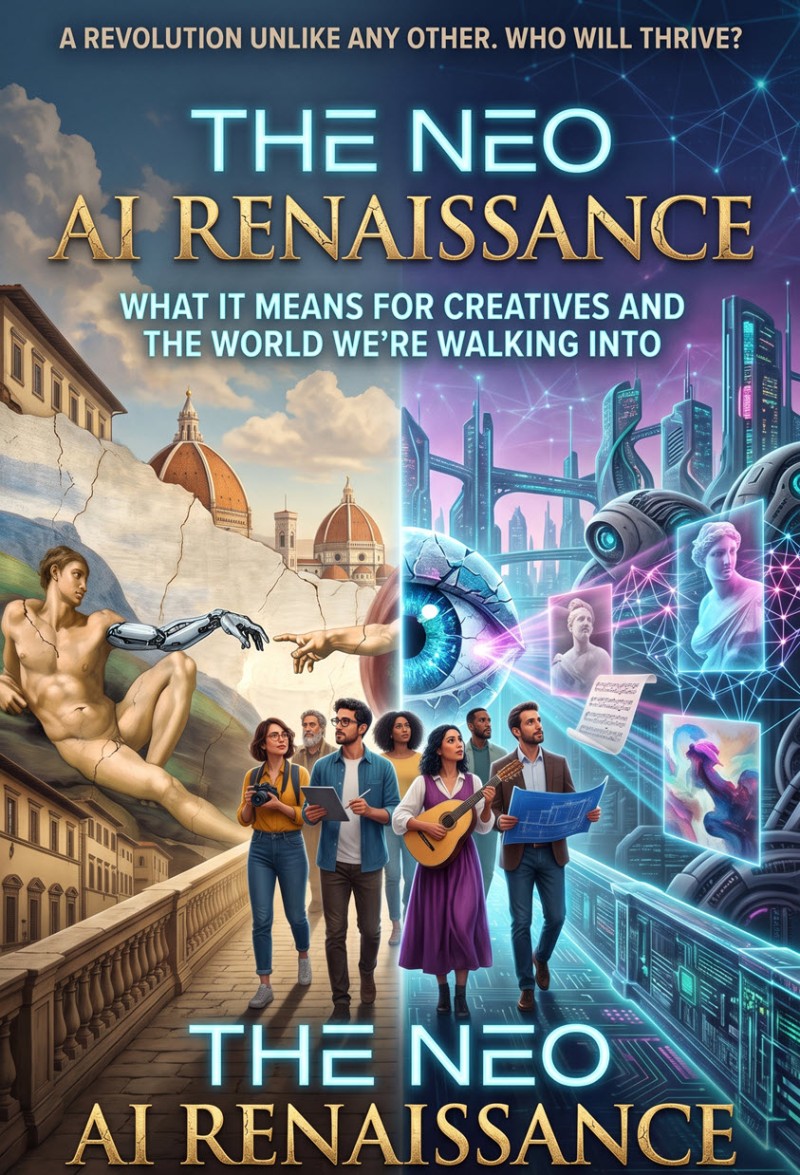
The AI renaissance isn’t really about AI. It’s about the end of the excuse that you couldn’t do it because you didn’t have access. The tools exist. The platforms to distribute to exist. The audience is there.
You have access now. The only remaining question is what you’re going to make with it.
Start with the problem. Build toward the solution. One seed at a time.
AI CREATIVES AND CANNABIS, READ ON...