

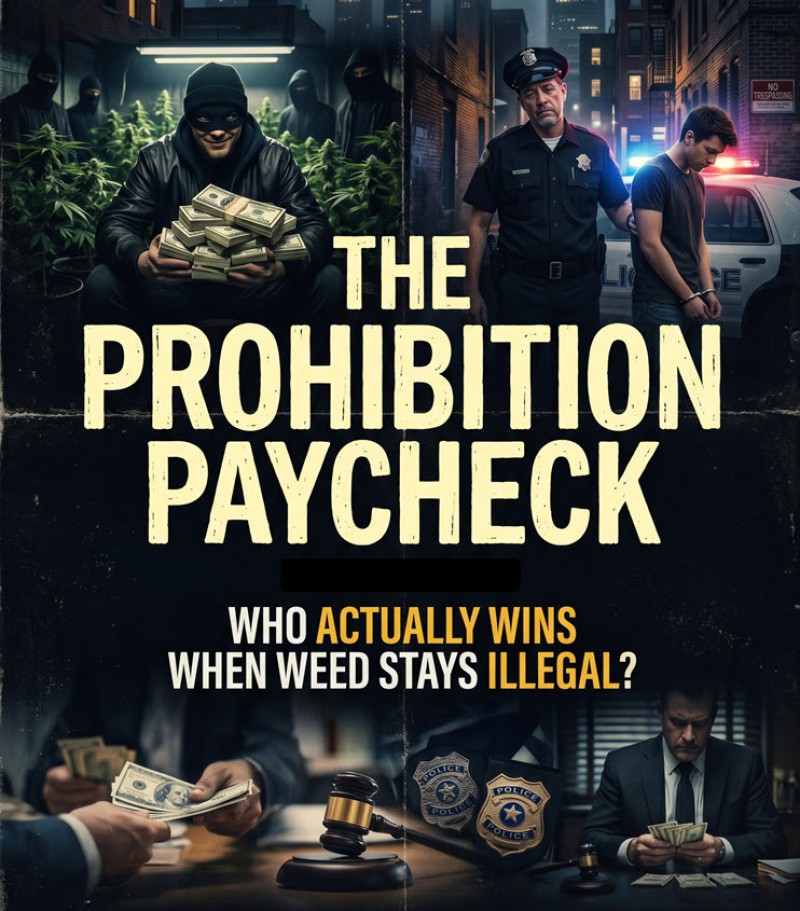
The Prohibition Paycheck
Who Actually Wins When Weed Stays Illegal
Let's be honest about something the mainstream press rarely wants to touch with a ten-foot bong: cannabis prohibition isn't a policy failure. It's a policy success. Just not for you.
For the millions of people who've been arrested, fined, fired, or incarcerated over a plant that's less lethal than aspirin, prohibition looks like a disaster. But zoom out. Follow the money. Ask who keeps donating to anti-legalization campaigns, who keeps lobbying Congress, who keeps funding 'public health' groups that happen to hate weed. When you trace those threads, you find a very clear answer to the question nobody in power wants to ask: who actually benefits when cannabis stays illegal?
The answer, in short, is everyone who isn't you.
Big Pharma: The Trillion-Dollar Motive
Start with the most obvious one. The pharmaceutical industry loses, by some estimates, around $10 billion annually in markets where medical cannabis is legal. Patients substitute cannabis for opioids, sleep aids, anti-anxiety medications, and antidepressants. Not all patients, and not always — but enough to show up in the revenue reports.
Here's where it gets interesting: roughly half of the FDA's funding comes from pharmaceutical companies through a scheme politely called 'User Fees,' formally the Prescription Drug User Fee Act (PDUFA). The FDA, the agency responsible for regulating drugs, is partially funded by the industry it regulates. Then that same FDA has historically classified cannabis as Schedule I, meaning no accepted medical use. The circularity should offend you.
Pharmaceutical companies have also been caught funding anti-legalization efforts through nonprofit proxies. A 2017 investigation by the Associated Press found that Insys Therapeutics, maker of a fentanyl-based painkiller, donated $500,000 to an Arizona campaign opposing recreational cannabis legalization. Insys would later plead guilty to federal bribery charges for paying doctors to overprescribe opioids. These are the people funding prohibition. Let that sit.
Sources: Associated Press, 2017; Prescription Drug User Fee Act (FDA.gov); JAMA Internal Medicine, 2019 — 'Association Between US State Medical Cannabis Laws and Opioid Prescribing in the Medicare Part D Population.'
Law Enforcement: The Arrest Economy
Cannabis arrests are a revenue engine. In 2022 — years after the national legalization conversation supposedly reached critical mass — the FBI's Crime Data reported over 227,000 cannabis-related arrests in the US. The majority were for simple possession. Not trafficking. Not distribution. Possession.
Civil asset forfeiture laws mean police departments can seize cash, cars, and property from people suspected of drug crimes, often without a conviction. The Institute for Justice has documented billions of dollars flowing through these seizures annually. Cannabis busts are a reliable pipeline. You stop someone with a bag of weed in a state where it's still illegal, and suddenly their car is the government's car. It's legalized robbery with a badge.
Beyond forfeiture, cannabis enforcement props up departmental budgets through federal grants tied to drug enforcement metrics. The Byrne JAG grant program, for instance, historically rewarded jurisdictions based on the number of drug arrests. More arrests, more money. The incentive isn't to reduce drug use. The incentive is to keep the arrest numbers up.
Private prison corporations understand this math better than anyone. The GEO Group and CoreCivic, the two largest private prison companies in the US, have spent millions lobbying against drug policy reform. Their contracts with state and federal governments depend on maintaining a steady supply of inmates. Cannabis offenders are low-risk, non-violent, and easy to process. They're practically ideal inventory.
Sources: FBI Uniform Crime Reporting, 2022; Institute for Justice, 'Policing for Profit' reports; OpenSecrets.org lobbying data for GEO Group and CoreCivic.
The Alcohol and Tobacco Industry: Protecting Market Share
The beverage alcohol industry has a documented history of opposing cannabis legalization. A 2019 report by the Boston University School of Public Health found that alcohol sales drop measurably in states that legalize recreational cannabis. People substitute. Not everyone, but enough.
The Wine & Spirits Wholesalers of America donated to anti-legalization campaigns in California. Beer distributors have done the same in multiple states. They couch it in language about 'public safety' and 'protecting children,' but their financial disclosures tell the real story. Their product kills 95,000 Americans per year according to CDC estimates. Cannabis kills zero from overdose. The chutzpah required to invoke safety while selling ethanol at scale is staggering.
Tobacco companies, meanwhile, have been quietly buying into cannabis — Philip Morris parent company Altria took a major stake in cannabis company Cronos Group — while lobbying to delay the kind of clear regulatory framework that might give smaller, organic operators a fighting chance. Their preferred scenario: prohibition long enough for legacy cannabis businesses to collapse, legalization on terms that allow Big Tobacco infrastructure to dominate.
Sources: JAMA Internal Medicine, 'Medical Marijuana Laws and Excess Opioid Mortality'; CDC alcohol-related deaths data; OpenSecrets.org; Altria/Cronos Group SEC filings.
The Plastics and Fossil Fuel Industries: The Hemp Problem
This is the piece of the story that rarely makes it into the evening news.
Hemp is cannabis. Legally, it's just cannabis with less than 0.3% THC by dry weight, a distinction created by Congress in 1937 when the Marihuana Tax Act was passed. That timing is not coincidental. By 1937, hemp represented a direct threat to nascent petrochemical and synthetic fiber industries. DuPont had just developed nylon. The timber industry was growing. Hemp — which produces stronger fiber than cotton, can be used to make paper, bioplastics, biofuel, building materials, and textiles — was a competitor that could be legislated away.
Jack Herer documented this extensively in 'The Emperor Wears No Clothes,' tracing the influence of newspaper magnate William Randolph Hearst (massive timber holdings, used wood pulp for paper) and the DuPont family (petrochemical investments) on the political push to criminalize cannabis. The scholarship is sometimes contested, but the documented financial interests are real.
Today, the plastic industry produces over 400 million metric tons of plastic annually. Hemp-derived bioplastics are a legitimate alternative for many applications. If hemp had been allowed to develop commercially throughout the 20th century, the fossil fuel and plastics industries would look very different. Keeping cannabis in a legal gray zone — or outright illegal — suppressed industrial hemp development for nearly a century. That suppression had winners.
Sources: Jack Herer, 'The Emperor Wears No Clothes'; UN Environment Programme plastic production figures; USDA hemp market reports.
Politicians: The Drug War as Career Infrastructure
Follow the campaign money. The Smart Approaches to Marijuana (SAM) organization, one of the most visible anti-legalization advocacy groups, has documented ties to rehabilitation clinics that profit from court-mandated cannabis treatment. Their funding sources and the politicians who echo their talking points deserve a much longer article, but the pattern is consistent: prohibition creates a cottage industry of treatment, enforcement, and political fundraising.
The drug war also functions as a tool of political control. Nixon aide John Ehrlichman said the quiet part loud in a 2016 Harper's Magazine interview: 'We knew we couldn't make it illegal to be either against the war or black, but by getting the public to associate the hippies with marijuana and blacks with heroin, and then criminalizing both heavily, we could disrupt those communities.' Nixon's war on drugs was, by Ehrlichman's own account, a political weapon. That weapon is still loaded.
Minority communities disproportionately bear the enforcement burden of cannabis laws despite roughly equal rates of use across racial groups. The ACLU has found that Black Americans are 3.73 times more likely to be arrested for cannabis possession than white Americans, despite similar usage rates. Politicians who want to suppress certain voter bases, maintain certain donor relationships, or appear 'tough on crime' have every incentive to keep the prohibition framework intact.
Sources: ACLU, 'A Tale of Two Countries,' 2020; Harper's Magazine, John Ehrlichman interview, 2016; OpenSecrets.org SAM lobbying disclosures.
The Bottom Line
Prohibition is not a mistake. It's a business model. Pharmaceutical companies protect revenue. Law enforcement protects budgets. Private prisons protect contracts. Alcohol and tobacco protect market share. Petrochemical industries protect their stranglehold on material production. Politicians protect donors.
None of these parties are going to voluntarily walk away from the arrangement. The only pressure that has ever moved the needle is direct, sustained public and legislative action, and the growing evidence that legal cannabis markets don't collapse civilization. They generate tax revenue, reduce opioid deaths, and give adults the freedom to make their own choices.
The people who profit from your incarceration are counting on you not doing the math. Now you have.
DESTROYING ILLEGAL CANNABIS,, BUT WAIT, READ ON...