

A new study drops, and predictably, the headlines follow. Cannabis triples your lung cancer risk. Heavy users beware. Smoke at your peril. The coverage makes it sound like rolling a joint is roughly equivalent to gargling asbestos, and the average reader is left with one clear takeaway: marijuana will kill you.
The study in question, led by Tyler J. Gallagher and colleagues at the Keck School of Medicine at USC, analyzed more than 118 million American medical records from 67 major U.S. hospitals, covering two decades of patient data between 2004 and 2024. The researchers defined cannabis exposure through a clinical diagnosis of cannabis use disorder — the threshold doctors flag when marijuana use interferes with work, health, or daily life. Even after stripping out every patient with any tobacco or nicotine record, they still found an elevated cancer risk in heavy cannabis users. Multiple tumor types showed up at elevated rates: adenocarcinoma, squamous cell carcinoma, even small cell carcinoma.
That is a serious study. It deserves to be taken seriously. But taking it seriously means reading it carefully — including what it cannot tell you and what its own framing leaves out. Because the moment you zoom out, the picture gets a lot more complicated than the headlines suggest.
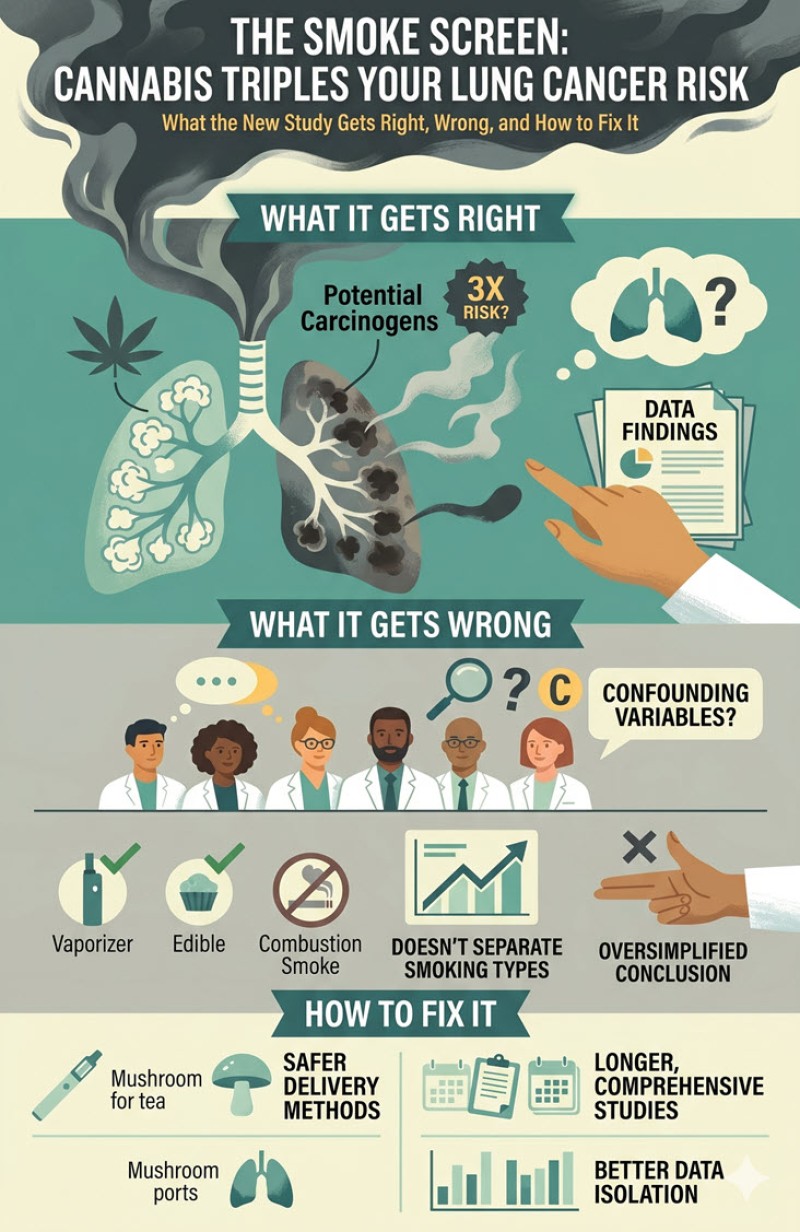
The Part the Study Gets Right: Smoke Is the Problem
Let's start with what nobody should argue with. When plant material burns, whether it's tobacco or cannabis, it produces smoke loaded with polycyclic aromatic hydrocarbons, or PAHs. These are pro-carcinogens. Inhale them, and enzymes in your lung tissue convert them into active carcinogens that bind to DNA, causing mutations. Mutated cells that survive and replicate are the first step toward malignancy. This is not controversial. This is basic combustion chemistry, and it applies equally to a Marlboro Red and a joint.
Cannabis smoke actually contains some carcinogens in higher concentrations than tobacco smoke. Marijuana smokers also tend to inhale more deeply and hold smoke in their lungs longer, which deposits more material per session. On raw toxicology, cannabis smoke is not a clean substance. The Keck study is not inventing a problem. Combustion is the problem. The study is just measuring its consequences.
The Part the Study Glosses Over: THC Is Not Nicotine
Here is where the study, and most of its coverage, goes quiet on some crucial biochemistry. Two plants can produce toxic smoke with similar carcinogenic compounds, but what those plants do after the DNA damage happens is not the same story at all.
Nicotine, the active compound in tobacco, binds to receptors in the lungs and activates survival pathways. It blocks programmed cell death signals. In practical terms, nicotine keeps genetically damaged, mutated cells alive. It functions as a kind of rogue maintenance crew that patches over warning signs rather than flagging the defective unit for removal. A mutated cell that survives long enough to replicate is a cell that can become a tumor. That is the mechanism behind tobacco's 20-fold increase in lung cancer risk.
THC does the opposite. It binds to cannabinoid receptors — CB1 and CB2 — and triggers apoptosis, the biological term for programmed cell death. When a lung cell's DNA gets hit by a carcinogen from the smoke, THC sends a signal to that damaged cell: shut it down. Self-destruct. Don't replicate. Beyond that, cannabinoids have been shown to inhibit angiogenesis, the formation of new blood vessels that tumors need to grow, and to suppress the spread of cancer cells through surrounding tissue.
This is not speculative. Dr. Donald Tashkin at UCLA, a pulmonologist who spent thirty years studying cannabis and went into his landmark 2006 study fully expecting to find a cancer link, came out of it surprised. His team studied 611 lung cancer patients, 601 with head or neck cancers, and 1,040 healthy controls. Heavy marijuana users — people who had smoked more than 500 to 1,000 times, some as many as 20,000 lifetime uses — showed no increased cancer risk. The cancer risk ratios for cannabis came in below 1.0. Tobacco, in the same study, showed a 21-fold elevated risk. Tashkin's own conclusion pointed toward THC's apoptotic properties as the most plausible explanation. His words: "What we found instead was no association at all, and even a suggestion of some protective effect." (Tashkin et al., Cancer Epidemiology, Biomarkers & Prevention, 2006)
The Keck researchers are not unaware of this prior work. But the new dataset is orders of magnitude larger, covers a more modern population of cannabis users, and catches something Tashkin's study might have missed — the upper end of the dose range. And here is where both sides of the argument have to be honest.
The Part Nobody Wants to Say Out Loud: QA Has a Throughput Limit
Think of THC's apoptotic mechanism as a quality control system on a factory floor. A good QA system catches defects before they leave the building. But if you flood the line with defective parts, QA gets overwhelmed. Some bad units slip through. That is not a failure of the QA concept. It is a failure of volume management.
The Keck study's subjects were not casual users. Cannabis use disorder is a clinical diagnosis. These are people whose cannabis consumption was significant enough to disrupt daily functioning. If any population is generating enough smoke-induced DNA damage to overwhelm the body's endocannabinoid repair signaling, it is this one. Tashkin's protective hypothesis may hold at moderate use levels and break down at the extreme end of the consumption spectrum. That is a coherent reading of both datasets without having to dismiss either.
The Journal of Thoracic Oncology has separately published findings declaring no conclusive link between cannabis and lung cancer. A 2025 PMC review noted that despite shared toxic constituents with tobacco smoke, "the link between cannabis smoking and lung cancer remains inconclusive" with epidemiological studies presenting conflicting findings. Science is genuinely unsettled here. The Keck study adds weight to the concern side, but it does not close the debate.
The Part Nobody Tells You: The Fix Is Already on the Shelf
Here is the thing these studies never quite get around to saying, because their job is to identify risk, not solve it. The entire problem being studied — the PAHs, the tar, the carbon monoxide, the carcinogenic byproducts — is a combustion problem. Every single scary compound in cannabis smoke exists because something was set on fire. Remove the fire, and you remove the problem.
A dry herb vaporizer heats cannabis flower to a controlled temperature, typically between 175°C and 220°C (roughly 350°F to 430°F). That range is above the boiling point of cannabinoids and terpenes, but below the combustion threshold of plant material, which requires temperatures closer to 450°F to 900°F. The result is vapor, not smoke. The active compounds aerosolize. The plant does not burn. The PAHs, tar, carbon monoxide, benzene, formaldehyde — none of these form in meaningful quantities because the chemical process that creates them, combustion, never happens.
Research from Pax, comparing aerosols from a smoked joint versus their vaporizer at maximum temperature, found up to 99% reduction in harmful combustion byproducts. The Multidisciplinary Association for Psychedelic Studies (MAPS) published findings that vaporization drastically reduces carcinogenic compound formation relative to smoking. A 2007 study in the Harm Reduction Journal reported that users who switched from smoking to vaporization experienced significantly fewer respiratory symptoms — less coughing, less phlegm, less wheezing. The underlying chemistry is consistent across sources: no combustion means no smoke toxins.
You still get the THC. You still get the terpenes. You still get the apoptotic QA mechanism working in your favor. You just stop flooding your lungs with the PAHs that trigger the DNA damage in the first place. The QA department never gets overwhelmed because the defective parts are not entering the line.
These Studies Are Not the Enemy — Lazy Reading Is
The Keck study is not a propaganda hit. It is a large, methodologically serious dataset asking a legitimate question. But studies like this circulate in a media environment that strips context, headlines fear, and leaves readers with the impression that marijuana is simply dangerous. Full stop. No nuance, no mechanism, no solutions.
The study does not distinguish between combustion methods. It does not analyze vaporizer users separately from smokers. It does not account for edible or tincture consumers. It treats cannabis use disorder as a monolithic exposure category without controlling for delivery method. In 2024, a growing share of cannabis users do not smoke flower at all. Lumping a daily vaporizer user in with a pack-a-day joint smoker is the same conceptual error as lumping a nicotine patch user in with a Marlboro smoker. The exposure is categorically different.
A properly designed follow-up study would stratify by consumption method. My prediction: the combustion group carries most of the risk signal. The vaporizer group looks a lot more like Tashkin's 2006 numbers. We do not have that study yet, which means the Keck findings should prompt better research, not reflexive prohibition arguments.
The Bottom Line
Yes, smoking cannabis produces toxic smoke. Yes, at high enough volumes, that smoke likely creates enough DNA damage to exceed whatever protective ceiling THC's apoptotic mechanism provides. The Keck study is credible, the concern is real, and heavy daily smokers who light up with a flame should take it seriously.
But the answer is not to stop using cannabis. The answer is to stop using fire. A dry herb vaporizer eliminates the combustion problem entirely, delivers the same active compounds, and renders the primary mechanism of this study's risk factor moot. It is not a theoretical harm reduction strategy. The technology exists, it is widely available, and the underlying science is sound.
The world is rarely as black and white as a headline. Cannabis is not safe or unsafe in the abstract. Combustion is unsafe. Smoke is unsafe. Cannabis — delivered without setting it on fire — is a genuinely different conversation. Read the study. Understand the mechanism. And maybe put the lighter down.
References
Tashkin, D.P. et al. (2006). Marijuana Use and the Risk of Lung and Upper Aerodigestive Tract Cancers. Cancer Epidemiology, Biomarkers & Prevention, 15(10), 1829-1834.
Georgakopoulou et al. (2025). Cannabis use and its impact on respiratory physiology and lung cancer risk. PMC/NCBI Open Access Review.
Harm Reduction Journal (2007). Decreased Respiratory Symptoms in Cannabis Users Who Vaporize.
Gallagher, T.J. et al. (2024-2025). Keck School of Medicine of USC: Cannabis Use Disorder and Lung Cancer Risk Analysis — 118 Million Patient Records.
GreenState (2026). Smoking vs Vaping Weed Study: Pax Vaporization Research on Combustion Byproduct Reduction.
CANNABIS AND LUNG CANCER STUDIES, READ ON...