

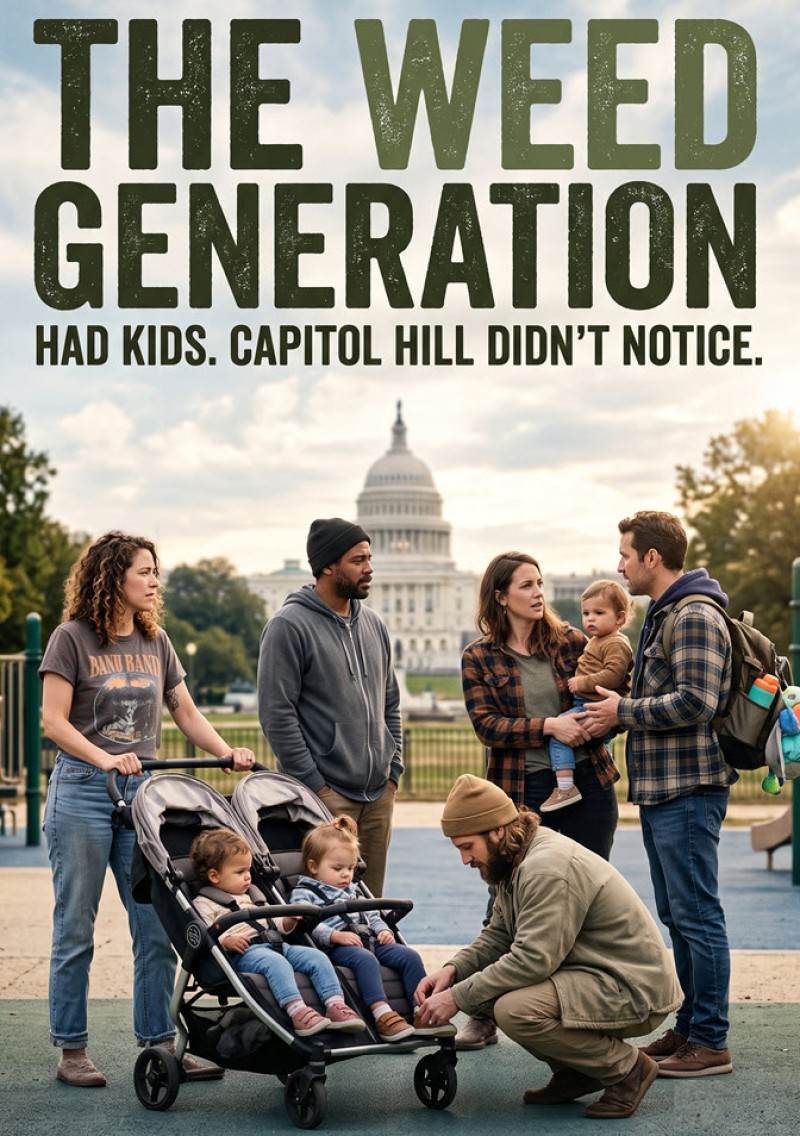
Somewhere in America right now, a parent is putting a toddler to bed, closing the door, and rolling a joint. Not a headline. Not a scandal. Just a Tuesday. And the politicians writing the laws that govern that parent's life are, on average, old enough to be that toddler's grandparent.
That's not a jab. It's a math problem. And it's the one nobody in Washington seems to be doing.
The Parents Are Different Now
Start with who's actually raising kids in America today. The generation currently in the thick of parenting — late twenties through mid-forties — came of age through the internet, through the tail end of the D.A.R.E. era collapsing under its own credibility, through state after state legalizing while the sky stubbornly refused to fall. This is the straddle generation: Gen X and millennial, the ones who watched prohibition-era messaging get quietly retired in real time.
The numbers back up what you'd expect from that. Millennials currently show the highest cannabis use rate of any generation, at 36%, with Gen X close behind at 34% — both ahead of Gen Z and well ahead of Baby Boomers. Millennials alone account for nearly half of all recreational cannabis sales. And the legalization support gap is generational, not partisan in the way people assume: 77% of Democratic millennials and more than half of Republican millennials back legalization, compared to 57% of Gen X and just 38% of Boomers.
This is also, not coincidentally, the exact generation now buried in car seats and school pickup lines.
Why They're Reaching for It
Ask cannabis-using parents why they use, and the answer isn't rebellion. A Marist College poll found the top reason parents cited for cannabis use was simple: relaxation and coping with the stress of parenting — 37% of respondents, well ahead of "just for fun" at 16% or socializing at 10%.
That tracks with a federally funded study out of Sacramento, published in Parenting: Science and Practice and backed by a CDC grant, which followed 77 cannabis-using parents (average age 32, nearly three-quarters mothers) through two weeks of real-time daily surveys. The finding that got headlines: parents who vaped marijuana showed lower odds of aggressive discipline in the hours after use. Modest study, small and self-selected sample, and the authors said as much — but it's a data point suggesting the "chill parent" stereotype might have some functional basis, not just a punchline.
It's not all one direction, and I'd be doing exactly what I criticize other outlets for if I left it there. A separate study of 266 parents recruited through primary care practices found that parents who reported cannabis use also reported more negative parenting behaviors, more anxiety and depression, and more adverse childhood experiences of their own. The catch: once researchers controlled for those other risk factors — the anxiety, the depression, the personal history — cannabis use itself stopped predicting the negative outcomes. Translation: stressed, struggling parents are more likely to use cannabis and more likely to struggle with parenting, but the weed isn't obviously the thing causing the struggle. Correlation doing its usual mischief.
Put those together and you get a more honest picture than either "cannabis moms are neglectful" or "cannabis makes you a zen parent": stressed people reach for a coping mechanism, and for a growing number of parents, that mechanism is a plant instead of a bottle of wine.
The Kids Are Watching a Different Normal
Here's the part that actually matters for the next twenty years. A whole generation of children is being raised watching cannabis treated the way their parents' generation watched a beer after work — unremarkable, occasional, not hidden in shame, not whispered about. Ninety-four percent of Americans now say marijuana is more socially acceptable than it was in previous years. That number doesn't move that fast without kids absorbing it at the dinner table.
My bet — and this is a bet, not a finding — is that most of these kids grow up seeing cannabis as exactly that ordinary. Not a taboo to rebel against, not a gateway to anything, just another adult thing that adults sometimes do to unwind. The forbidden-fruit effect that fueled a lot of reckless teenage experimentation in prior generations loses its power when the fruit isn't forbidden anymore. Whether that produces a healthier relationship with the plant across the population, or just a different set of problems nobody's thought to study yet, is an open question. I don't think anyone honestly knows yet. But normal is normal, and normal is where this is heading.
Meanwhile, on Capitol Hill
Here's where the disconnect becomes measurable instead of just a vibe.
The median age of a U.S. Senator in the current Congress is 64. The median age of a U.S. Representative is 57. The chamber average across both houses sits at 58.9 — making this the third-oldest Congress in American history. The median age of the country they represent is 39.1.
Sit with that gap. The people voting on cannabis scheduling, banking access for dispensaries, research restrictions, and interstate commerce rules are, as a body, roughly two decades older than the median American — and closer to three decades older than the parents doing the actual reaching-for-a-joint-after-bedtime described above. This isn't a fringe issue where you'd expect a generational gap. It's a substance a huge and growing share of the electorate's parents are using in their own homes, regulated by a legislature that skews old enough to remember Reefer Madness re-runs as contemporary programming rather than camp.
That's not an accusation of malice. It's a structural explanation for why the laws keep lagging so far behind the culture. You don't need to believe any individual senator is out of touch to notice that a body with a median age of 64 is going to legislate cannabis differently than a body with a median age of 39 would. Lived experience shapes policy instincts whether anyone intends it to or not.
Where This Leaves Us
The picture that's forming isn't complicated, even if it's inconvenient for both the "cannabis parents are neglecting their kids" crowd and the "cannabis makes you a better parent" crowd. Parents are stressed. A large and growing number of them are managing that stress with cannabis instead of alcohol. The evidence on whether that's better or worse for the kids is genuinely mixed and mostly explained by factors other than the plant itself. And the institution writing the rules for all of it is old enough that its median member came of age when "reefer" was still doing the cultural work "gateway drug" does today.
The culture has already moved. The question isn't whether the next generation will see cannabis as normal — that part looks close to settled. The question is how long it takes the people writing the laws to catch up to the people already living the answer.
PARENTS WHO USE CANNABIS, READ ON...