

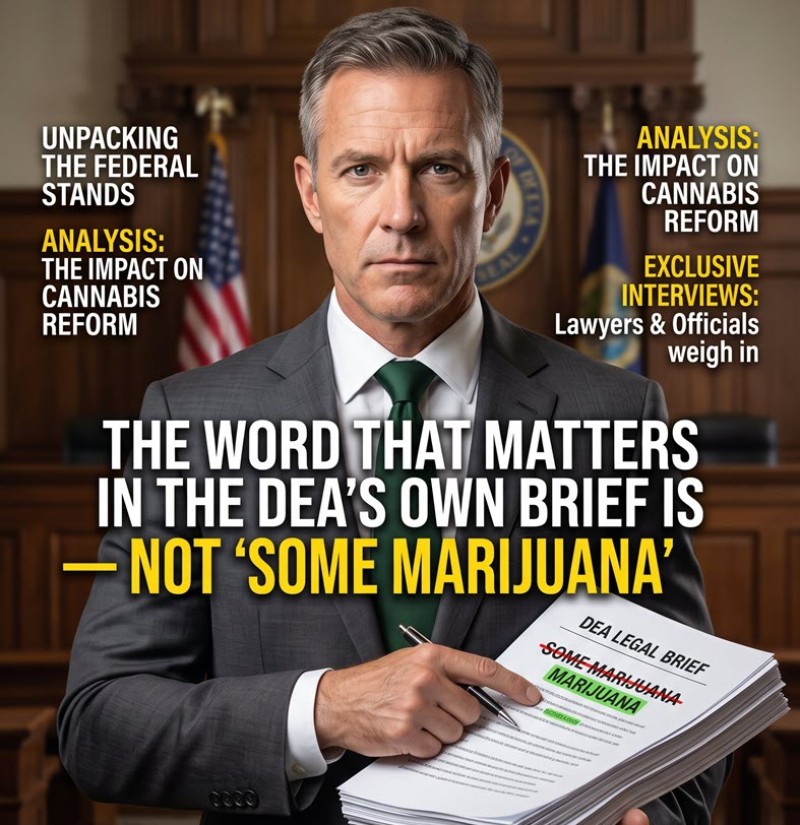

Buried in a 50-page legal brief filed August 17 with a DEA administrative law judge is a sentence that reads almost like a mic drop: "Marijuana can no longer remain in Schedule I." Not "certain formulations of marijuana." Not "FDA-approved marijuana products." Not "state-licensed medical marijuana." Just marijuana, full stop, as the government's own lawyers put it in their closing argument in the ongoing rescheduling hearing, first reported in detail by High Times. That word choice is not an accident, and if you're the kind of person who reads legal language the way sommeliers read tannins, it's worth sitting with, because it may end up mattering more than anything cannabis users actually wanted out of this process.
What Schedule I Actually Requires
Here's the legal hinge nobody argues about: a substance can only stay in Schedule I if it has no accepted medical use. That's not one factor among many — it's the threshold question. The 2023 Health and Human Services scientific review, conducted as part of this same rescheduling process, found accepted medical use in three areas: chronic pain, appetite loss tied to a medical condition, and chemotherapy-induced nausea and vomiting. Under a 2024 Office of Legal Counsel opinion, the DEA has to give that HHS finding “significant deference” rather than re-litigating the science from scratch, and the government's brief makes the obvious point that finding just one accepted medical use is enough to disqualify a substance from Schedule I. That's the legal spine of the whole 50 pages.
The Precedent Nobody's Talking About Enough
Here's the part I think gets lost in the coverage of witness credibility fights and sequestration violations, because it's less dramatic than watching lawyers take apart a sheriff's testimony. Cannabis is not waiting for this administrative hearing to establish that it has accepted medical use in the eyes of the federal government. That already happened. On April 23, 2026, the acting Attorney General signed a final order moving two categories of marijuana — FDA-approved drug products and marijuana handled through state-licensed medical marijuana programs — from Schedule I to Schedule III, effective immediately, under presidential direction from a December 2025 executive order. Multiple law firms tracking cannabis regulation, including Arnold & Porter, Gibson Dunn, and Holland & Knight, confirmed the same basic mechanics of that order: it didn't just protect a single isolated pharmaceutical compound, it covered the plant material moving through legal state medical channels.
That's the tell. Schedule III status cannot legally exist for a substance the government still officially believes has no accepted medical use, because accepted medical use is the specific gate a substance has to clear to leave Schedule I in the first place. So as of April, the federal government is already on record, in a binding legal order, treating marijuana as a substance with government-recognized medical value. Not hypothetically. Not as an aspiration cannabis advocates are hoping a judge grants. As settled administrative fact, already in force, already being relied on by state-licensed operators claiming tax relief and by manufacturers moving product under new registration pathways.
This actually isn't even the federal government's first pass at the idea. Back in 2018, the DEA placed certain FDA-approved cannabidiol products, effectively Epidiolex, into Schedule V rather than treating them as Schedule I marijuana, after the compound cleared FDA approval for treating rare forms of epilepsy. That was a much narrower move, limited to one isolated cannabinoid in one finished drug product. April's order is a different animal, because it swept in plant-derived marijuana moving through ordinary state medical dispensary systems, not just a single manufactured pharmaceutical.
Why “Categorically” Is the Right Word
This is where I'll push back gently on how a lot of cannabis media has framed this fight, because “particular marijuana” and “medical marijuana” are doing a lot of quiet work in most coverage, as if the plant itself splits into legally distinct species depending on who's holding it. It doesn't. Marijuana is one controlled substance under the Controlled Substances Act, defined by its chemical and botanical identity, not by which zip code it's sold in. When the government places marijuana moving through state medical programs into Schedule III, it is making a finding about marijuana, the substance — because that's the only kind of finding the statute allows it to make. The CSA schedules substances, not sales channels.
That's the logical pressure point sitting underneath this entire hearing, and it's arguably the same pressure point the government's own brief is leaning on when it tells Judge Derek Julius that marijuana can no longer remain in Schedule I. You can't coherently hold that a substance has “no accepted medical use” for purposes of keeping most of it in Schedule I, while simultaneously maintaining, in a separate binding order, that the identical substance has accepted medical use sufficient to justify Schedule III status for a meaningful slice of it. Something has to give, and the brief's own language suggests the government knows it.
What This Doesn't Mean
I want to be precise here, because overstating a legal win is its own kind of misinformation, and I'd rather be right than popular. Cannabis users, as a community, have not gotten what most of them have spent years advocating for. This proceeding is not about descheduling. It is not decriminalization. It is not adult-use legalization at the federal level. Schedule III is still a controlled substance schedule — it still means federal registration requirements, still means restrictions that don't remotely resemble how alcohol or tobacco are regulated, and recreational cannabis explicitly remains outside the scope of both the April order and this hearing. If Judge Julius recommends the broader move and DEA Administrator Terrance Cole adopts it, what changes is where the rest of the plant sits on a five-schedule ladder, not whether the ladder itself goes away.
It's also not resolved. The D.C. Circuit is still sitting on a motion to stay April's order, and Julius faces no deadline to issue his recommendation, nor does Cole face one to act on it. Multiple parties opposing rescheduling — Smart Approaches to Marijuana, three state governments, a drug-testing industry group — filed their own closing briefs arguing the legal test itself is illegitimate, calling the two-part medical-use standard the government now relies on a test that was, in one brief's words, made up for this proceeding. That fight over which legal test controls, the older five-factor test or the newer two-part inquiry blessed by the 2024 OLC opinion, is genuinely unresolved and could still change the outcome.
What It Does Mean
Here's where I land: the categorical language matters as precedent, independent of whether this specific hearing goes cannabis's way. Once a federal order exists using marijuana, not a narrow sub-category of marijuana, to justify Schedule III placement, that order becomes a legal fact future litigants, future petitioners, and future courts can point to. It's a crack in the foundation of “no accepted medical use” as applied to the whole plant, put there by the government itself, not by an advocacy group's brief. Litigation is not linear, and precedent doesn't guarantee outcomes, but it does narrow the range of arguments the government can credibly make going forward without contradicting its own prior findings.
So no, nothing changed yet for the person buying flower at a state dispensary or driving across a state line with it in the trunk. But the government just spent 50 pages telling a federal judge, in writing, that marijuana can no longer remain in Schedule I, after already having moved a real slice of it there in April. That's not the finish line. It's a door that's now legally harder to close.
Sources referenced: High Times, “Marijuana Rescheduling: DEA's Final Brief Asks Judge for Schedule III” (Aug. 20, 2026); U.S. Department of Justice Office of Public Affairs order announcement (April 23, 2026); Arnold & Porter, Gibson Dunn, Holland & Knight, and Dickinson Wright legal client alerts on the April 2026 rescheduling order; Congressional Research Service Legal Sidebar LSB11424.
DEA ON RESCHEDULING, READ MORE...