
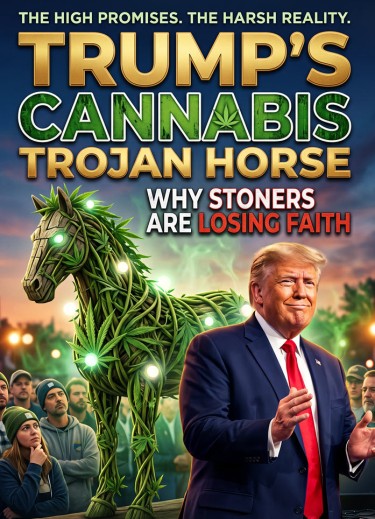
There’s an old rule in politics: you can fool a voting bloc once with a promise, but you can’t keep fooling them once they start doing math. Cannabis consumers just did the math.
According to the latest quarterly NuggMD/Marijuana Moment tracking poll, only 48 percent of marijuana consumers now approve or strongly approve of the Trump administration’s cannabis actions. That’s down from 73 percent last quarter. Thirteen percent disapprove, and a striking 40 percent have simply checked out into “no opinion” territory. When four in ten of your most engaged constituency shrugs at you, that’s not apathy. That’s disillusionment wearing apathy’s coat.
I want to sit with that number for a second, because it’s not a random wobble. It’s a straight line down from a peak, and the peak itself tells you everything about how this game is played.
The Sugar High and the Crash
Rewind to the end of 2025. Cannabis consumer approval of Trump sat at a pathetic 6 percent. Then, in December, the president signed an executive order directing officials to move forward on rescheduling. Approval rocketed to 73 percent almost overnight. That’s not enthusiasm for a policy that had been implemented — it’s enthusiasm for a promise. A press release. An order to consider doing something.
Then, in April, Acting Attorney General Todd Blanche actually did something concrete: he reclassified state-licensed medical cannabis and FDA-approved cannabis products from Schedule I to Schedule III. A separate hearing began, overseen by a DEA judge, to decide whether to move all marijuana — recreational included — to Schedule III more broadly. Testimony in that hearing wrapped up last week. Final briefs are due August 17. Then the judge makes a recommendation, and the DEA administrator makes the actual call.
Notice what’s missing from that timeline: recreational users. Medical cannabis patients got their reclassification. Everybody else got a hearing schedule and a promise that the grown-ups are still discussing it.
That gap between “medical rescheduling happened” and “the thing that would actually matter to the 24 states with adult-use markets is still pending” is exactly where consumer trust went to die. NuggMD’s director of content, Tyler Elson, put it plainly: there’s a clear divide between support for medical rescheduling and support for the broader recreational reforms consumers actually wanted. A separate poll this month found most cannabis consumers don’t even believe rescheduling will be fully implemented by the end of the year.
Here’s the part I find almost admirable in its cynicism: 54 percent of cannabis consumers say they’d support the administration “much more” or “a bit more” if it fully legalized cannabis. Thirty-nine percent said “much more.” That’s a voting bloc handing the administration a blueprint for how to keep their support, and the administration choosing, instead, to litigate a Schedule III hearing that a House committee already voted to try to block in May — while cannabis companies, per Marijuana Moment’s own newsletter this week, are busy cutting checks to a Trump-linked PAC. Draw your own conclusions about where the actual lobbying energy is going.
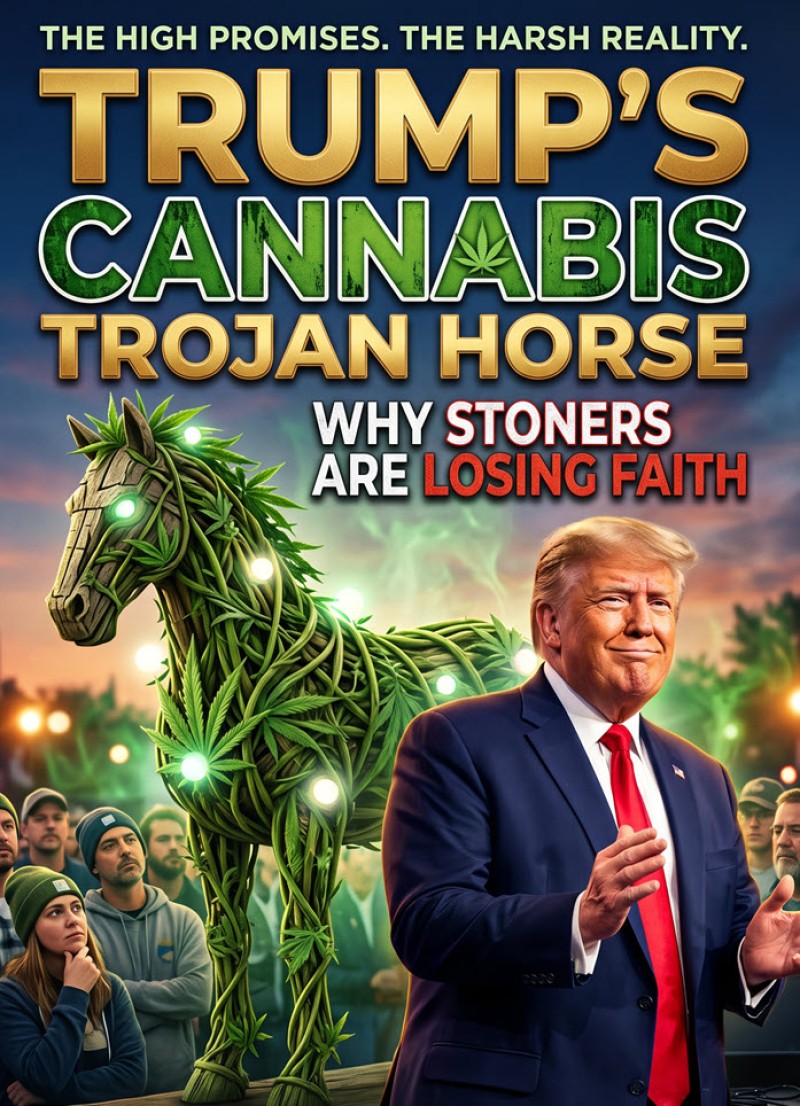
The Trojan Horse Theory
Now, depending on who you ask, Trump is either heaven-sent or a spawn of Satan. I fall into neither camp. My working theory is that Trump functioned less as an ideological standard-bearer and more as a hostile takeover vehicle for a Republican Party that had grown allergic to its own base’s actual grievances.
Here’s the thing nobody on cable news wants to say plainly: most Americans didn’t care whether their neighbor transitioned, came out, or lived however they wanted. But during the Biden years, a specific strain of institutional moral pressure — the sense that disagreement, or even silence, made you a bigot by default — combined with Twitter-era censorship, unchecked illegal immigration, and eye-watering federal spending to produce a genuine backlash. Not necessarily a backlash against the underlying causes, but against the tone. Against being lectured. A lot of people who otherwise couldn’t care less about culture-war minutiae looked at the whole circus and said, essentially, “to hell with this,” and reached for the political option that felt like a middle finger to the people doing the lecturing.
Trump was that middle finger. The “devil we know” option. Except this devil turned out to be running a different con than the one his voters signed up for. Cannabis reform is a clean case study: reform is “overwhelmingly popular” with voters, according to White House Press Secretary Karoline Leavitt back in April — and it is, genuinely, popular across party lines. So the administration invoked it, took credit for an executive order, and has since let the actual mechanism grind through a DEA hearing process that’s simultaneously being challenged in court by the drug-testing industry, a pharmaceutical company, and legalization opponents. Promise the base the moon, deliver a hearing schedule, bank the approval-rating bump in the meantime. That’s not reform. That’s harvesting a constituency’s hope as a renewable resource.
What Happens When the Grift Comes Undone
I don’t think cannabis consumers losing trust in Trump is a new story. It’s the entirely predictable next chapter of an old one — the moment when a grift’s arithmetic stops working because the marks have started keeping score. And the interesting question isn’t really about marijuana policy anymore. It’s about what happens to a coalition once enough of its pieces figure out they were promised more than they’re getting.
I think we’re watching the early tremors of a real political realignment, and I don’t think it plays out over one election cycle — I think it’s a decade-long process. Tucker Carlson and others have been floating third-party trial balloons, and for the first time in my adult life, the conditions for an actual third party feel less like fantasy and more like arithmetic. An “America First” formation that’s genuinely populist, skeptical of endless foreign entanglements, and unbeholden to either party’s donor class could peel off pieces of both coalitions — the MAGA voters who feel used, and the disaffected independents who never had a real home to begin with. Whether that formation would frame Israel policy as the central grievance, as some in that lane already do, I genuinely don’t know — that’s speculation on my part, not reporting, and it’s a claim serious people disagree about. But the underlying mechanism — a base realizing its loyalty was rented rather than earned — is not speculation. That’s just what a 25-point quarterly approval collapse looks like in real time.
The Sticky Bottom Line
Cannabis consumers aren’t a fringe constituency anymore — they’re a multi-billion-dollar, multi-state voting bloc that helped hand Trump credibility on an issue where his own party’s committees are actively trying to slow him down. When 40 percent of that bloc goes numb and 54 percent tell you exactly what would win them back, and the response is another hearing date, you’re not looking at a policy failure. You’re looking at a trust failure. And trust, unlike a Schedule III filing, doesn’t come back just because the paperwork eventually clears.
August 17 is the next real checkpoint. I’ll be watching the briefs, not the press releases.
THE RISE AND FALL OF CANNABIS UNDER TRUMP, READ ON...
THE RISE AND FALL OF CANNABIS UNDER TRUMP, IS THERE HOPE?