
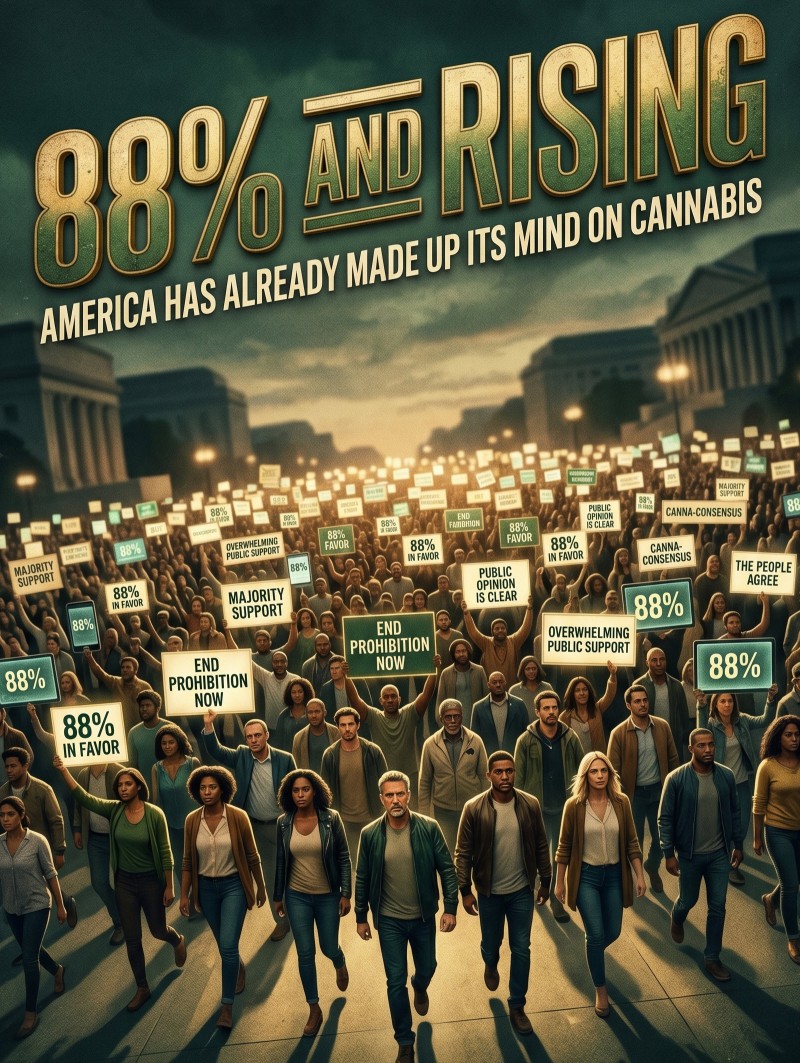
Eighty-eight percent. Let that sit for a moment. According to the latest nationwide polling from Pew Research Center, released May 26, 2026, only one in ten American adults thinks cannabis should remain fully illegal. That's it. One in ten. The same fraction that still believes the Earth is flat, that cursive handwriting is essential life infrastructure, or that dial-up internet was fast enough.
And yet, here we are. Federal prohibition still standing. The DEA still scheduling hearings. Elected officials still hedging. The gap between what Americans want and what American policy delivers has become so wide you could park a dispensary in it — which, incidentally, 79% of Americans now live close enough to do.
NORML's Deputy Director Paul Armentano put it plainly: "Elected officials who refuse to take action to end cannabis criminalization, or who vote to stand in the way of these reform efforts, do so at their own political peril." That's not advocacy rhetoric. That's arithmetic.
The Numbers Are Not Close
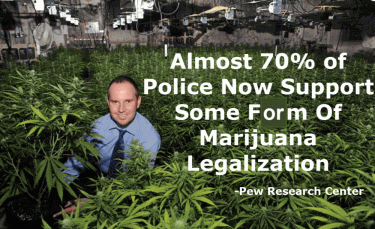
The Pew breakdown: 55% of Americans support full adult-use legalization. Another 33% support medical-only access. Combined, 88% want some form of legal cannabis. The remaining 12% who support blanket prohibition represent the narrowest prohibitionist coalition in modern American history.
Support skews younger and more liberal, as it has for years. The 18-to-29 demographic is the most enthusiastic. The oldest and most conservative Americans remain the holdouts. This is not a surprise. It is also not a stable political position, because demographics are not static. The 75-and-over crowd opposed to cannabis is, bluntly, on a biological clock. The 18-to-29 crowd supporting it is the future of the electorate. Prohibition is losing its bench by attrition.
Twenty-four states have legalized adult-use cannabis. Forty-one states regulate medical access. More than half of Americans already live somewhere with a legal adult market. This is not a fringe position creeping toward the mainstream. The mainstream long ago arrived at legalization. The federal government is what's trailing.
The 'Slight Decline' That Keeps Getting Cited
Every few months someone writes the same article. Cannabis use ticked down a percentage point or two. Youth consumption dipped slightly. Support for legalization dropped marginally from its 2022 peak. The subtext is always the same: see, the tide is turning, prohibition was right all along.
This framing is dishonest. A 3-point dip from an all-time high still leaves you at an all-time near-high. Eighty-eight percent is not "declining support." It is overwhelming consensus with minor statistical noise. The United States Supreme Court rarely sees that kind of agreement on anything. Congress hasn't managed it since declaring war on Japan.
Yes, some Americans who were casual legalization supporters have grown more cautious. Concerns about potency, youth access, and the oversaturated legal market are real and worth discussing. But "worth discussing" and "therefore prohibition" are not the same sentence. You don't respond to concerns about drunk driving by re-banning alcohol. You regulate, educate, and enforce responsibly. The same logic applies here, and the American public already understands this.
The Alcohol Parallel That Nobody Wants to Say Out Loud
Cannabis isn't risk-free. I've said that before, I'll say it again, because it's true and pretending otherwise is bad advocacy. Heavy adolescent use carries real developmental risks. High-potency products affect people differently. Some individuals are more susceptible to anxiety or dependence than others. These things are true.
They are also true of alcohol. Alcohol causes liver disease, cancer, fetal alcohol syndrome, cardiovascular damage, and addiction at rates that dwarf anything cannabis produces. Alcohol-related traffic fatalities run around 13,500 per year in the United States. The lethal dose of cannabis is so high it's essentially theoretical. Nobody has died from a THC overdose in the clinical sense. Nobody.
The public has already done this math. That's why 88% of them don't want prohibition. They aren't cannabis evangelists claiming the plant is a miracle with zero downsides. They're pragmatists who can see that the risk profile of cannabis is manageable, that adult regulation is possible, and that spending billions on enforcement to maintain a prohibition that fails by every measurable metric is indefensible.
The managed-risk framework is already alive in the legal states. Colorado, California, Washington, Illinois — these aren't drug-addled hellscapes. They're states with regulated dispensaries, age verification, packaging requirements, testing standards, and tax revenue funding schools and infrastructure. The sky did not fall. It rarely does when you trust adults to make decisions.
Who Benefits From Pussyfooting?
The gap between public opinion and federal policy does not exist by accident. It exists because specific interests benefit from the gap's persistence.
The pharmaceutical industry has a vested interest in cannabis remaining Schedule I, or hovering in a Schedule III limbo that lets them control the research pipeline and eventual product forms. Alcohol and tobacco lobbies have historically funded anti-legalization campaigns because cannabis is a competitor. Private prison industries depend on drug arrests to fill beds. Law enforcement agencies have built budget justifications around drug enforcement for fifty years.
None of these interests are the American public. Not even close.
Meanwhile, the cannabis industry itself remains hamstrung by 280E tax provisions that treat plant-touching businesses like drug traffickers for IRS purposes, banking restrictions that force cash-only operations, and a Schedule I designation that makes serious federally-funded research nearly impossible. We are simultaneously telling the public that cannabis remains too dangerous to legalize while denying researchers the tools to study it properly. The circular logic is breathtaking.
Cannabis Is Here. The Question Is How.
The plant isn't going anywhere. Americans are already consuming it at rates that exceed daily alcohol consumption, according to recent survey data. The black market doesn't care about federal scheduling. It doesn't ID teenagers. It doesn't test for contaminants. It doesn't pay taxes. Every day that legal reform stalls is another day unregulated, untested, untaxed cannabis moves through underground channels.
Pussyfooting about legalization helps nobody except the people who profit from the status quo. The 88% of Americans who want some form of legal cannabis aren't asking for chaos. They're asking for the same common-sense framework that governs every other adult product: regulation, age limits, testing, and the basic dignity of not being treated as a criminal for a personal choice that harms nobody else.
Sixty years of prohibition has produced exactly one reliable data point: it doesn't work. The drugs didn't disappear. The market didn't shrink. The public didn't comply. The only things prohibition reliably produces are black markets, racial disparities in enforcement, and a stubborn 88% of the population telling every pollster they've had enough.
The numbers are not ambiguous. The direction is not unclear. The only question left is how long elected officials plan to pretend they haven't seen the data.
Sources: Pew Research Center, May 26 2026 (pewresearch.org); NORML, May 27 2026 (norml.org); CDC alcohol mortality data; NORML polling archive (norml.org/marijuana/library/surveys-polls/).
CANNABIS SUPPORT AMONG POLICE, READ ON...