

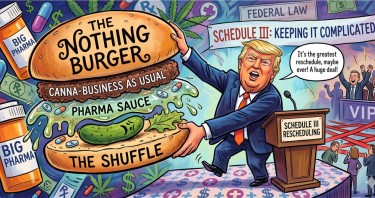
Let's get one thing straight before the spin machine buries it: the federal rescheduling of cannabis from Schedule I to Schedule III did not happen because Donald Trump had a change of heart about the plant. He didn't wake up one morning with a profound respect for the 50-year fight cannabis advocates have waged against the federal government. This process started in October 2022 when President Biden directed the Department of Health and Human Services and the DEA to review how marijuana is scheduled under the Controlled Substances Act. Biden's HHS recommended Schedule III. Biden's DOJ proposed the rule. That effort stalled in bureaucratic limbo before Biden left office. Trump then signed an executive order in December 2025 telling his attorney general to finish the job someone else started.
He's now standing at the podium taking a bow for someone else's touchdown.
What This Actually Does (And What It Doesn't)
The DEA's final order, issued April 22nd, does not reschedule all marijuana. It only moves specific categories into Schedule III: FDA-approved drug products containing marijuana, marijuana extracts contained in FDA-approved products or subject to a state medical marijuana license, and marijuana subject to a qualifying state-issued medical marijuana license.
Read that again slowly.
Everything else, including unlicensed bulk marijuana, anything not in an FDA-approved product, synthetic THC, and all recreational marijuana, remains in Schedule I. These categories remain illegal under federal law.
So if you're one of the 24+ million Americans who use cannabis recreationally, this announcement means absolutely nothing to you. Your federal status hasn't changed by a single scheduling tier. You are still, in the eyes of the federal government, in the same category as a heroin user.
The wins that do exist are real but narrow. State medical marijuana licensees are no longer constrained by the Section 280E deduction ban, which only applies to Schedule I and II substances. That's genuinely useful for medical operators who have been paying taxes on gross revenue with no deductions, a tax burden that has crushed smaller operators for years. State-licensed cannabis operators can now apply for a federal DEA Schedule III registration through a new expedited process. And some criminal penalties tied to scheduling will decrease, though mandatory minimums under 21 U.S.C. § 841, based on drug quantity, aren't touched by this change.
So the people most at risk of going to federal prison for cannabis? Still going to federal prison.
The Corporate Fingerprints Are All Over This
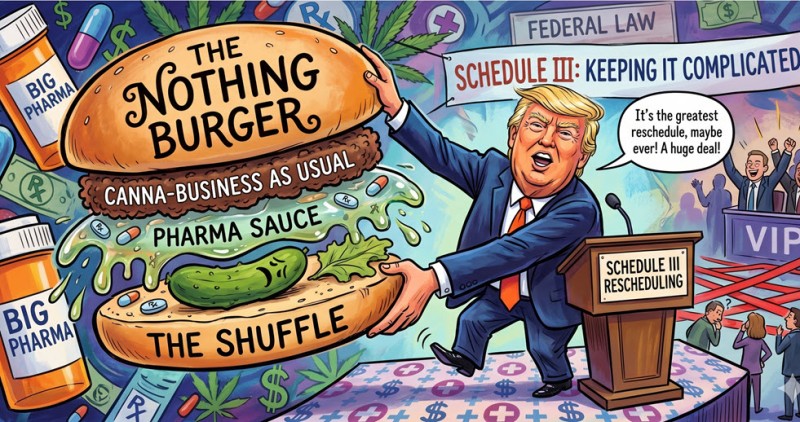
Look at who benefits. The order specifically covers FDA-approved drug products containing marijuana, which means pharmaceutical companies who have already navigated the FDA approval process are the primary beneficiaries of immediate federal recognition. The cannabis that tens of millions of Americans actually use, grown by independent operators, sold through state-licensed dispensaries, purchased by adults exercising their legal rights under state law, doesn't qualify.
Critics are concerned the policy could create a two-track system for drug development that may allow developers to bypass the FDA process entirely in favor of state-level pathways. What that actually looks like on the ground is a system where Big Pharma's cannabis-derived products sit comfortably in Schedule III while your dispensary-bought flower stays in Schedule I alongside heroin. The pharmaceutical industry gets a federally recognized lane. Everyone else gets a hearing scheduled for June 29th.
This isn't cannabis reform. It's market positioning.
A Drowning Man Grabs Any Rope
Here's the context the press releases won't give you. As of late April 2026, approximately 39 percent of Americans approve of Trump's job performance, while 57.7 percent disapprove, with his net approval hitting a second-term low of -18.8. Net approval has declined from +6 in January 2025 to -26 by March and April 2026, with Reuters attributing the sustained weakness to economic dissatisfaction. His economic approval rating dropped to 32 percent, with 13 percent strongly approving, and 52 percent of those disappointed with his economic handling say they strongly disapprove.
Among Gen Z voters, Trump's approval collapsed from +9 in February 2025 to -42 by February 2026, the lowest level ever recorded for this age group in that survey series. Young Americans, who skew heavily toward cannabis legalization, are watching.
The midterms are in November. The math isn't complicated.
Trump told donors in August 2025 he was "interested" in reclassification and that an announcement was coming "in weeks." Reports suggested the administration would order rescheduling before year's end. He waited four months past that. The announcement finally dropped when the polling numbers hit the floor. That's not policy leadership. That's a Hail Mary from a quarterback who threw three interceptions.
An Insult Dressed Up as Progress
Cannabis advocates have been fighting this fight since before most of Washington's current power brokers knew what a terpene was. NORML petitioned the government to reschedule cannabis back in 1972. Fifty-four years of petitions, lawsuits, state ballot initiatives, civil disobedience, and political organizing. People lost careers, families, and decades of their lives to federal prosecution over a plant that 38 states now recognize as having medical value and 24 states have legalized outright.
And the federal government's answer in 2026, after all of that, is to move select pharmaceutical-adjacent cannabis products one tier on a scheduling chart while recreational users, who represent the overwhelming majority of actual cannabis consumers in America, stay exactly where they were.
Rescheduling is movement. It is not freedom.
The advocates who marched, lobbied, and bled for this issue didn't fight for a better tax situation for licensed medical operators. They fought for the end of a prohibition that was, by the government's own belated admission, built on fraudulent science and racist enforcement. Schedule III doesn't expunge a single record. It doesn't release a single person from federal prison. It doesn't touch mandatory minimums. It doesn't legalize the plant that 70 percent of Americans now support legalizing.
What it does is hand pharmaceutical companies a regulatory advantage, give Trump a headline going into a brutal midterm cycle, and allow the administration to claim credit for a process Biden started and Trump's own DEA spent months trying to slow down. The prior rulemaking proceedings were stuck in a quagmire over the integrity of actions taken by the last DEA administrator, who allegedly was undermining the rescheduling process. The administration that inherited and nearly killed this process is now the one cutting the ribbon.
The Legacy Problem
Trump's political legacy is becoming a cautionary tale in real time. The base that carried him to two terms contains a significant slice of libertarian-leaning voters who care about cannabis freedom. He's now delivered them a corporate-structured half-measure that primarily benefits the pharmaceutical and medical-licensing establishment while leaving recreational users untouched. He sold out his libertarian flank to pharma interests while claiming credit for Biden's homework.
A new administrative hearing on broader rescheduling will commence June 29, 2026, to consider whether cannabis more broadly should be moved from Schedule I to Schedule III. June 29th. Five weeks before the midterm campaign season hits full stride. That timing is not a coincidence.
The cynicism here is so thick you could roll it up and smoke it, if the DEA would let you.
If you're going to reform cannabis policy, reform it. Deschedule it. Expunge the records. Let the legal market compete without pharmaceutical gatekeepers. Stop handing the plant's future to the same industry that spent decades lobbying to keep it illegal.
This isn't liberation. It's the federal government deciding which corporations get to profit from the thing they spent 50 years criminalizing, with a press release timed for maximum political benefit and minimum actual change.
Cannabis users deserved better. They've always deserved better.
TRUMP 2.0 AND CANNABIS REFORM....READ ON.