
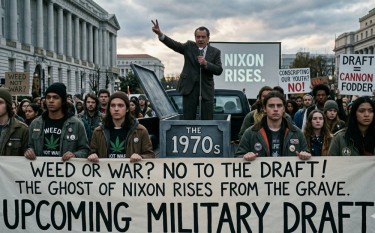
Weed, War, and the Ghost of Nixon: A Pattern That Keeps Repeating
There's a line you can draw from Vietnam to the War on Drugs, and from the War on Drugs to where we sit today — cannabis still federally illegal, wars nobody asked for burning through billions, and a president who rhymes with the last one who used the drug war as a weapon. If you can't see the shape of it, you're not looking.
Let me walk through it.
Vietnam Broke the Draft. Nixon Fixed It With Weed.
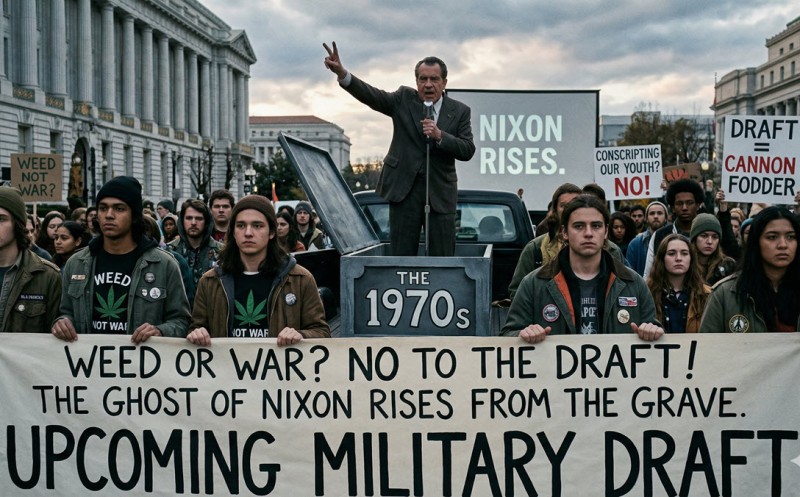
By 1970, Vietnam was deeply unpopular. Anti-war sentiment had fused with the counterculture — long hair, protest music, and cannabis. These weren't separate threats in Nixon's mind. They were the same threat. His domestic policy chief, John Ehrlichman, was explicit about this years later. In a 1994 interview published in Harper's Magazine in 2016, Ehrlichman said: "We knew we couldn't make it illegal to be either against the war or Black, but by getting the public to associate the hippies with marijuana and Blacks with heroin, and then criminalizing both heavily, we could disrupt those communities."
That's not conjecture. That's a Nixon aide describing the strategy on record.
The Controlled Substances Act passed in 1970. Cannabis landed in Schedule I — more dangerous than cocaine, allegedly. The timing wasn't coincidence. It was policy designed to criminalize dissent and strangle the anti-war movement at its cultural roots.
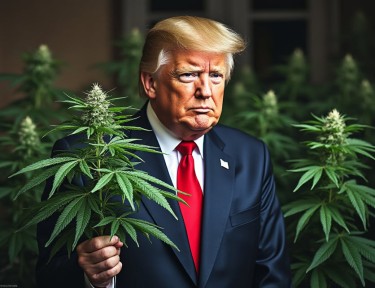
Trump and Nixon: Two Presidents, One Playbook
You don't have to squint hard to see the parallels. Nixon was a law-and-order president who weaponized federal agencies against political enemies, escalated a war he inherited, used moral panic to consolidate power, and ran a domestic drug policy built more on politics than pharmacology. He resigned in disgrace.
Trump in his second term is operating in an eerily similar register. The rhetoric around drugs — fentanyl, the border, cartel activity — has been maximalist and deliberately inflammatory. His DEA under this administration has shown zero urgency toward the rescheduling process that Biden's DOJ had initiated. The Schedule III rescheduling recommendation from the FDA, which moved forward in 2024, has stalled in administrative limbo. Meanwhile, Trump's broader posture has been hawkish: tariffs read as economic warfare, NATO relationships fraying, and open flirtations with military posturing toward Greenland, Panama, and Canada — actual NATO allies.
This isn't policy competence. It's familiar chaos with a familiar purpose.
The Recruitment Problem Nobody Wants to Talk About
The U.S. Army missed its recruiting targets by roughly 25% in 2022. The Marines and Navy weren't far behind. The pool of eligible recruits is shrinking for several overlapping reasons: obesity rates, mental health disqualifications, criminal records, and cannabis use. Roughly 18% of Americans — about 49.6 million people — use cannabis, with the highest usage concentration among males of military age.
The House-approved NDAA included a provision that removed mandatory marijuana testing as a condition of military enlistment. The same bill included automatic Selective Service registration for men 18-26. Read those two moves together: you're removing a disqualifier while simultaneously expanding the registered pool.
The DOD was also required, under that same NDAA, to report on how many service members had been discharged for cannabis use over the prior decade. That number, when it comes out, is going to be significant. The military has been throwing out trained, experienced people over legal weed in 38 states. That's the kind of institutional waste you only bother auditing when you're planning to stop doing it.
Vietnam Again, in Slow Motion
The wars currently burning are not small. Ukraine grinds on. Gaza. Red Sea shipping disruptions. Taiwan tension ratcheting. U.S. troops are positioned near Russian borders in Poland and the Baltics. Russia reportedly tested a hypersonic missile system in 2024. Saudi Arabia has moved to price some oil transactions outside the petrodollar framework — a structural shift in dollar dominance that doesn't headline well but matters enormously to how the U.S. funds its foreign policy.
When the economic engine that underwrites American hegemony starts rattling, historically, the military-industrial complex finds a gear. Boeing, Raytheon, Lockheed Martin, and the funds that hold them have had strong quarters.
The parallels to early Vietnam escalation are structural, not decorative. The U.S. didn't formally announce it was going to war in Southeast Asia. It crept. Advisors. Equipment. Funding. Then bodies.
The Narrative Comes Before the Policy
The pattern is documented. Iraq 2003 — the WMD narrative ran 12-18 months before the invasion. The Patriot Act's surveillance infrastructure pre-existed 9/11; the event just opened the window to execute it. Vietnam conscription was preceded by years of escalating communist threat rhetoric.
Narrative first. Policy second.
Right now the cannabis narrative is fragmented. You have conservative media pushing it culturally, parental groups framing it as a youth mental health crisis, some "national fitness" rhetoric creeping in. It's not yet consolidated around a specific civic frame — nothing like "cannabis is incompatible with serving your country" has gone mainstream.
That's the tell to watch. When the framing shifts from "it's bad for your brain" to "it's bad for national readiness," you'll know the next move is policy. And that policy won't be decriminalization.
The Uncomfortable Through-Line
The last time this country fought an unwinnable war, the government used drug prohibition to suppress the people who noticed first. The plant got scheduled. The protesters got criminalized. The veterans came home to nothing, and many of them found that same plant was the only thing that touched their PTSD.
Now we have a new unwinnable war — or several — a president who governs by grievance the way Nixon did, a military struggling to fill its ranks, and cannabis still caught in federal scheduling purgatory despite a majority of Americans supporting full legalization.
The scheduling limbo isn't an accident. It keeps cannabis criminalized enough to disqualify people, control communities, and use as a political lever when needed. A fully legal plant is a plant nobody can threaten you with.
That's always been the point.
The question worth sitting with is this: if this administration decides it needs bodies for a conflict the public won't volunteer for, will it loosen cannabis restrictions to draft a bigger pool — or tighten them to control who dissents? History says it can go either way. Nixon went tight. The current NDAA went loose.
Both are moves. The game is the same.
This article draws on documented statements including the 1994 Ehrlichman interview published in Harper's Magazine (April 2016), the House-passed NDAA provisions on cannabis testing and Selective Service (2024), SAMHSA data on cannabis use prevalence, Army recruiting shortfall reporting (2022-2023), and the FDA/DEA rescheduling process initiated under the Biden administration.
IS TRUMP NIXON 2.0 , READ ON..