

They Told You Weed Would Disqualify You. Now They Need You Anyway.
A few weeks ago, I wrote about a pattern that's been bothering me for a while — mainstream media's coordinated pivot back toward cannabis alarmism, arriving suspiciously close to military buildup, Middle East escalation, and quiet conversations in Washington about whether the Selective Service still has teeth.
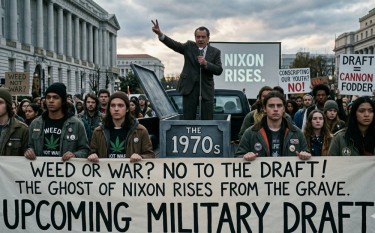
The theory, loosely put: the state has a history of suppressing cannabis when it needs compliant, drug-free recruits. Nixon did it. The Vietnam era anti-war movement and cannabis were inseparable. And the timing of the current media narrative shift felt less like journalism and more like groundwork.
Then this landed in my inbox last week.
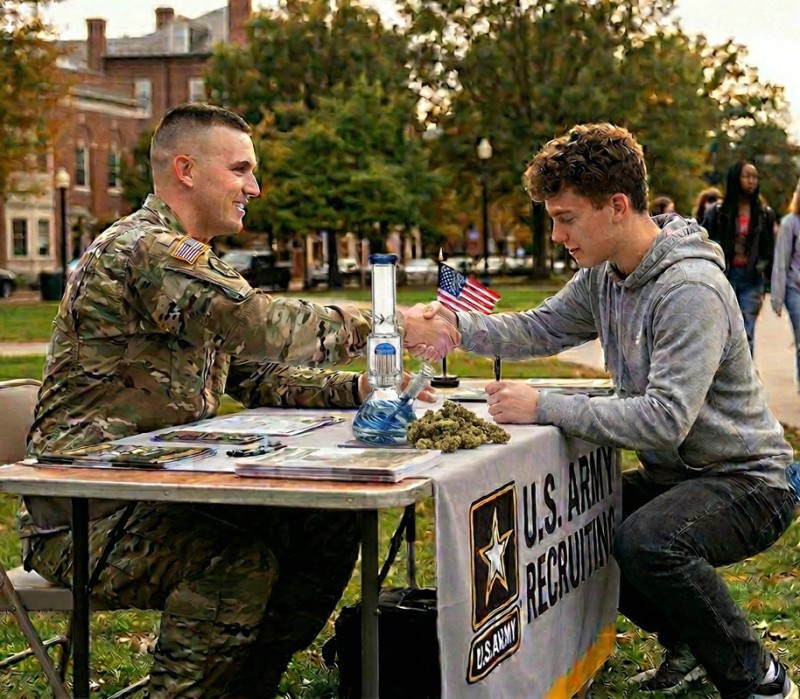
The United States Army just quietly removed one of its longest-standing barriers to enlistment. Recruits with a marijuana-related conviction were previously required to undergo a two-year waiting period, seek a special Pentagon waiver, and pass a drug test. Those restrictions have now been dropped for anyone with a single conviction for possessing marijuana or marijuana-related paraphernalia. norml
Let that sit for a second.
The same federal government that has spent 80-plus years telling you that cannabis is a dangerous Schedule I substance with no accepted use, that has arrested millions of Americans for possession, that has denied veterans access to medical cannabis while they dealt with PTSD from wars those same officials sent them to fight — that government just said: actually, your weed conviction is no longer a problem. We need the numbers.
Why Now?
The Army didn't do this because they had an ideological awakening about cannabis justice. Army representative Col. Angela Chipman framed the decision around legal reality, noting that most states now regulate cannabis for medical or adult-use purposes, and asked the obvious question about whether holding people to a conviction that is legal in some states still makes sense. norml
That's a reasonable argument. It's also an argument that cannabis advocates have been making for the better part of a decade, while the federal government consistently refused to act on it. The thing that changed isn't the logic. The thing that changed is the recruitment numbers.
Military officials have been walking back enlistment standards steadily since falling short of recruitment targets in 2022. norml This cannabis move is one in a series of rule relaxations designed to widen the pool of eligible bodies. They're not doing cannabis consumers a favor. They're doing the Army a favor.
NORML's Political Director Morgan Fox put it cleanly: "This particular policy shift appears to be largely opportunistic and not in any way reflective of a broader shift in the federal government's stance toward those who consume marijuana responsibly." norml
He's right, and the contrast he draws is damning. For years, advocates have pushed for federal changes to provide medical cannabis access to military veterans and secure federal employment for those with prior cannabis use history — and the federal government has consistently ignored or resisted those reforms. norml Federal prosecutors are still charging people for simple possession on federal land. Low-level cannabis arrests are still being used to trigger deportations. Rescheduling remains stalled despite an executive order from December.
The government will take your cannabis conviction off the table when it needs to send you somewhere. It won't take it off the table for anything else.
The Contradiction in Plain View
Here is the position the US federal government currently holds, simultaneously, in the same calendar year:
Cannabis is still a Schedule I controlled substance, meaning — officially — it has no accepted medical use and a high potential for abuse.
Cannabis convictions are still grounds for deportation.
Federal employees in certain positions still cannot use cannabis legally, in states where it is fully legal, without risking their jobs.
Veterans still cannot get medical cannabis recommendations through VA doctors in most contexts.
And cannabis possession convictions — the kind that put Americans in cages, that ended careers, that stripped voting rights, that built the $50 billion prison industry — are now fine for Army enlistment purposes, effective immediately.
The federal government has not changed its mind about cannabis. It has changed its math.
What This Confirms
The previous article I wrote raised a question about whether the suppression of cannabis had a strategic military logic to it — that keeping the drug demonized kept the recruitment pool cleaner, the workforce more compliant, and the protest culture quieter.
This development doesn't fully answer that question. But it does reveal something important about how the federal government actually relates to cannabis policy: not as a matter of science, or public health, or constitutional rights — but as a lever. They pull it one direction when they need to restrict. They push it the other direction when they need recruits.
Cannabis consumers have always been the pawn in this game, not the player.
NORML's Morgan Fox put a sharper point on it than I could: "It's time to start treating cannabis consumers like people, not political pawns." norml
The Army just demonstrated, without meaning to, exactly why that statement still needs to be made.
WEED AND THE MILITARY DRAFT, READ ON...