
Congress just bought itself another month to figure out what it thinks about hemp. On Saturday, the Senate voted 61-32 to table an amendment from Senator Ted Budd that would have let a federal ban on most hemp-derived THC products take effect on schedule. Instead, the ban that Congress passed last year now starts December 11 instead of November 12, and the $28 billion hemp industry gets a brief reprieve while lawmakers try to write actual regulations instead of a blanket prohibition.
Buried in that continuing resolution is a phrase that deserves more scrutiny than it's getting: a carve-out that allows immediate recriminalization, even during the delay, of cannabinoids "that are not capable of being naturally produced by a Cannabis sativa L. plant." In plain English, lawmakers drew a line between hemp products and something they're calling "synthetic" cannabinoids. Attorneys general, senators, and industry lobbyists have all been throwing the word "synthetic" around for months now, usually to score a point rather than clarify one. So let's do the thing nobody in Washington seems interested in doing. Let's actually define it.
Synthetic Just Means "Made in a Lab," Not "Dangerous"
Strip away the political baggage and "synthetic" is a chemistry term. It describes a compound assembled through a manufactured chemical process rather than pulled directly out of a living organism. That's it. Aspirin is synthetic. Insulin used by millions of diabetics is synthetic. Vanillin, the compound behind most vanilla flavoring on earth, is overwhelmingly synthetic because there isn't enough vanilla orchid on the planet to meet demand. Being synthetic tells you nothing about safety. It tells you about origin.
The confusion around cannabis happens because the word gets deployed as a scare tag rather than a chemistry description. When a state attorney general says hemp companies are peddling "synthetic THC," the average reader pictures a meth lab. What they should picture depends entirely on which compound we're actually discussing, and here the industry itself has done a lousy job drawing the distinction.
K2 and Spice Are the Real Deal
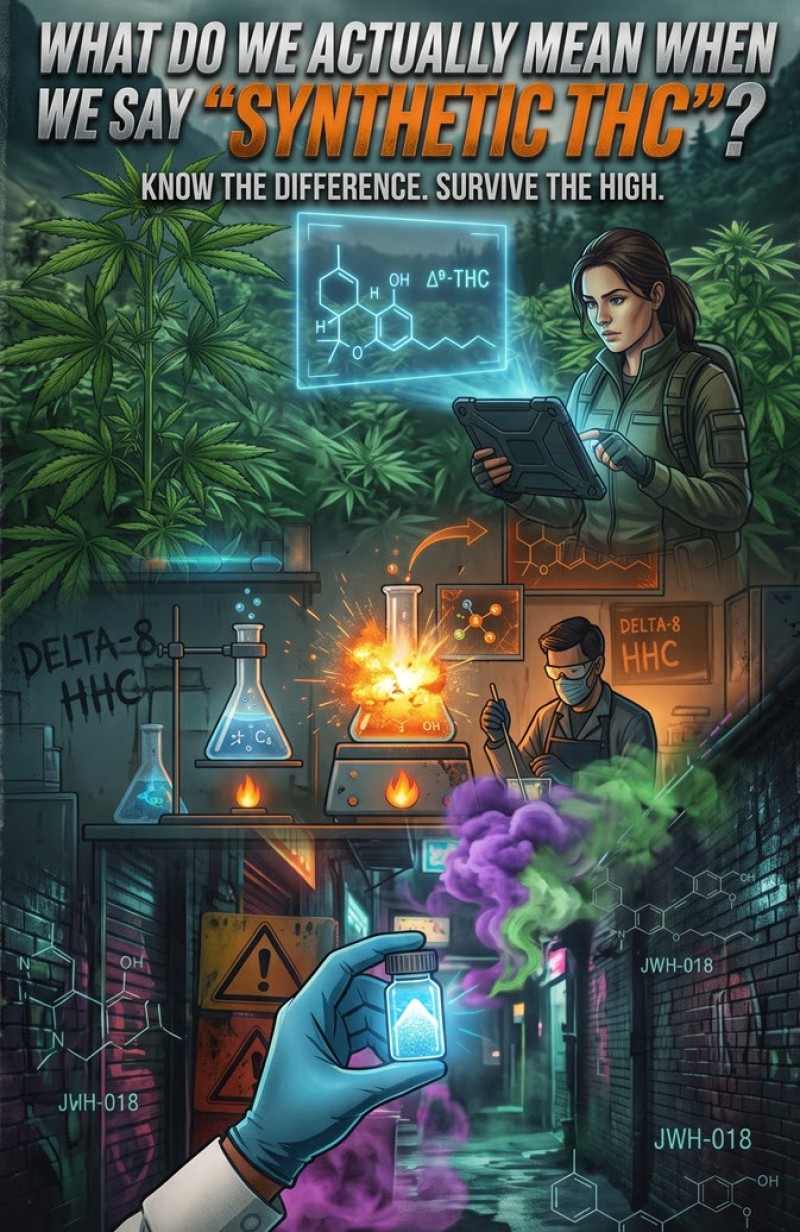
If you want to see actual synthetic cannabinoids, look at K2 and Spice. These are street names for a category of designer drugs first cooked up in academic labs in the 2000s to study how the endocannabinoid system works, then reverse-engineered by black market chemists once the recipes leaked. Compounds like JWH-018 and AB-FUBINACA share no plant origin with cannabis whatsoever. They're built from scratch out of industrial chemical precursors, sprayed onto shredded plant material so the finished product looks smokable, and packaged as "herbal incense" to dodge drug laws.
Pharmacologically, these compounds are a different animal from anything in cannabis. THC is what's called a partial agonist at the CB1 receptor, meaning it activates the receptor but only up to a point. Many synthetic cannabinoids are full agonists, binding harder and triggering a much more intense, much less predictable physiological response. That difference shows up in emergency rooms. Poison control centers have logged synthetic cannabinoid cases involving seizures, psychosis, kidney failure, and death, outcomes that essentially never occur from natural cannabis alone. K2 and Spice earned the "synthetic cannabinoid" label because they are, in the most literal sense, cannabinoid receptor agonists that share no chemical lineage with a cannabis plant.
Delta-8, HHC, and the Hemp Aisle Are a Different Story
Now compare that to what's sitting in gas station coolers under names like Delta-8, Delta-10, THC-O, or HHC. Delta-8 THC exists naturally in the cannabis plant, just in trace amounts too small to extract profitably. Manufacturers instead start with CBD, which hemp produces in abundance, and convert it into Delta-8 through an acid-catalyzed isomerization reaction. The resulting molecule is chemically identical to the Delta-8 that occurs naturally in the plant. Nothing about its structure changes based on which shelf it came off of.
Is that process "synthetic" in the strict sense? Technically, sure, human intervention drove the conversion. But this is where the lexicon breaks down, because the word gets used interchangeably to describe two very different things: a compound with no natural counterpart at all, and a compound identical to one nature already makes, just produced through a lab shortcut instead of waiting on a plant to make enough of it on its own. Chemists have a better term for the second category: semi-synthetic. It's the same category insulin analogs, many antibiotics, and most of the aspirin in your medicine cabinet fall into. Nobody calls those "synthetic drugs" in the pejorative sense, because the term is understood to describe a manufacturing method rather than a safety verdict.
HHC (hexahydrocannabinol) complicates the picture further. It's produced by hydrogenating THC, similar to how vegetable oil becomes margarine, and while trace amounts of HHC have been found in aged cannabis plant material, virtually all commercial HHC is lab-made. THC-O acetate goes a step further still: it's an acetate ester of THC that doesn't occur naturally in the plant at all and requires acetic anhydride, a genuinely hazardous reagent, to produce. This is where legitimate safety questions belong, not because the compound is "synthetic" as a category, but because specific production methods and specific molecules carry specific, documented risks that deserve specific regulation.
Blame the Farm Bill's Fine Print, Not the Chemists
None of this would matter if Congress had written a tighter law in the first place. The 2018 Farm Bill legalized hemp by defining it as cannabis containing no more than 0.3 percent Delta-9 THC by dry weight, a threshold aimed at separating industrial hemp from marijuana. What the bill's authors didn't anticipate was that a plant can stay under that Delta-9 threshold while still containing enormous quantities of CBD, and that CBD can be chemically converted into Delta-8, HHC, or a dozen other intoxicating cannabinoids using equipment you can buy on Amazon. That gap, commonly called the hemp loophole, is what built the multibillion-dollar industry now facing a countdown clock. Last year's redefinition tried to close it by capping total THC per container at 0.4 milligrams rather than measuring concentration by dry weight, a change intoxicating hemp companies say effectively bans their entire product line regardless of which specific cannabinoid is in the bottle.
That history matters because it shows the "synthetic" fight isn't really about synthesis at all. It's about a legal definition written for industrial fiber and rope that a market found a chemical workaround for within a few years. Calling the resulting products "synthetic" retroactively assigns them the moral weight of a designer drug, when what actually happened is that entrepreneurs read a badly drafted statute closely and built businesses in the gap it left open.
The Word Gets Weaponized Because Precision Is Inconvenient
Here's the uncomfortable part. Groups on both sides of the hemp fight benefit from keeping "synthetic" vague. Prohibitionist attorneys general get to lump gas station THC-O next to K2 in the same sentence, letting the genuine horror stories about synthetic cannabinoid poisonings do rhetorical work for a ban that would also sweep up Delta-8 gummies chemically identical to what's already in the plant. Meanwhile, some hemp operators wave away every safety question by pointing out that Delta-8 is "natural," glossing over the fact that solvent residue, uncontrolled reaction byproducts, and sloppy lab practices in an unregulated industry are real problems that a shrug doesn't solve.
Precision cuts both ways, and that's exactly why nobody in the debate seems eager to use it. The Lawful Hemp Protection Act, the bill hemp advocates are pushing as an alternative to outright prohibition, reportedly aims to set potency caps and close what regulators call the "hemp loophole" while distinguishing legitimate hemp-derived cannabinoids from the genuinely novel, genuinely untested compounds flooding a market that grew up with almost no federal oversight. Whether Congress can actually write that distinction into law before December 11, instead of just borrowing the word "synthetic" as a blunt instrument, is the real story here.
Why This Matters Beyond the Chemistry Lesson
Words drive policy, and sloppy words drive sloppy policy. A law that bans "synthetic cannabinoids" without defining the term with any chemical rigor risks either being toothless against genuinely dangerous designer drugs or wildly overbroad against a hemp industry selling compounds that are, molecule for molecule, identical to what a cannabis plant already produces. Given that this exact fight determines whether a $28 billion industry survives past mid-December, getting the lexicon right isn't pedantry. It's the whole ballgame.
So next time you see the phrase "synthetic THC" in a headline, ask which of these three things is actually being described: a designer drug cooked from scratch with zero cannabis lineage, a plant-identical cannabinoid produced through a lab shortcut, or a genuinely novel molecule that never existed in nature until a chemist decided it should. Those are three different conversations, three different risk profiles, and three different policy answers. Congress owes the public that distinction. So far, it hasn't delivered one.
Sources
Forbes, "Senate Votes To Delay Looming Hemp THC Ban," Aug. 9, 2026
Marijuana Moment, "Senate Rejects Amendment To Keep Hemp THC Product Ban On Track," Aug. 2026
Cannabis Business Times, "Senate Votes to Delay Intoxicating Hemp THC Product Ban," Aug. 2026
The Hill, "Senate delays hemp THC ban," Aug. 2026
National Geographic, "The real science behind delta-8 and synthetic weed," 2025
WHAT IS SYNTHETIC THC IN THE STORES? READ ON...