
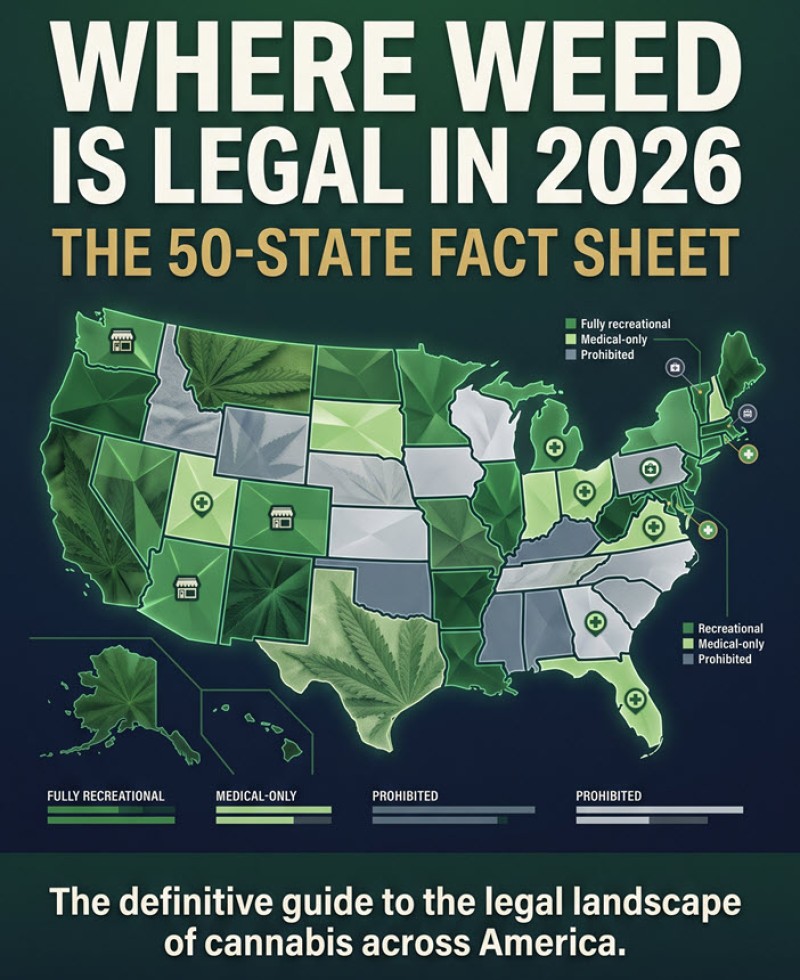
Every year I tell myself this list won’t need updating much. Every year I’m wrong. Georgia just became the 41st state with a comprehensive medical program, Virginia finally unveiled a retail framework for a recreational market that’s technically been legal for five years, and the federal government spent the year deciding whether to reschedule the plant at all — which is a separate, ongoing story I’ve covered elsewhere. Here’s the ground truth, state by state, as of July 2026, drawn from NORML’s state law tracker and Forbes’ 2026 legal-status roundup.
Four categories exist in American cannabis law right now:
-
Recreational (Adult-Use) — Legal for adults 21+ to purchase and possess without a medical card. Medical access is automatically included.
-
Comprehensive Medical — A real medical program: qualifying conditions, dispensaries, meaningful product access (flower, concentrates, edibles) for registered patients. No adult-use market.
-
Limited/CBD-Only Medical — Programs restricted to low-THC or CBD-dominant products, usually for a narrow list of conditions like epilepsy. Not a real medical cannabis program by most clinical standards.
-
Fully Illegal — No functioning medical or recreational program of any kind.
One quick note before the list: home-cultivation rules and exact possession penalties are the fastest-moving details in this entire field, and they vary by plant count, county ordinance, and even how many roommates you have. Treat the home-grow notes below as a general compass, not a legal citation, and check NORML’s state-by-state pages before you plant anything.
Recreational (Adult-Use) — 24 States + D.C.
|
State |
Home Grow |
|---|---|
|
Alaska |
Yes — 6 plants |
|
Arizona |
Yes — 6 plants |
|
California |
Yes — 6 plants |
|
Colorado |
Yes — 6 plants |
|
Connecticut |
Yes — up to 6 plants (3 mature) |
|
Delaware |
No home grow permitted |
|
District of Columbia |
Yes — up to 6 plants (no legal retail sales; gifting-based model) |
|
Illinois |
Medical patients only |
|
Maine |
Yes — 3 mature plants + immature/seedlings |
|
Maryland |
Yes — 2 plants |
|
Massachusetts |
Yes — 6 plants per adult, 12 per household |
|
Michigan |
Yes — 12 plants |
|
Minnesota |
Yes — 8 plants (4 mature) |
|
Missouri |
Yes — with registration |
|
Montana |
Yes — 4 mature, 4 seedlings |
|
Nevada |
Yes, only if 25+ miles from a licensed dispensary |
|
New Jersey |
No home grow permitted |
|
New Mexico |
Yes — 6 mature plants |
|
New York |
Yes — 6 plants (3 mature) |
|
Ohio |
Yes — 6 plants per adult, 12 per household |
|
Oregon |
Yes — 4 plants |
|
Rhode Island |
Yes — 3 mature plants |
|
Vermont |
Yes — 6 plants (2 mature) |
|
Virginia |
Yes — 4 plants (retail sales don’t launch until July 2027) |
|
Washington |
No home grow permitted |
Penalties for exceeding legal possession or plant limits in these states are generally civil or low-level misdemeanor rather than felony, but excess quantities, sales without a license, or transport across state lines can still trigger serious criminal charges everywhere on this list. Legal in your state doesn’t mean legal at the airport, and it doesn’t mean legal in the next state over.
Comprehensive Medical Only — 17 States
These states have real medical programs — dispensaries, qualifying conditions, meaningful product access — but no adult-use market. Recreational possession remains a criminal offense.
|
State |
Notes |
|---|---|
|
Alabama |
Medical program launched in recent years; smokable flower generally restricted |
|
Arkansas |
Dispensary-based medical program since 2019 |
|
Florida |
Large medical market; flower permitted for vaporizing, not smoking in all cases |
|
Georgia |
Newest entrant — expanded from low-THC-only to full medical cannabis via SB 220, effective July 2026; unique in allowing licensed pharmacies to dispense |
|
Hawaii |
First state to legalize medical cannabis via legislature (2000); no recreational market despite repeated legislative attempts |
|
Kentucky |
Medical program still ramping up dispensary access |
|
Louisiana |
Pharmacy-based medical dispensing model |
|
Mississippi |
Medical program established 2022 |
|
Nebraska |
Medical program in early implementation |
|
New Hampshire |
Restrictive qualifying-condition list |
|
North Dakota |
Medical-only, dispensary-based |
|
Oklahoma |
Notably permissive medical program relative to peers |
|
Pennsylvania |
Medical since 2016; recreational push has repeatedly stalled in the legislature |
|
South Dakota |
Medical-only after voters rejected recreational legalization |
|
Texas |
Compassionate Use Program — tightly limited, historically low-THC-focused, expanding slowly |
|
Utah |
Medical program with limited dispensary network |
|
West Virginia |
Medical-only, limited product forms |
Limited Medical / CBD-Only — 8 States
These states allow only low-THC or CBD-dominant products, typically for a narrow list of severe conditions like intractable epilepsy. Functionally, this is not medical cannabis access in any meaningful clinical sense.
|
State |
Notes |
|---|---|
|
Iowa |
Limited medical program capping THC purchases (4.5 grams per 90 days) |
|
Indiana |
CBD/low-THC only |
|
Kansas |
CBD/low-THC only |
|
North Carolina |
CBD/low-THC only |
|
South Carolina |
CBD/low-THC only |
|
Tennessee |
CBD-only, essentially epilepsy-focused |
|
Wisconsin |
CBD-only |
|
Wyoming |
CBD-only |
Fully Illegal — Idaho
Idaho stands alone as the only state with no functioning medical or recreational cannabis law of any kind, and no CBD/low-THC carve-out either. Possession of any amount remains a criminal offense, and Idaho consistently maintains some of the harshest cannabis penalties left in the country. If there’s a symbolic “last domino,” it’s this one.
What’s Actually Moving in 2026
Georgia’s jump to full medical status is the headline change so far this year, and Virginia’s rollout of an actual retail licensing framework — five years after adult-use technically became legal there — closes one of the more absurd gaps in American cannabis law, where possession was legal but there was nowhere lawful to buy it. Florida could see another recreational ballot measure in November, though it needs 60 percent approval to pass and fell short in 2024 even with a presidential endorsement. Hawaii and Pennsylvania both have unfinished business — Hawaii through a possible ballot initiative, Pennsylvania through a governor who supports legalization but a legislature that hasn’t gotten there. Iowa’s restrictive medical program could see incremental expansion, following the pattern set by Texas and Georgia easing their own limited programs open over time.
And overhanging all of it: the DEA’s rescheduling hearing, which could shift the entire federal classification of cannabis by the end of the year — or, if the poll numbers in my other coverage are any indication, could just as easily slip past that deadline entirely.
The Sticky Bottom Line
Forty-one states now have real medical cannabis access. Twenty-four states plus D.C. have full adult-use legalization. Eight states are stuck in the CBD-only purgatory that lets legislators claim they “did something” without doing much of anything. And one state, Idaho, hasn’t moved an inch. That’s the map. It’ll be out of date again by next year — it always is — but for July 2026, that’s where the lines are actually drawn.
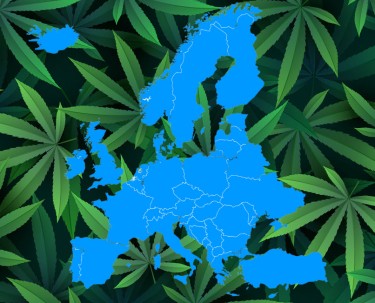
WHERE IS WEED LEGAL IN EUROPE, READ ON...