

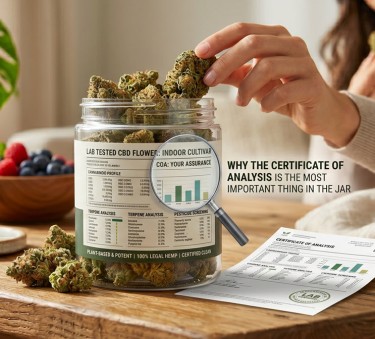
You can learn a lot about a CBD flower just by looking at it. Dense trichomes, rich color, a strong aroma are all good signs. But none of that tells you what's actually inside. That's where lab testing comes in. And in a market where nearly 70% of hemp product labels misrepresent CBD potency, according to research published in The Journal of the American Medical Association, what's on the label and what's in the flower can be very different things.
If you're shopping for CBD flowers whether for relaxation, wellness, or just to see what the buzz is about understanding lab testing isn't optional. It's the difference between a product that does what it promises and one that doesn't.
What Is CBD Flower, and Why Does Testing Matter So Much?
CBD flower comes from Cannabis sativa plants specifically bred to produce high levels of cannabidiol (CBD) while staying under the federal legal limit of 0.3% Delta-9 THC. The raw, dried buds contain not just CBD, but an entire ecosystem of cannabinoids, terpenes, and other plant compounds all of which contribute to the experience.
That complexity is part of what makes CBD flowers so appealing. Researchers describe a phenomenon called the "entourage effect," where cannabinoids and terpenes interact synergistically to enhance each other's potential benefits. CBD doesn't work in isolation; the full plant profile matters.
But that same complexity is also why lab testing is essential. Hemp is what scientists call a bioaccumulator: it readily absorbs substances from the soil it grows in, including heavy metals, pesticides, and other contaminants. A flower that looks and smells beautiful on the surface can carry things inside it you definitely don't want to inhale.
Testing is the only way to know for sure what you're getting.
What Does "Lab Tested" Actually Mean?
When a brand describes its CBD flower as lab tested, that phrase should carry real weight but not all testing is created equal.
The gold standard is third-party testing by an ISO-certified laboratory. Third-party means the lab has no financial relationship with the brand whose products it's testing. ISO certification means the lab follows internationally recognized protocols and faces serious accountability if results aren't accurate. That independence is exactly what makes the results trustworthy.
In-house testing where a company tests its own products carries an obvious conflict of interest. If you see "in-house test" anywhere on a lab report, treat that as a red flag. Legitimate COAs from third-party labs are clearly labeled and often include the lab's name, accreditation details, and a verifiable report ID.
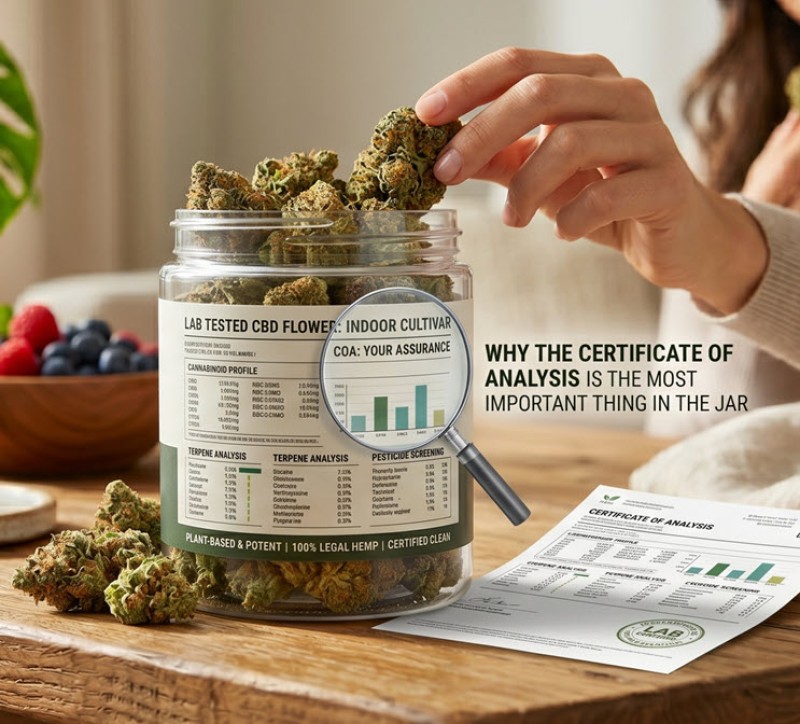
The document that comes out of this process is called a Certificate of Analysis (COA). It's the single most important document attached to any CBD flower product, and you should always read it before buying.
How to Read a CBD Flower COA
A quality COA covers several areas. Here's what to look for in each one:
Cannabinoid Profile This section lists the concentration of CBD, THC, and other cannabinoids like CBG, CBN, and CBDa. Confirm the CBD content matches what's on the label and verify that Delta-9 THC sits at or below 0.3% for legal hemp compliance. Any significant deviation from label claims is a problem.
Terpene Analysis Not every COA includes terpene data, but the best ones do. Terpenes like myrcene, limonene, linalool, and pinene shape both the aroma and the potential effects of CBD flower. Research suggests myrcene may have sedative and anti-inflammatory properties, while limonene is associated with uplifting effects, and pinene may support respiratory function and mental clarity. A terpene panel gives you a real window into the flower's character.
Contaminant Screening This is where lab testing earns its keep. A full-panel COA screens for pesticides, heavy metals (like lead, arsenic, cadmium, and mercury), residual solvents, and microbial contaminants such as mold and bacteria. A 2024 study detected heavy metals in 44 out of 202 CBD products tested, that's roughly 1 in 5. For context, a separate analysis found that 92% of illicit cannabis flower samples contained banned pesticides, compared to just 6% of legally and rigorously tested samples. Those numbers tell you everything you need to know about why skipping contaminant screening is a serious gamble.
Testing Date COAs have a shelf life. Look for results dated within the last 6 to 12 months. An outdated COA doesn't reflect the current batch you're buying.
Batch Specificity The best brands provide batch-specific COAs meaning the lab report matches the exact batch of flower you're purchasing, not some generalized company-wide test from months ago. Many reputable brands now include a QR code on their packaging that links directly to the relevant COA. Scan it. Verify it.
Red Flags to Watch For
Some CBD flower brands look great on the surface but fall short where it matters. Here's what to watch out for:
No COA, or an inaccessible one. If a brand buries its lab results or makes you jump through hoops to find them, that hesitation is telling. Confident brands share their COAs openly and prominently.
COAs that only test for cannabinoid potency. Potency testing alone doesn't confirm safety. A COA that doesn't screen for pesticides, heavy metals, and microbials is an incomplete picture and a product without those safety checks carries unnecessary risk.
Prices that seem too good to be true. Premium CBD flower grown, tested, and handled properly isn't cheap. A price dramatically below market rate usually reflects corners being cut somewhere often in testing.
Vague sourcing information. Quality brands tell you where their hemp is grown. U.S.-grown hemp operates under USDA oversight and stricter cultivation standards than many imports. If a brand can't or won't tell you where its flower comes from, that opacity should give you pause.
What to Look For in Quality CBD Flower Beyond the COA
Lab testing confirms safety and potency but there are other quality markers worth evaluating before you buy.
Visual appearance. Healthy CBD flower has intact, glistening trichomes, those tiny crystal-like structures on the surface of the bud. If trichomes look dull or dusty, the flower wasn't handled with care.
Aroma. Fresh, properly cured CBD flower has a strong, distinctive smell that reflects its terpene profile. Weak or flat aroma often signals age, poor storage, or low-quality growing conditions. Your nose is actually a decent quality indicator here.
Strain-specific information. Reputable brands tell you the strain, its approximate CBD percentage, and its terpene profile. This isn't just marketing, it helps you choose a flower that matches what you're actually looking for.
Organic or pesticide-free certification. "Natural" doesn't automatically mean organic. Look for USDA Organic certification or equivalent documentation if pesticide-free cultivation is a priority for you.
The Bottom Line on Lab Tested CBD Flower
The CBD flower market is growing fast, and the quality gap between the best and worst products is wide. Third-party lab testing is what separates trustworthy products from unreliable ones and it's the only tool you have as a consumer to verify that what's in the jar matches what's on the label.
A solid COA from an ISO-certified lab, covering cannabinoid profile, contaminant screening, and terpene analysis, isn't a bonus feature. It's a baseline requirement. Any brand that doesn't provide one clearly and willingly isn't one you should spend your money on.
When lab tested CBD flower is done right, grown cleanly, cured carefully, and tested thoroughly it's a genuinely impressive product. The plant has a lot to offer. Lab testing is simply how you make sure the product in your hands actually delivers it.