
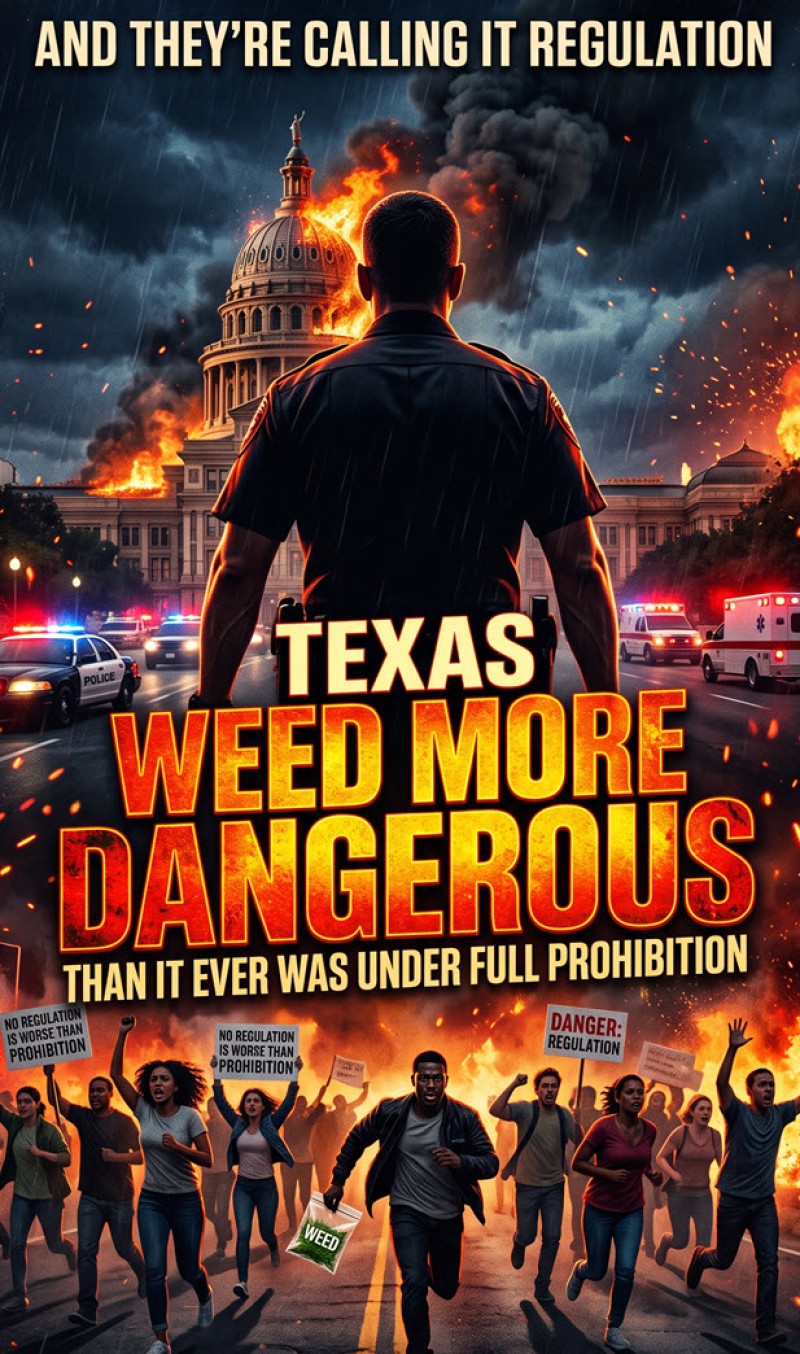
I want you to sit with a question for a second. If a state passes a law that punishes a hemp gummy more severely than the state used to punish a joint, is that state "regulating" cannabis, or is it doing something worse than prohibition ever did? Because that's exactly what just happened in Texas, and I don't think enough people have clocked how insane this actually is.
The Setup: How We Got Here
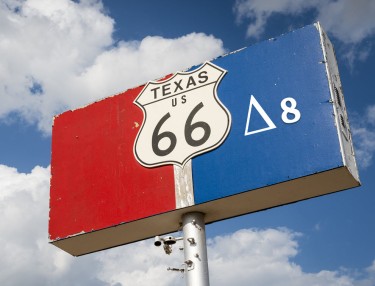
For the past five years, Texas has lived in a strange legal limbo. The 2018 Farm Bill legalized hemp at the federal level, defining it as cannabis with 0.3% or less delta-9 THC by dry weight. Texas, like most states, wrote that definition into its own hemp program. Entrepreneurs took the opening and ran with it, building a multi-billion-dollar industry of delta-8, delta-10, THCA flower, and other hemp-derived cannabinoids that got people high without technically being "marijuana." The Texas Department of State Health Services tried to shut this down by rule in 2021, reclassifying those cannabinoids as Schedule I controlled substances. A court blocked it with an injunction. For five years, the shops stayed open.
That injunction ended this May, when the Texas Supreme Court sided with the state. The reclassification took effect July 31, 2026. And now, if you possess a hemp-derived THC product that doesn't meet the narrow delta-9 exemption, you are, in the eyes of Texas law, holding a Schedule I controlled substance — the same legal category as heroin.
Now Do the Math
Here's where it gets genuinely absurd. Under Texas's long-standing marijuana possession law (Health & Safety Code 481.121), getting caught with two ounces of flower or less is a Class B misdemeanor: up to 180 days in county jail, a fine up to $2,000. Two to four ounces bumps you to a Class A misdemeanor. You have to clear four ounces before you're looking at a felony.
Now compare that to what happens if you're caught with a THC vape cartridge, a THCA pre-roll, or a hemp gummy under the new reclassification. These products fall under penalty rules analogous to Penalty Group 2 of the Health and Safety Code, and the thresholds are brutal:
-
Less than 1 gram: state jail felony — 180 days to 2 years, fine up to $10,000
-
1 to under 4 grams: third-degree felony — 2 to 10 years, fine up to $10,000
-
4 to under 400 grams: second-degree felony — 2 to 20 years, fine up to $10,000
-
400 grams or more: up to life in prison, fine up to $50,000
Read that again. A single gram of THC concentrate — less than what's in one or two vape cartridges — now carries a felony that starts where the old marijuana misdemeanor law never even reached. You could possess almost four ounces of flower and stay a misdemeanant, but a fraction of a gram of hemp-derived oil makes you a felon on day one. That's not a typo, and it's not an accident. It's what happens when concentrate-heavy products, which didn't really exist in the cultural mainstream when Penalty Group 2 was written, get slotted into a scheduling framework built for cocaine and methamphetamine.
So to answer my opening question directly: yes, in a meaningful, practical sense, Texas has built a legal architecture that is more punitive toward THC products today than the "reefer madness" era laws that criminalized marijuana outright decades ago. Prohibition never went away here. It got a new coat of paint, a court ruling, and a felony ladder.
"Legal" Doesn't Mean "Just"
This is the part I need you to internalize, because it's the whole game: this is prohibition operating entirely within a legal framework. The Texas Supreme Court didn't do anything unconstitutional. DSHS followed its rulemaking authority. The legislature has been busy too — Senate Bill 2024, which took effect September 1, 2025, made it a Class A misdemeanor just to sell or market a cannabinoid vape product. None of this is a rogue sheriff or a corrupt prosecutor. It is the codified will of a legislature and a court system, stacking felony exposure on top of a product category that was, until five days before the ban, sitting on smoke shop shelves statewide.
That's the trap with "legal framework" as a defense. Slavery operated within a legal framework. Segregation operated within a legal framework. Legality tells you a policy survived the machinery of government. It tells you nothing about whether the policy is wise, proportionate, or just. Texas cannabis experts and industry advocates are already saying the quiet part out loud — recriminalizing products that have been in commerce for five years does nothing but hand the market back to unregulated dealers who don't check IDs and don't test for contaminants.
Texas Isn't Alone
If you're tempted to write this off as a Texas problem, don't. This is a national pattern, and it's accelerating. Ohio's Senate Bill 56, signed in December 2025, imposed a categorical ban on intoxicating hemp products — a coalition called Ohioans for Cannabis Choice is now racing to collect 250,000 signatures for a repeal referendum. Louisiana banned most intoxicating hemp products back in 2024. Arkansas and Utah have clamped down hard on delta-8 and other cannabinoids. Montana banned intoxicating hemp products outright in 2025.
And looming over all of it is the federal government. Tucked into the government funding package that ended last November's shutdown is a provision that redefines hemp itself — shifting to a "total THC" standard and capping finished products at 0.4 milligrams of THC per container. Absent a legislative fix, that takes effect November 12, 2026, and the U.S. Hemp Roundtable estimates it wipes out roughly 95% of the hemp-derived products currently on the market, nationwide. Texas got there early. The rest of the country is on a one-year countdown to the same cliff.
So no, this isn't an isolated Lone Star State overreaction. It's a coordinated retreat from the hemp experiment of the last eight years, dressed up in public-safety language, arriving state by state and now at the federal level.
What We Do About It
I'm not going to pretend there's nothing to the "protect kids from unregulated intoxicants" argument — there were real problems with untested, unlabeled synthetic cannabinoids flooding gas stations. But the answer to a regulatory gap is regulation: licensing, testing, age limits, potency caps. Texas had a chance to build that system. Instead it reached for the felony ladder, the same tool that failed for fifty years of the drug war, and called it a solution.
As consumers, we don't get to just shrug this off. A few things worth doing: know your state's actual penalty structure before you buy anything, because "it was legal last month" is not a defense in court. Support the advocacy groups — the Texas Cannabis Policy Center among them — that are litigating and lobbying against these rollbacks. Show up for the Ohio-style ballot fights when they come to your state; referenda are one of the few tools voters have to overrule a legislature that's moving backward. And vote for representatives who understand the difference between regulating a product and criminalizing it out of spite.
The Sticky Bottom Line
Texas didn't just fail to modernize its cannabis laws. It built a system where a hemp vape cartridge can land you in prison longer than marijuana flower ever could under the old rules, and it did it entirely by the book. That should terrify anyone who thought "legal" and "fair" were the same word. They're not, and Texas just proved it.
TEXAS AND THC, READ ON...