

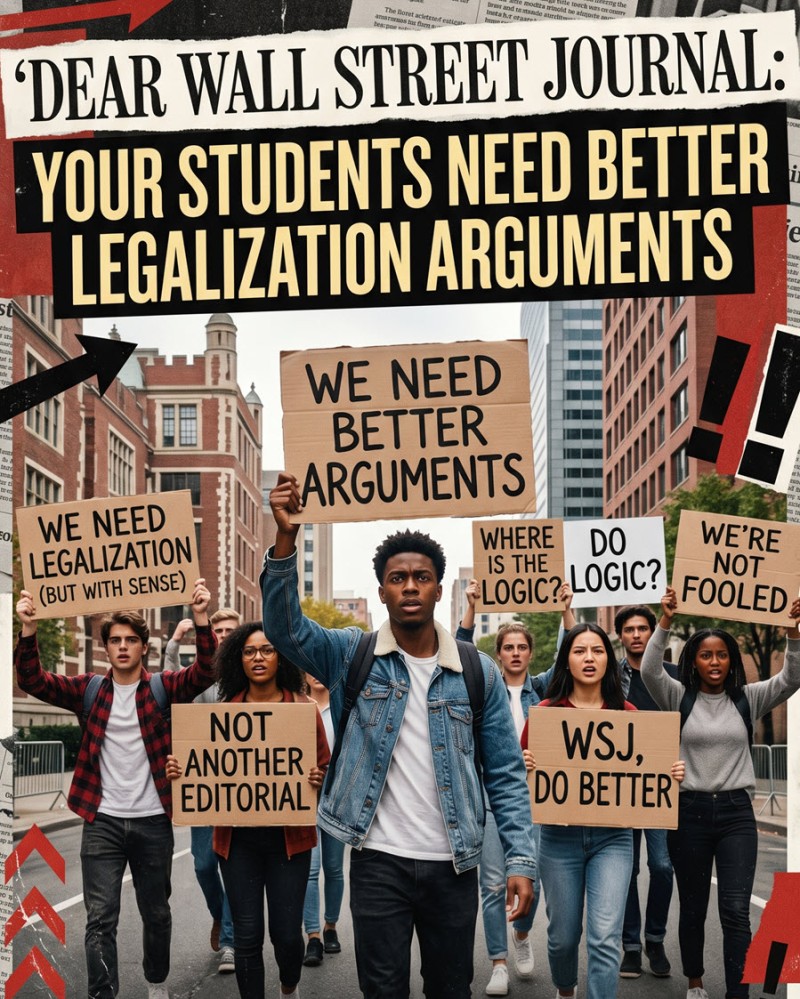
The Wall Street Journal's Future View recently asked college students whether marijuana should be legal. Several of them wrote thoughtful pieces. A few of them wrote arguments that collapse the moment you apply them consistently. I respect the exercise, and I respect that these are young people working through genuinely complex policy questions. But bad arguments don't improve with politeness, so let's get into it.
On God, Reason, and the Whiskey in Your Cabinet
Tyson Flaig at Baylor opens with a theological argument: marijuana impairs reason, reason is a divine gift, therefore legalizing marijuana is an affront to human dignity and moral accountability. It's a sincere position, and sincerely incomplete.
Alcohol impairs reason. Alcohol impairs memory, judgment, reaction time, and impulse control. Alcohol has been statistically linked to domestic violence, sexual assault, liver disease, drunk driving fatalities, and addiction at a scale cannabis has never approached. The CDC estimates roughly 95,000 people die from alcohol-related causes annually in the United States. Cannabis has never produced a confirmed fatal overdose in recorded medical history.
If impairing reason is the moral line, Flaig's argument demands prohibition of alcohol. We tried that. The 18th Amendment ran from 1920 to 1933, produced organized crime, corrupted law enforcement, filled prisons, and failed completely to stop Americans from drinking. Prohibition didn't eliminate demand. It handed the market to people with no interest in public health, product safety, or age restrictions.
The states that legalized cannabis have produced measurable results on the right side of the ledger. Legal markets generated over $15 billion in tax revenue in 2023 alone, funding schools, infrastructure, and public health programs. States with legal cannabis have seen reductions in opioid overdose deaths, with a 2019 study in the American Journal of Public Health finding a 25 percent lower opioid mortality rate in medical cannabis states. Traffic fatality data from legalized states has shown no consistent increase tied to cannabis. These aren't ideological talking points. They're outcomes.
The black-and-white framing, that legalization either fully endorses a substance or prohibition protects society from it, ignores every piece of evidence that regulated markets outperform criminal ones on public health metrics. The problem was never the plant. The problem was always the implementation.
The Government's Job Is Not to Keep You Orderly
Simon Olech grew up in Washington state, found the smell of marijuana in residential areas offensive, and concludes that recreational legalization corrupts neighborhoods and individuals. He invokes the CDC's figure that about one-third of reported cannabis users develop cannabis use disorder, and cites links between cannabis and schizophrenia and brain development issues.
Start with the smell. Plenty of legal things smell bad. Diesel exhaust, factory farming, cigarettes smoked on a public sidewalk. The offensiveness of an odor has never been a coherent basis for prohibition in a free society.
The cannabis use disorder statistic deserves context. The DSM criteria for cannabis use disorder include behaviors like "spending a great deal of time obtaining, using, or recovering," criteria that, applied to alcohol, caffeine, or social media, would produce similarly alarming prevalence numbers. Problem use exists and deserves treatment resources. It does not justify criminal prohibition of a substance used responsibly by tens of millions of adults.
On schizophrenia: the research shows correlation, not causation, and the direction of that relationship is actively debated. People with genetic predispositions to psychotic disorders may self-medicate with cannabis before a diagnosis, which would produce exactly the correlation the data shows without cannabis being the cause. This is not a settled question, and presenting it as a clear indictment of legalization misrepresents the literature.
The deeper problem with Olech's argument is his definition of government's purpose. He writes that government's role is to "keep society safe and ordered." The Declaration of Independence says governments are instituted to secure unalienable rights, including liberty. The Bill of Rights exists as a constraint on government power, not a license for it. A government that decides what legal substances adults may consume in their own homes, on the basis that it finds those substances disorderly, is not protecting freedom. It is restricting it.
The Breathalyzer Problem Is the Government's Problem to Solve
Sean Kelly at Dayton makes the most technically specific argument in the collection: without a reliable roadside test for current cannabis impairment, equivalent to alcohol's breathalyzer, legalization creates an unenforceable public safety problem.
The premise is factually correct. THC metabolites remain detectable in blood and urine long after any impairment has passed, making current testing inadequate for measuring real-time intoxication. This is a genuine limitation.
The conclusion doesn't follow.
Experienced cannabis users, particularly those who have used regularly over years, do not experience the same degree of impairment per dose that a naive user does. Tolerance is real, well-documented, and means that the relationship between THC in someone's system and their functional impairment is far less linear than blood alcohol content and impairment. A person who has used cannabis daily for five years and smokes before driving may be measurably less impaired than someone who had two glasses of wine and is still under the legal BAC limit.
More to the point: the government's failure to develop adequate testing technology is not a justification for restricting the freedoms of millions of adults. By that logic, we should ban all pharmaceuticals that affect cognition until law enforcement builds a roadside test for each of them. Ambien, Xanax, OxyContin, and dozens of other legal substances impair driving, and no breathalyzer equivalent exists for any of them. We don't ban those substances. We prosecute impaired driving as a behavior. The same standard applies to cannabis.
If law enforcement needs better tools, build better tools. That's a technology and policy problem. It has nothing to do with whether adults should be free to consume a legal plant in their own time.
You Don't Ban the Pool Because Kids Can Drown
Koy Hancock at Baylor makes the most scientifically detailed argument in the collection, and credit where it's due: the research on cannabis and adolescent brain development is real. THC does target the frontal lobe. Studies have found associations between adolescent cannabis use and thinning of the prefrontal cortex. The JAMA Psychiatry research he cites is legitimate. Teen cannabis use carries genuine risk that adults and policymakers should take seriously.
None of that supports prohibition for adults.
We do not ban alcohol because teenagers' livers are still developing. We do not ban tobacco because adolescent lungs are still developing. Pornography, which research has linked to measurable changes in dopamine pathways and reward circuitry, is legal and generates billions of dollars annually, with minimal serious political effort to restrict adult access. The argument "this substance can harm developing brains" has never, in American policy history, been sufficient justification for prohibiting adult use. The consistent approach is age restriction, education, and enforcement of access controls.
The data Hancock cites on teen use actually strengthens the case for legalization. As covered in Minnesota's latest Student Survey, teen cannabis use has dropped 57.7 percent since 2013, through a period in which dozens of states legalized adult use. Regulated markets with age-gated retail keep cannabis away from minors more effectively than prohibition does, because licensed dispensaries check IDs and street dealers don't.
If the concern is teenage brains, the answer is better education, better parental conversations, better school programs, and stricter enforcement of age restrictions at the retail level. All of those things are more achievable, and more effective, inside a legal regulated market than outside one.
Decriminalization Is a Floor, Not a Ceiling
Alfonso Tamez argues for decriminalization as a pragmatic middle ground: stop arresting users, keep penalties for traffickers, invest in education. It's a reasonable position, and directionally correct. But it stops short of where the evidence points.
Cannabis is not just a recreational substance that deserves tolerance. It is a plant with thousands of years of documented human use across medicine, industry, nutrition, and culture. Hemp produces fiber stronger than cotton, requires a fraction of the water, needs no pesticides, and was a major American agricultural product until the Marihuana Tax Act of 1937 effectively ended its cultivation. Cannabis has documented applications in chronic pain, epilepsy, nausea, anxiety, and appetite regulation. The seeds are a nutritionally complete food source. The applications span construction materials, biofuel, textiles, and paper.
The criminalization of this plant wasn't a public health decision. It was a political and economic one, driven by timber, cotton, and pharmaceutical interests who recognized hemp as a competitive threat, and by a federal government that weaponized racial anxiety to build public support for prohibition. Calling it a crime against humanity is not hyperbole. Millions of people, disproportionately Black and Latino, have been arrested, incarcerated, and stripped of voting rights, employment prospects, and housing access over a plant that was commercially integrated into American society for the first 150 years of this country's existence.
Decriminalization stops the bleeding. Full reintegration, across agriculture, medicine, food, and adult use, restores what was taken.
The Corporate Elephant in the Room
Joshua Poe raises the structural critique that deserves the most attention and gets the least: legalization as currently designed funnels money upward. Licensing costs exclude small operators and the communities most devastated by prohibition. Wealthy investors and large corporations capture the legal market while the people who bore the cost of criminalization get cut out of the economic upside.
He's right. The legal cannabis industry has reproduced, in many states, the same consolidation pattern visible across American industries generally. Multi-state operators with institutional capital have outcompeted local entrepreneurs. Social equity licensing programs have been underfunded, poorly designed, and inconsistently enforced. The gap between the liberation rhetoric of legalization campaigns and the corporate reality of legal markets is real and worth confronting.
But the solution to badly structured legalization is better-structured legalization. It is not prohibition. The communities most harmed by the war on drugs are not helped by keeping cannabis illegal. They are helped by legal frameworks that prioritize expungement, equity licensing, community reinvestment, and barriers to monopolization.
The United States has a consistent pattern of allowing corporate interests to shape policy that should serve the public. Cannabis legalization has not been immune to that pattern. That's a conversation worth having at length, and we'll be returning to it.
The WSJ asked whether pot should be legal. The students who answered mostly asked the wrong questions back. The right question isn't whether cannabis carries any risks. Of course it does. Every substance with physiological effects carries risk. The question is whether prohibition, with its documented costs in incarceration, racial disparity, black market violence, lost tax revenue, restricted research, and agricultural suppression, produces better outcomes than regulated legal access. And let’s not forget about the hidden issue – the Chinese backdoor into American society.
I’ve written on this issue for a long time, and while these students may have good intentions, they lack the awareness of the negative impacts of prohibition.
COLLEGE KIDS AND CANNABIS, READ ON..