

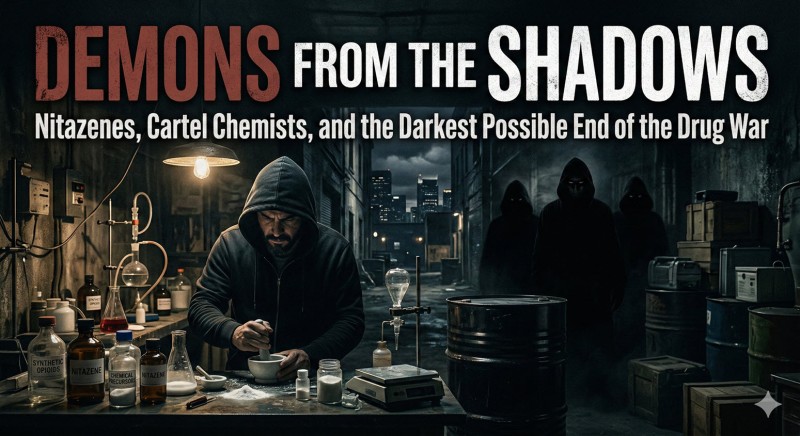
DEMONS FROM THE SHADOWS
Nitazenes, Cartel Chemists, and the Darkest Possible End of the Drug War
By Reginald Reefer | February 2026 | Part II of the MAGA Drugs Series
[Editor's Note: This is the second piece in a series. Read "Make America High Again: How Legalizing Organic Drugs Is the Only Way to Win America's Chemical War with China" first — it establishes the geopolitical framework, the Chinese precursor subsidy system, and the case for domesticating the drug supply. What follows is where that argument gets existentially urgent.]
In the first piece, I argued that the United States is losing a chemical war with China, and that the only asymmetric counter-strategy with any historical precedent for success is domesticating the drug supply — legalizing the agrarian, organic substances that humans have used for millennia, regulating them intelligently, and stripping the cartels of their customer base through market competition.
That argument is correct. I stand by it. But I left something out.
I left out what comes next if we don't.
Meet the nitazenes. And understand that they are not the end of this story. They are a chapter in a book that has no natural conclusion — only progressively darker pages — as long as prohibition remains the policy and chemistry remains infinite.
The Drug That Makes Fentanyl Look Gentle
Fentanyl became the dominant killing agent of a generation because it is approximately 100 times more potent than morphine and 50 times more potent than heroin. We covered this. We know the number: 75,000 Americans dead last year. We know the WMD designation. We know the salt-grain metaphor — a lethal dose fits on the head of a pin.
The nitazenes make fentanyl look like a children's aspirin.
Benzimidazole-opioids — the chemical family that includes etonitazene, isotonitazene, metonitazene, and protonitazene — were developed in the 1950s by a Swiss pharmaceutical company called CIBA, looking for a non-addictive alternative to morphine. They found something with extraordinary analgesic properties and immediately shelved it because the addiction potential was catastrophic and the therapeutic window — the gap between an effective dose and a fatal one — was essentially nonexistent. These compounds were too dangerous to develop into medicine. They were buried in the pharmacological archives for sixty years.
They did not stay buried.
Etonitazene, the most potent of the class, is conservatively estimated at 1,000 times stronger than morphine. Some analogues clock in higher. To put that in context: if fentanyl is a scalpel that can kill you with a grain of salt, etonitazene is a scalpel that can kill you with a fraction of that grain. We are operating at doses measured in micrograms — millionths of a gram — where the difference between a high and a body bag is a measurement error.
"These compounds were too dangerous to develop into medicine. They were buried in the pharmacological archives for sixty years. They did not stay buried."
The detection problem compounds the lethality problem. Nitazenes are structurally distinct from fentanyl. Standard field tests — the immunoassay strips that first responders and harm reduction workers use to check street drugs — do not detect them. Forensic panels at most labs don't either, unless specifically calibrated for benzimidazole-opioids. A user buying what they believe is heroin or fentanyl-pressed counterfeit pills has no way of knowing whether what they're holding is the drug they expect or something exponentially more lethal. Neither does the paramedic who responds to the overdose call.
The first indication that nitazenes are in a batch is often a cluster of unexplained overdose deaths in a short window — bodies that don't respond the way fentanyl overdoses respond, in quantities that suggest a contaminated supply rather than individual user error.
When Naloxone Isn't Enough: The Ghost That Comes Back to Kill You
Here is the detail that should terrify every first responder, every emergency physician, and every harm reduction worker in America: nitazene overdoses frequently require multiple doses of naloxone to reverse, and patients who appear to have recovered can relapse into fatal respiratory depression hours later.
To understand why, you need a brief pharmacology lesson. Naloxone — Narcan — works by binding to the mu-opioid receptor more strongly than the opioid that's killing you, displacing it and reversing the respiratory depression. It works on fentanyl because fentanyl's dissociation rate from the receptor — how quickly it lets go — is fast enough that naloxone can compete effectively.
Nitazenes have a higher binding affinity and a significantly slower dissociation rate. They hold on to the receptor with more force and for longer. Naloxone can displace them temporarily, but as the naloxone clears the system — its half-life is short, 30 to 90 minutes — the nitazene metabolites that have been circulating in the bloodstream reattach. The patient wakes up, appears stable, is discharged or left alone, and then stops breathing again. Hours later. When no one is watching.
This is not a theoretical concern. Clinicians managing nitazene overdoses in Europe — where these compounds began appearing in the drug supply years before the U.S. — have documented exactly this pattern. Patients requiring two, three, sometimes four naloxone doses. Extended observation periods of 12 to 24 hours even after apparent reversal. ICU admissions for what looked like routine overdoses because the drug ghosts back up when you think the fight is over.
"The patient wakes up, appears stable, is discharged or left alone, and then stops breathing again. Hours later. When no one is watching."
The clinical challenge this creates for an already strained emergency medicine system is severe. Fentanyl overdoses, ghastly as they are, have a reasonably predictable reversal protocol. Nitazene overdoses require prolonged monitoring resources that emergency departments — particularly in the rural and suburban communities hit hardest by the opioid crisis — simply do not have in sufficient quantity. The drug is not just more lethal. It is more resource-intensive to treat. It is engineered, accidentally by the 1950s chemists and deliberately by the 2020s criminal organizations, to overwhelm the medical response infrastructure.
The Cartel's R&D Department: How Criminal Organizations Became Pharmaceutical Companies
This brings us to the part of the story that the conventional drug war narrative consistently fails to reckon with: the cartels are no longer gangs. They are vertically integrated transnational corporations with research and development capabilities, and they are actively solving the problem of how to make their products more lethal, more addictive, and more legally elusive.
The Sinaloa and Jalisco New Generation Cartels have recruited university-trained specialists. People with master's degrees in biochemical engineering. People who are not following recipes handed down through criminal networks — they are engineering. They are designing pills calibrated to maximize dependence in the consumer base. They are manipulating molecular structures in direct response to international scheduling decisions, creating what the research literature calls "pre-precursors" — unregulated chemical analogues that fall outside existing legal definitions until legislators catch up, which typically takes years.
The transition from agrarian drug production to synthetic manufacturing wasn't just an economic upgrade for the cartels. It was a civilizational phase shift in the nature of the threat. When cartel power was tied to the Golden Triangle — the Sierra Madre poppy fields, the geography of harvest cycles — they were vulnerable to the same forces that make any agricultural operation vulnerable: weather, eradication, surveillance. A field of poppies can be photographed by satellite. It can be sprayed. It takes months to grow.
A clandestine synthetic lab can be hidden in an urban apartment. It operates 24 hours a day, seven days a week, with no harvest cycle and no weather dependency. The entire production footprint — the difference between nothing and thousands of lethal doses — is a few dozen square meters and a supply of precursor chemicals that can be ordered from Chinese e-commerce platforms and shipped in containers labeled as furniture parts.
"The transition from agrarian to synthetic wasn't just an economic upgrade for the cartels. It was a civilizational phase shift in the nature of the threat."
The nitazenes represent the next logical step in this evolution. When international pressure on fentanyl precursors intensifies — and it is intensifying, through sanctions, the WMD designation, the Stop Chinese Fentanyl Act of 2025 — the cartel chemists don't stop. They reach back into the pharmacological archives. They find the compounds that were buried because they were too dangerous to become medicine and they ask a different question: too dangerous for whom?
CIBA's scientists in the 1950s were trying to heal people. The therapeutic window problem — the impossibly narrow gap between effective dose and fatal dose — was a disqualifying flaw for a pharmaceutical product. For a criminal organization selling to a population that is largely uninformed about what they're consuming, a narrow therapeutic window is not a flaw. It is, in the coldest possible sense, a feature. A drug that creates dependency faster and more completely, that is harder to reverse when it goes wrong, and that cannot be detected by standard field tests — this drug serves the cartel's business model more effectively than fentanyl does.
That is the R&D logic. It has nothing to do with accident and everything to do with the incentive structure that prohibition created and sustains.
The Evolutionary Trap: Where This Road Leads
Let's trace the arc clearly, because it is important to understand that this is not a static crisis. It is a dynamic one with a clear directional vector.
Prohibition creates demand without supply. Black markets emerge to fill the vacuum. Early black markets traffic in the same substances that were prohibited — cannabis, heroin, cocaine, the agrarian classics. Law enforcement focuses on these substances. Border interdiction improves. International scheduling expands.
The market adapts. Synthetic alternatives appear that mimic the effect while circumventing the legal definition. K2 for cannabis. Bath salts for MDMA. Novel research chemicals for classical psychedelics. These substitutes are pharmacologically cruder, often more dangerous, and completely outside any regulatory framework because they were designed specifically to be outside any regulatory framework.
Law enforcement adapts to the synthetics. New scheduling. New precursor controls. International pressure on supply chains.
The market adapts again. More potent compounds. More chemically novel structures. Deeper dives into forgotten pharmacological archives. Fentanyl replaces heroin. Nitazenes emerge to replace fentanyl when fentanyl precursors face pressure. After nitazenes — and let's be clear, the research is already underway — comes whatever compound the cartel chemists are developing right now in labs that don't appear on any map.
This is not speculation. This is a documented pattern with a documented trajectory. Each iteration of the cycle produces substances that are more potent, more addictive, harder to detect, harder to reverse, and more lethal per unit of volume. The logic is inexorable: prohibition creates a market that rewards exactly these properties, and chemistry is infinite.
"Each iteration of the prohibition cycle produces substances that are more potent, more addictive, harder to detect, harder to reverse, and more lethal. The logic is inexorable: chemistry is infinite."
There is a theoretical endpoint to this progression that should disturb everyone who thinks about it seriously. At sufficient potency and sufficient undetectability, you stop having a drug crisis and start having something that looks more like a biological weapons deployment. Nitazenes at 1,000 times morphine's potency, undetectable by standard field tests, with a reversal protocol that overwhelms emergency infrastructure — we are not far from a substance that can cause mass casualty events not through deliberate targeting but through ordinary market distribution.
The WMD designation for fentanyl was not hyperbole. It was a recognition of a direction of travel. And the direction has not changed.
The Argument That Cannot Be Answered
I want to return here to the argument from the first piece, because the nitazene story makes it not just compelling but unavoidable.
The case for legalizing organic, agrarian substances — cannabis, psychedelics, MDMA, cocaine, and their plant-derived relatives — is not primarily a civil liberties argument, though the civil liberties case is strong. It is not primarily a harm reduction argument, though the harm reduction evidence is overwhelming. It is, at its core, a market disruption argument.
Every person who can access clean, tested, licensed cannabis is a person who has no reason to buy K2. Every person who can access pharmaceutical-grade MDMA at a licensed dispensary is a person who will not pay a premium for bath salts that might cause psychosis. Every cocaine user who can buy quality-controlled product from a regulated domestic source is a person who is not buying street powder that may contain fentanyl, nitazenes, or whatever compound comes after nitazenes.
And critically: every opioid-dependent person who has access to free, clean, supervised pharmaceutical heroin through a Swiss-model harm reduction program is a person who has no reason to buy anything the cartels are selling. The demand that funds the entire supply chain — the demand that pays for the Chinese precursor subsidies, the CMLN mirror transactions, the cartel chemists with their biochemical engineering degrees — disappears.
You cannot win this war by fighting the supply. You have fifty years of evidence for that conclusion. The supply is adaptive, chemically infinite, geopolitically subsidized, and operationally invisible. Every time you pressure one compound, the next one is already being synthesized. Every time you dismantle one supply route, the financial infrastructure routes around it. Every time you kill a kingpin, the organization restructures and diversifies.
You can win this war by making the supply irrelevant. By giving people something better, cleaner, safer, and domestic. By taking the profit out of the black market not through enforcement but through competition.
The nitazenes are the argument for MAGA Drugs that the drug warriors will never make, because acknowledging it requires acknowledging that the war they've been fighting has been making things worse in direct proportion to how hard they've been fighting it. Every scheduling decision that closed a loophole pushed chemists deeper into the archives. Every border interdiction that disrupted one supply chain pushed the market toward more concentrated, more potent, more portable compounds. Every dollar spent on the Mérida Initiative produced a more fragmented, more diversified, more technically sophisticated criminal organization.
We did not produce this crisis despite the drug war. We produced it because of the drug war.
The Sticky Bottom Line
There is a compound being synthesized right now, somewhere, in a lab that doesn't exist on any government map, by a chemist with a graduate degree who is being paid by an organization with the financial infrastructure of a mid-sized corporation and the operational security of an intelligence agency. That compound will be more potent than the nitazenes. It will be harder to detect. It will be harder to reverse. It will reach American streets before any regulatory body has even named it.
This is not a prediction. This is a description of the system as it currently operates, extended forward along its existing trajectory.
The question is not whether we can stop this through enforcement. We cannot. The pharmacological universe is too large and the incentive structure too powerful. The question is whether we choose to compete — with clean, domestic, regulated substances that serve human needs without funding a geopolitical assault — or whether we continue the current approach, which is to ban, interdict, and prosecute our way into progressively more dangerous compounds.
Nitazenes are the warning shot. They are the system showing you, in advance, where the next ten years go if nothing changes. More potent. Less detectable. Narrower therapeutic window. More deaths. More overwhelmed emergency rooms. More overdose clusters in communities that have already been devastated.
The drug war has always been sold as the responsible choice — the choice that protects people, especially the vulnerable, from the chaos of a legal market. The nitazenes are the evidence that the drug war is, in fact, the irresponsible choice. It is the choice that guarantees progressively more dangerous products will reach the most vulnerable people in the country, with no quality control, no dosage information, no harm reduction infrastructure, and no accountability.
Legalize the organic. Regulate the classical. Fund the education. Run the Swiss model for opioids. Take the profit. Starve the chemists.
Or wait for whatever comes after nitazenes.
Your call, America.
— Reginald Reefer
Sources: 2024 National Drug Threat Assessment (DEA); House Select Committee on the CCP, 2024 Fentanyl Investigation; Pergolizzi et al., "Nitazenes: A New Wave of Synthetic Opioids" (2021), Pain and Therapy; European Monitoring Centre for Drugs and Drug Addiction (EMCDDA), Nitazene Early Warning Reports 2022-2025; Swiss Federal Office of Public Health, Heroin-Assisted Treatment Program Data; Volkow et al., "Probing the Complex Consequences of Synthetic Cannabinoid Use," Neuropsychopharmacology (2020).
READ PART 1 OF THIS SERIES HERE....