

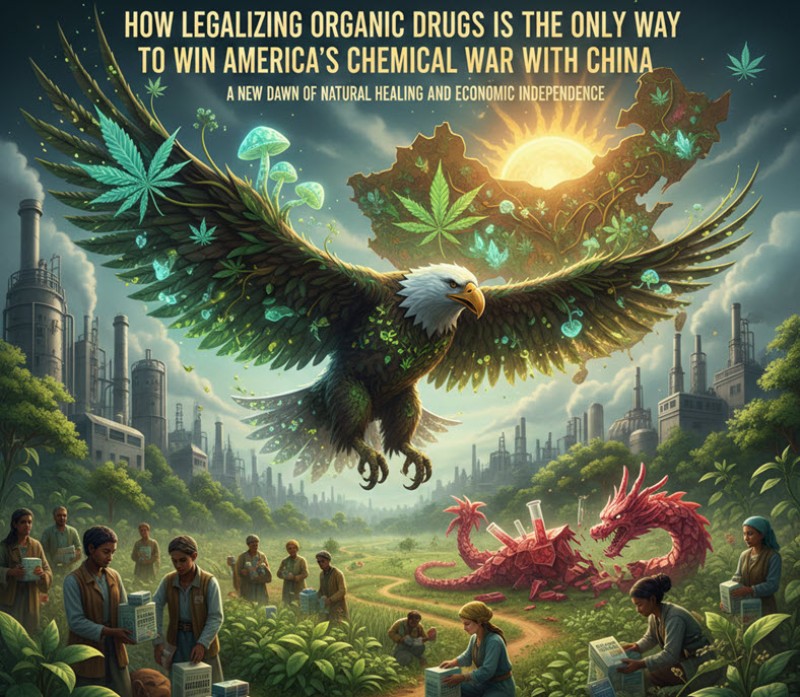
Let me tell you something they won't say on cable news, something that makes too much sense to survive the standard political discourse: the United States is losing a chemical war, and the only way to win it is to get its citizens legally, safely, and gloriously high.
Not on the Chinese stuff. Not on the fentanyl — those microscopic grains of synthetic death that are killing 75,000 Americans a year. Not on the K2, the bath salts, the grey-market research chemicals that have been slowly filling the void left by decades of prohibition. No. I'm talking about the real thing. The plants. The molecules that humanity has been dancing with for ten thousand years before a bunch of suits in Washington decided to make them illegal.
I'm talking about MAGA Drugs. Make America's Goods Again. Homegrown. Quality-controlled. Taxed. Educated. Safe. American.
Before you click away, let me walk you through what is actually happening in the world right now, because the full picture will make your head spin — and not in the fun way.
The Chemical War Nobody Wants to Name
In December 2025, the United States government did something unprecedented. They classified illicit fentanyl as a Weapon of Mass Destruction. Let that land for a second. The same legal category as nerve agents, anthrax, and dirty bombs. Fentanyl. A drug you can measure in grains of salt. A drug that is now the leading cause of death for Americans aged 18 to 45.
At the same time, eight major cartels — including the Sinaloa and Jalisco New Generation Cartel — were designated Foreign Terrorist Organizations. The U.S. military was authorized to engage "narco-boats" and disrupt what Washington is now openly calling "narcoterrorists."
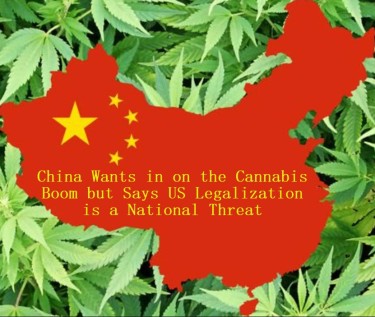
The architecture behind all of this is grimly fascinating. Congressional investigations have revealed that Chinese chemical companies, with the backing of PRC government tax rebates, are subsidizing the manufacture and export of fentanyl precursors directly to Mexican cartels. These companies advertise on social media. They ship precursors in containers labeled as furniture parts, makeup, vases. When U.S. law enforcement sends formal requests for assistance to Beijing, PRC security services reportedly tip off the targets before they can be interdicted.
"This isn't a drug problem. It's a geopolitical assault using chemistry as the weapon and addiction as the delivery system."
The financial mechanics are equally jaw-dropping. Chinese Money Laundering Networks — CMLNs — have become the preferred financial infrastructure for cartel money. Through a system called mirror transactions, cartel cash in Los Angeles gets converted into pesos in Mexico without a single dollar crossing a border. Wealthy Chinese nationals use the same networks to move money out of China and into U.S. real estate. Between 2020 and 2024, financial institutions flagged over $53.7 billion in suspicious CMLN-linked activity. It's a circular economy of devastation, elegant in its structure and catastrophic in its consequences.
This is not a drug problem. It's a geopolitical assault using chemistry as the weapon and addiction as the delivery system.
So what do you do? You send in the military? You bomb the labs? You impose tariffs? Sure, try all of that. The United States has been doing versions of it for fifty years. The Mérida Initiative poured billions into Mexico. The kingpin strategy took out cartel leaders one after another. The result? The cartels fragmented, diversified, and got more dangerous. The drugs got cheaper and more lethal. The "whack-a-mole" approach has a 100% failure rate because it treats the symptom — supply — while ignoring the engine — demand.
And demand, my friends, is a human constant that no government has ever legislated out of existence.
K2, Bath Salts, and the Monster Prohibition Built
Here is something the pharmacology textbooks will confirm and the drug warriors would rather you not think about too hard: K2 and Spice exist because cannabis was illegal.
When you criminalize a substance that people want — and have always wanted — you don't eliminate the demand. You redirect it into a shadow market with no quality control, no consumer protection, and no accountability. Into that shadow market crawls the most opportunistic chemists alive, who synthesize novel compounds specifically designed to mimic the effect of the illegal substance while technically existing outside the law.
The pharmacological difference between natural THC and synthetic cannabinoids like K2 is the difference between a partial agonist and a full agonist. THC, the active compound in cannabis, partially activates the CB1 receptor in your brain. There is a biological ceiling on how activated that receptor can get from natural cannabis. This is why a fatal marijuana overdose is, for all practical purposes, impossible.
K2 hits the same receptor as a full agonist — maximum activation, no ceiling. Binding affinities 10 to 100 times stronger than THC. The result: seizures, acute kidney injury, cardiovascular failure. These are not cannabis side effects. These are the side effects of a prohibition-manufactured substitute that never would have found a market if the original, infinitely safer plant were available at a licensed dispensary.
The same logic cascades across the entire drug landscape. MDMA, a relatively well-understood compound with a credible therapeutic safety profile, gets replaced on the street by bath salts — cathinone derivatives with unpredictable psychosis risks. LSD, a substance with perhaps the lowest toxicity-to-effect ratio of any psychoactive compound known, gets replaced by novel research chemicals that nobody has studied and nobody can test for. Natural cocaine, a plant-derived stimulant with a pharmacological profile not dramatically more dangerous than alcohol at recreational doses, gets replaced by fentanyl-laced street product that will kill you by accident.
"The synthetic drug crisis is not a failure of human virtue. It is the direct, predictable, documented consequence of prohibition policy."
The synthetic drug crisis is not a failure of human virtue. It is the direct, predictable, documented consequence of prohibition policy. You banned the agrarian drugs — the ones that grew from the earth, that humanity developed a relationship with over millennia, that the human body has evolutionary context for — and you created a vacuum that industrial chemistry filled with something far more dangerous.
China didn't create the fentanyl market. Prohibition did. China just found a way to weaponize it.
The Case for Organic: Earth's Drugs vs. The Lab
There is a simple, elegant truth at the center of this argument that cuts through the politics: natural drugs derived from plants and classical synthesis are categorically less dangerous than the synthetic alternatives that prohibition forces people to consume.
Cannabis. Psilocybin mushrooms. Peyote. Ayahuasca. MDMA. LSD. Cocaine. These substances share something important in common — they have been used by human beings for hundreds or thousands of years, which means we have extensive observational data on their effects, their risks, and the conditions under which they are and aren't dangerous. The human body has, in many cases, literal evolutionary context for these molecules. The endocannabinoid system exists. The serotonergic system that psychedelics interact with exists. These are not alien compounds hijacking your neurology; they are keys for which locks already exist.
The risk profiles, examined honestly, are manageable. Cocaine's primary danger in 2026 is not the cocaine — it's the fentanyl that gets mixed into street product, and the complete absence of any dosage information, quality control, or harm reduction guidance. Pharmaceutical-grade cocaine, known purity, known dose, used with awareness of the cardiovascular considerations — this is not a public health catastrophe. It is a substance that lawyers, executives, and entertainers have used recreationally for decades, mostly without ending up in the emergency room.
This is not a pro-drug argument. This is an argument for honesty about risk. We permit alcohol — a substance with a well-documented association with violence, liver disease, cardiovascular damage, addiction, and approximately 95,000 deaths per year in the United States — while simultaneously treating cocaine as an existential menace. The inconsistency is not accidental. It is the product of a century of political decisions dressed up as public health policy.
The Licensed Drug Model: A Driver's License for Your Mind
Here is the framework that makes this work politically, practically, and ethically. You don't just legalize everything and put it on a shelf next to the energy drinks. You build a system — intelligent, phased, and grounded in genuine education rather than the abstinence propaganda that has been failing for sixty years.
Phase one: licensed consumption. Before you can purchase any substance beyond cannabis, you get a drug license. Think of it like a driver's license, except the vehicle is your own consciousness and you are about to change the channel on your perception of reality. The licensing process is not punitive. It is educational. You learn the pharmacology — what the substance actually does, how it interacts with your body's systems, what the real risks are. Cardiovascular risks for cocaine. Serotonin syndrome risks for MDMA combinations. The importance of set and setting for psychedelics. Drug interaction contraindications. Dosage guidance.
Your license comes with a card. On that card, in plain language: "Cocaine increases cardiovascular stress. If you have heart disease or hypertension, this substance poses elevated risk. Know your body." Not a scare tactic. Not propaganda. A fact, presented like the facts on a pharmaceutical label, because that is what respect for the consumer actually looks like.
For teenagers, the conversation changes but doesn't disappear. The new framework isn't silence — it's honesty. "Drugs are legal now, but access is licensed and age-gated, and here is why: your developing brain is more vulnerable to dependency patterns than an adult brain. Here is what these substances actually do. Here is how to make informed decisions." That is actual harm reduction. That is what the DARE program was pretending to be.
Phase two, after roughly a decade of data collection, outcomes monitoring, and cultural adjustment: remove the licensing requirement for adults 25 and older. By that point you have a population that grew up with honest drug education, a decade of real-world outcome data, and a legal market that has been systematically undercutting the black market's product quality and price. The cartel's customer base has been legally poached by Uncle Sam.
"The cartel's customer base has been legally poached by Uncle Sam."
The heroin and opioid piece requires its own track. This is the Swiss model, and it works. Pharmaceutical-grade heroin, administered in supervised facilities, free of charge, for people dependent on opioids. This is not enabling addiction — the addiction already exists. This is replacing a Chinese-manufactured WMD with a medically supervised, pharmacologically pure alternative. Every person who walks into a supervised consumption site and accepts pharmaceutical heroin instead of street fentanyl is a person who is not funding the cartels, not funding the CMLNs, not funding the PRC's subsidized precursor industry. They are, in the most literal sense, refusing to participate in a geopolitical attack on their own country.
Uncle Sam's H. It'll get you there. It won't kill you. And it won't make anybody in Wuhan rich.
The National Security Math
Let's look at this from a purely strategic angle, because that is what this ultimately is — strategy.
The fentanyl supply chain runs: PRC chemical manufacturers (subsidized by Chinese government VAT rebates) → Mexican cartels → American streets. The financial counter-flow runs through CMLN mirror transactions into U.S. real estate and back to China. The entire system depends on American demand for illicit opioids being serviced exclusively by this supply chain.
The moment you introduce a legal, free, supervised alternative for the opioid-dependent population, you sever the demand side of that chain. Not theoretically — empirically. Switzerland did it. The heroin-assisted treatment programs of the 1990s essentially collapsed the street heroin market in participating Swiss cities. Crime dropped. HIV transmission dropped. The cartels lost customers. This is documented, not speculated.
Extend the same logic to the broader drug market. Every dollar spent on legal, taxed, domestic cannabis is a dollar not flowing to the Sinaloa cartel. Every MDMA purchase from a licensed dispensary is a demand unit that the black market doesn't get to fill with bath salts. Every cocaine user who can access quality-controlled product through a licensed channel is a consumer who is not buying fentanyl-laced street powder.
The revenue from taxation funds the education system, the harm reduction infrastructure, and the law enforcement that goes after those who violate the new framework — aggressively, because the rules have been made lenient and the remaining violations are therefore genuinely serious. You want to sell unlicensed drugs to minors? You want to traffic synthetics in competition with the legal market? The consequences are severe precisely because everything else has been decriminalized.
This is how you MAGA the drug supply. You domesticate it. You regulate it. You educate around it. You strip the cartels of their market, the CMLNs of their revenue streams, and the PRC's subsidy program of its downstream customers. You do it not by force — force has failed completely and repeatedly — but by the oldest competitive principle in capitalism: give people a better product at a better price with less risk.
American drugs. Clean. Tested. Taxed. Educated. Against Chinese drugs. Contaminated. Lethal. Criminal. Unregulated.
For a rational consumer — even one in the grip of addiction — that is not a difficult choice.
The Sticky Bottom Line
Human nature does not submit to legislation. The evidence for this is overwhelming and spans every culture, every era, and every substance. People alter their consciousness. They always have. They will continue to do so regardless of what any government decides. The only policy question that matters is: under what conditions does this happen?
Right now, those conditions are: in the dark, with unknown substances, of unknown purity, at unknown doses, purchased from criminal networks that funnel the proceeds through Chinese money laundering operations into geopolitical leverage against the United States. That is the current system. That is what "keeping drugs illegal" has built.
The alternative — licensed, educated, quality-controlled, domestically supplied — is not utopia. People will still make bad decisions. Addiction will still occur. There are no risk-free choices in this space. But the comparison is not between the legal model and a perfect world. The comparison is between the legal model and what we have right now: 75,000 Americans dead from fentanyl last year, a WMD designation for a drug that fits in a salt shaker, and a geopolitical adversary that has figured out how to wage chemical warfare with plausible deniability.
They allegedly got El Mencho yesterday — the man at the top of the CJNG, the biggest fentanyl exporter in Mexico. And if you believe that changes anything structurally, I have a kilo of pharmaceutical-grade optimism to sell you. The kingpin dies. The organization survives. The demand persists. The supply adapts. This is what fifty years of war has taught us, and we keep forgetting it the moment there is a press conference with a trophy.
The war on drugs cannot be won with bullets, borders, or bans. It can be won with something far more disruptive to criminal enterprise: a legal, affordable, honest alternative.
Make America's Goods Again. The drugs of the earth, regulated, taxed, and freely available to educated adults who have chosen to alter their consciousness on their own terms. Against the chemical weapons of a geopolitical rival, dispensed through criminal intermediaries, with the specific intent to devastate the American social fabric.
That is the choice. And it is not even close.
CHINA ON CANNABIS, READ ON...