

THE BACKDOOR
How America's Drug War Built the Perfect Infrastructure for a Chemical Attack — and Why Liberty Is the Only Defense
By Reginald Reefer | March 2026 | Part III — The Final Piece
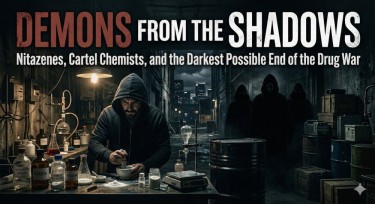
[Editor's Note: This is the conclusion of a three-part series. Part I — "Make America High Again" — establishes the geopolitical case: China is subsidizing the fentanyl supply chain as a strategic assault on American society. Part II — "Demons from the Shadows" — introduces the nitazenes: synthetic opioids up to 1,000 times stronger than morphine, undetectable by standard field tests, capable of ghosting back through a patient's system hours after apparent recovery. This piece is where those two threads converge into something that should keep national security planners awake at night. It begins where most drug war journalism refuses to go.]
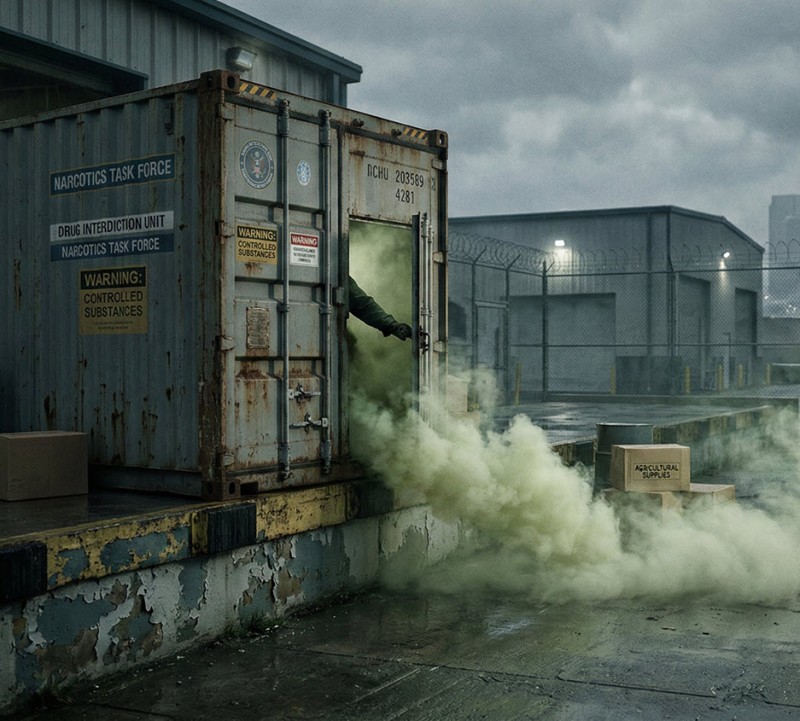
Imagine it's a Tuesday.
Nothing special about the Tuesday. No declaration of war. No satellite imagery of missile silos. No intercepted communications that trigger the machinery of national defense. The stock market opens normally. The morning shows run their segments. The President has a full schedule.
And then, over the course of that Tuesday and the Wednesday that follows and the Thursday after that, emergency rooms across the country begin to fill. Not with the usual rhythm of overdose calls — the ones that have become so normalized that first responders barely register them anymore as crises. Something different. Overdoses that don't respond to Narcan the first time. Or the second time. Patients who wake up, seem stable, get moved to recovery — and then stop breathing again four hours later when the night shift is stretched thin and nobody is watching closely enough.
By Friday, the pattern is undeniable but the cause is invisible. Standard tox screens are coming back inconclusive. The drug is not fentanyl — at least not fentanyl alone. It's something that looks like fentanyl on the street, that users bought as fentanyl, that moved through the same supply chain as fentanyl. But it is killing people at a rate that fentanyl, catastrophic as it is, does not match.
By the following Monday, the ICU system is breaking.
"No declaration of war. No missile silos. No intercepted communications. Just a Tuesday — and then the emergency rooms start to fill."
This is not a movie plot. This is a threat scenario that emerges directly from the documented architecture of the current illicit drug supply chain — the Chinese precursor subsidies, the cartel chemists with graduate degrees, the nitazenes already appearing in European and American drug supplies, the CMLN financial networks that move billions in the dark. It requires no new technology, no science fiction, and no extraordinary leap of imagination. It requires only that the system operating right now be used with slightly more strategic intent than it already is.
How we got here is a story about prohibition. How we get out is a story about liberty. But first, let's look at what the attack actually costs — because when you put numbers to it, the abstraction becomes a catastrophe you can measure.
The Numbers That Should Be in Every Defense Budget Conversation
Before we get to the scenario, understand the baseline. The opioid crisis in its current form — before any coordinated escalation, running on ordinary cartel business logic — already costs the United States approximately $1.5 trillion annually. That figure comes from a 2021 analysis published in JAMA Network Open, and it encompasses healthcare expenditure, lost workforce productivity, criminal justice costs, and social services. $1.5 trillion. For context, the entire U.S. defense budget for 2025 was $886 billion.
The drug war is already more expensive than the military that's supposed to be protecting the country from foreign threats. And that's the peacetime number.
Now layer in the scenario. There are approximately 2.7 million Americans currently diagnosed with opioid use disorder. Conservative estimates of active daily heroin and fentanyl users run between 500,000 and 900,000 people — human beings who interact with the illicit opioid supply chain every single day. These are not statistics confined to skid rows and back alleys. They are distributed across every congressional district, every income bracket, every demographic. They are in rural counties in Ohio and affluent suburbs in Connecticut and mid-sized cities in the Mountain West. They are everywhere, because the supply chain reaches everywhere, because the supply chain was designed by market forces rather than geography.
The United States has approximately 900,000 hospital beds total. ICU capacity nationally sits around 80,000 to 100,000 beds, running at 65 to 80 percent occupancy on any given day — a figure that COVID demonstrated can reach 100 percent and beyond with consequences that are still being tabulated. FEMA's mass casualty event protocols begin triggering federal emergency responses at around 1,000 simultaneous critical patients nationally.
The active opioid user population is 500 times that threshold.
"The active opioid user population is 500 times FEMA's mass casualty threshold. This is not a security gap. It is a security abyss."
A standard fentanyl overdose, treated with naloxone and basic supportive care, costs between $8,000 and $15,000 per emergency department visit. A nitazene overdose — requiring multiple naloxone doses, ICU admission, and 12 to 24 hours of monitored observation because the drug can reassert itself after apparent reversal — runs $30,000 to $75,000 per case at minimum, and that assumes the infrastructure exists to handle it. The U.S. Strategic National Stockpile maintains naloxone reserves, but those reserves were calculated against fentanyl overdose protocols, not against a benzimidazole-opioid that consumes three to five times the naloxone per case.
A gradual substitution event affecting even ten percent of the active user population simultaneously — 50,000 to 90,000 people — would exhaust the national naloxone stockpile, saturate ICU capacity in affected regions, and generate emergency costs in the range of $1.5 to $6.75 billion in the first week alone. First responders would begin experiencing the cascading effects of system overload within 72 hours: triage protocols abandoning lower-priority cases, ambulance response times collapsing, emergency physicians making decisions about who gets the last ICU bed.
And critically — it would be invisible until it was already catastrophic. There is no early warning system for this. There is no radar, no satellite, no signals intelligence network monitoring the molecular composition of street drugs in real time. The detection infrastructure does not exist because the threat was never framed as a military problem. It was framed as a law enforcement problem, which meant the response was always reactive rather than preventive.
The Opium Wars in Reverse: China's Institutional Memory
To understand why this threat deserves a military framing rather than a public health one, you have to go back to the 19th century — because Beijing never forgot what happened, and the lesson they took from it is different from the one Western history textbooks teach.
The British East India Company, operating with the tacit support of the Crown, forced the opium trade on China through two wars fought between 1839 and 1860. The mechanism was elegant in its brutality: grow opium in British India, ship it to China, create mass dependency in the Chinese population, and use that dependency as economic and political leverage. At the peak of the trade, an estimated 10 to 15 percent of the Chinese population was addicted to opium. The social consequences were documented in excruciating detail — workforce incapacitation, military degradation, government corruption, family dissolution, demographic collapse in affected provinces.
China calls this period the "Century of Humiliation." It is not rhetorical language. It is a foundational national trauma that shapes PRC strategic doctrine to this day. Xi Jinping references it regularly. The institutional memory of what a state-sponsored narcotics campaign does to a civilization is baked into the DNA of Chinese foreign policy.
Now consider: a nation with that institutional memory, watching the United States maintain a prohibition policy that keeps a massive, unregulated, criminally controlled drug market permanently in operation on its own soil — what does that nation see? It sees an infrastructure. It sees a delivery system that America built, that America maintains, that reaches into every community in the country, that operates completely outside government control, that is funded by American consumers and managed by criminal organizations with no national loyalty and every financial incentive to adopt whatever product maximizes their margins.
"China experienced firsthand what a state-sponsored narcotics campaign does to a civilization. They took notes. The textbook they wrote is being used against us."
The House Select Committee on the CCP documented in 2024 that Chinese government-linked entities are providing VAT tax rebates to manufacturers specifically conditioned on selling precursor chemicals to foreign markets. PRC security services have reportedly warned fentanyl manufacturers when U.S. law enforcement probes were incoming. This is not passive negligence. This is a state that has decided the fentanyl supply chain is a strategic asset worth protecting.
The British didn't need to fire many shots to prosecute the Opium Wars. They had the East India Company's commercial infrastructure, a dependent population, and the patience to let the drug do the strategic work. The PRC has the Chinese chemical industry, the CMLN financial networks, the cartel distribution system, and the patience of a civilization that thinks in decades rather than electoral cycles.
The backdoor was not built by China. It was built by American prohibition policy. China simply noticed it was unlocked.
The Gradual Substitution: How You Fight a War Nobody Declares
The most effective version of this attack does not look like an attack. That is its defining characteristic and its greatest strategic advantage.
A sudden, simultaneous substitution of fentanyl with nitazenes across the entire supply chain would trigger immediate pattern recognition — a spike in overdose deaths so dramatic that it would generate emergency federal response within days. The military framing would become unavoidable. The political will to respond would crystallize quickly.
A gradual substitution achieves the same strategic objectives — overwhelming the medical response infrastructure, generating mass casualties, imposing catastrophic economic costs — while maintaining plausible deniability indefinitely. You introduce nitazenes into a fraction of the supply. Some users die. The deaths are attributed to "fentanyl overdoses" because that is the default assumption, because the testing infrastructure to distinguish them doesn't exist at scale, because medical examiners in underfunded county offices are running months-long backlogs on toxicology.
You increase the fraction slowly. The overdose death rate climbs — but it has been climbing for years, and each year's increase gets absorbed into the ongoing narrative of the opioid crisis rather than recognized as an escalation of a strategic campaign. The frog does not notice the temperature rising.
Meanwhile, the economic damage compounds continuously. Each percentage point increase in the nitazene concentration of the street supply translates to longer hospital stays, more ICU admissions, higher naloxone consumption, more first responder burnout, more emergency department closures in communities that can't sustain the volume. The $1.5 trillion annual baseline climbs. The workforce participation rate among working-age Americans — already suppressed by the opioid crisis — falls further. The social fabric frays in the communities hit hardest, which are disproportionately the communities that manufacture things, grow things, and maintain the physical infrastructure of the country.
There is no threshold at which this triggers a war powers response, because it never looks like war. It looks like a public health crisis. It looks like a failure of social services. It looks like a cultural problem, a moral failing, an addiction epidemic — all the framings that have been applied to the opioid crisis for thirty years while the death toll climbed and the strategic architecture behind it went unexamined.
"There is no threshold at which this triggers a war powers response, because it never looks like war. It looks like a public health crisis. It looks like America failing itself."
The invisibility is not accidental. The drug war framing — enforced by fifty years of political investment in the prohibition model — actively prevents the national security framing from taking hold. As long as overdose deaths are categorized as public health statistics rather than enemy casualties, the appropriate response remains social services rather than strategic defense. The budget allocations, the institutional responses, the political accountability structures — all of them are pointed in the wrong direction.
An enemy that understood this — and the documented evidence suggests the PRC understands it very well — would have no reason to change tactics. The attack is working. It is cheap. It is deniable. It is self-sustaining because the American prohibition system maintains the delivery infrastructure at no cost to the attacker. And it is protected from the most effective counter-measure — legalization and domestication of the drug supply — by the political inertia of the very institutions that should be recognizing the threat.
The Defense That Isn't: Why Enforcement Cannot Solve a Strategic Problem
The WMD designation for fentanyl was the right symbolic move. The FTO designations for the cartels were legally necessary. The Stop Chinese Fentanyl Act, the sanctions expansions, the De Minimis closure — all of these are correct responses within the enforcement paradigm.
None of them solve the strategic problem.
The enforcement paradigm operates on the assumption that if you disrupt the supply chain sufficiently, demand will go unmet and the market will contract. This assumption has been tested for fifty years and has failed every single time, for a reason that is simple enough to state in one sentence: an unmet need does not disappear, it finds another way to be met.
The cartel chemists with their biochemical engineering degrees are not sitting idle while sanctions are debated in Congress. They are already working on whatever comes after nitazenes. They are already identifying the next compound in the pharmacological archives — the next substance that was abandoned by legitimate medicine because it was too dangerous, that becomes valuable to criminal enterprise precisely because of that danger. The chemical universe is not finite. The scheduling list will always be one step behind. The precursor controls will always be circumvented through molecular modification.
You cannot win a chemical arms race through law enforcement when one side is constrained by legal process and the other is constrained only by market logic. The asymmetry is insurmountable within the current framework.
What you can do — what the enforcement framework structurally cannot do but a legalization framework can — is eliminate the delivery infrastructure entirely. Not disrupt it. Eliminate it. Not by force, but by competition.
Liberty as the Final National Security Argument
Here is the argument that should be made in every national security briefing, every congressional hearing on the drug crisis, every conversation about the fentanyl WMD designation:
The illicit drug supply chain exists because prohibition created it. It persists because prohibition maintains it. Every person who buys an illegal substance through that supply chain is an unwitting participant in a system that funds the cartels, launders money through Chinese financial networks, and maintains the delivery infrastructure for what may be — what the documented evidence suggests is — a deliberate strategic assault on American society.
The only way to destroy that infrastructure is to make it economically nonviable. The only way to make it economically nonviable is to give the people who currently use it a better alternative. Clean. Tested. Domestic. Regulated. American.
This is not a radical argument. It is the most conservative argument available: protect the homeland by denying the enemy their weapon. The weapon is the supply chain. The supply chain's power source is prohibition. Legalization is not surrender in the drug war — it is the strategic strike that enforcement has never been able to land.
"Legalization is not surrender in the drug war. It is the strategic strike that fifty years of enforcement has never been able to land."
A licensed dispensary selling quality-controlled cannabis, MDMA, psychedelics, and cocaine to educated adults with drug licenses is not a moral compromise. It is a national security asset. Every sale it makes is a sale the cartel doesn't make. Every dollar that flows through the taxed, regulated domestic market is a dollar that doesn't travel through a CMLN mirror transaction into Chinese real estate. Every opioid-dependent person who walks into a supervised consumption facility and accepts pharmaceutical-grade heroin instead of street fentanyl is a person who has just opted out of the attack.
The education system built around the licensing model — the drug license that teaches pharmacology honestly, that treats adults as capable of informed decision-making, that puts cardiovascular warnings on cocaine the same way pharmaceutical inserts warn about drug interactions — is simultaneously a public health infrastructure and a counter-intelligence operation. An informed population is a population that cannot be as easily weaponized through its own addictions.
Think about what that means at the individual level. A person who knows what they are consuming, who obtained it from a regulated source, who understands the risk profile and has made an informed choice — that person is not a vulnerability in the national security architecture. They are a citizen exercising bodily autonomy within a framework designed to protect them. The person buying unlabeled powder from a street dealer, with no knowledge of what's in it, no recourse if it kills them, and no connection to any system that could help them — that person is a vulnerability. That person is a potential casualty in an attack they don't know is happening.
Freedom over your own body is not just a philosophical position. In the context of a chemical supply chain being managed by foreign adversaries and their criminal proxies, it is a strategic necessity. When you own your body — when you decide what goes into it, from sources you trust, with information you've been given — you have closed the backdoor.
The British East India Company needed Chinese people to be dependent on opium they couldn't obtain from any other source. That dependency was the weapon. The moment China could have grown its own, processed its own, distributed its own — at any quality and price that competed with the British product — the weapon would have failed.
America is the China of this story. And the opium is already flowing.
The Sticky Bottom Line
What happens when a drug stronger than nitazenes appears? Because it will. The chemical logic is inexorable — each enforcement cycle pushes cartel chemists deeper into the pharmacological archives, and the archives are not empty. Whatever comes next will be more potent, harder to detect, with a therapeutic window — the gap between high and dead — narrower still. It will move through the same supply chain that fentanyl moves through, the same one that nitazenes are beginning to move through, the same one that has been operating continuously since prohibition created it decades ago.
The medical system that would have to respond to a mass casualty event from that compound has 80,000 to 100,000 ICU beds running near capacity. It has naloxone stockpiles calculated for fentanyl protocols, not benzimidazole-opioids that ghost back through a patient's system six hours after apparent recovery. It has no early warning system, no real-time molecular surveillance of street drug composition, no detection infrastructure built to military specification because the threat was never classified as military.
The cost of the current system — before any deliberate escalation — is $1.5 trillion a year. More than the defense budget. Paid annually. Growing. And that cost is borne by the country that built the system, maintains the system, and refuses to dismantle the system because dismantling it requires admitting that the system was always the problem.
Two pieces in this series laid out the evidence: the Chinese subsidy infrastructure, the CMLN mirror transactions, the cartel chemists, the nitazenes, the naloxone ghost, the direction of travel. This piece has given you the scenario those pieces were building toward — not as fiction, but as the logical extension of documented, operational reality.
The defense is not more enforcement. Enforcement built this. The defense is not more scheduling. Scheduling accelerated the chemical arms race. The defense is not more military pressure on cartels. Kingpin strategy produced more fragmented, more sophisticated, more dangerous organizations.
The defense is liberty. The defense is an American citizen who buys American cannabis, American MDMA, American psychedelics, American cocaine — from a licensed source, with honest information, at a price that makes the cartel's product economically irrational. The defense is a supervised consumption facility where the person with opioid dependency takes pharmaceutical heroin from a nurse instead of nitazene-laced powder from a dealer who answers to an organization that answers to a supply chain that answers, ultimately, to people in Beijing who remember the Opium Wars and have been paying attention ever since.
Own your body. Own your country's security.
Make America High Again — on American drugs, pure, tested, honest, and free.
Because the alternative has a name now. And it's already in the supply chain.
— Reginald Reefer
Sources: JAMA Network Open, "The Economic Burden of the Opioid Crisis" (2021); DEA 2024 National Drug Threat Assessment; House Select Committee on the CCP, Fentanyl Investigation Report (2024); Pergolizzi et al., "Nitazenes: A New Wave of Synthetic Opioids," Pain and Therapy (2021); EMCDDA Nitazene Early Warning Advisory (2022-2025); FEMA Mass Casualty Incident Response Framework (2023); American Hospital Association, Hospital Capacity Data (2024); U.S. Strategic National Stockpile, Naloxone Reserve Guidelines; Congressional Research Service, "Chinese Money Laundering and the Fentanyl Supply Chain" (2024); Stuart B. Schwartz, "The Opium Wars and the Century of Humiliation" in China's Historical Memory, Harvard Asia Quarterly (2019).
READ PART 2 BELOW.....