
The cannabis industry has a dirty secret, and it has nothing to do with the plant. It's the power bill.
Right now, the dominant model for cannabis production in the United States is indoor cultivation — sealed warehouses stuffed with high-intensity discharge lights, industrial HVAC systems running around the clock, and CO2 tanks pumping carbon into rooms that never see the sun. A landmark study out of Colorado State University published in Nature Sustainability found that indoor cannabis cultivation produces between 2,283 and 5,184 kilograms of CO2 per kilogram of dried flower — depending on where in the country you're growing. To put that in perspective, outdoor and greenhouse electricity emissions clock in at roughly 22.7 and 326.6 kg CO2 per kilogram respectively, per the New Frontier Data 2018 Cannabis Energy Report. The gap isn't close. It isn't even in the same stadium.
And yet, the industry keeps building warehouses. Why? Because control feels like quality. Because indoor has the cultural cache. Because we got so obsessed with the idea of the perfect, hermetically-sealed grow room that we forgot the sun exists.
I want to make a case — a firm one — that the greenhouse model, particularly when integrated with hydroponic systems, is not just a viable alternative to indoor growing. It's the superior system. And if the industry is serious about sustainability, scalability, and producing better cannabis at a lower cost, it needs to become the standard.
The Sun Does It Better
Let's start with the most fundamental input in any grow: light.
Indoor growers spend enormous resources trying to simulate sunlight. High-pressure sodium (HPS) lights, metal halide, and LEDs all attempt to replicate what the sun delivers for free. And here's the inconvenient truth: they don't fully succeed. A study comparing sun-grown and indoor-grown cannabis using genetically identical clones found that naturally grown samples had less oxidized and degraded cannabinoids, and significantly more terpenes — both in quantity and variety — particularly sesquiterpenes, compared to their indoor counterparts. Same genetics. Different environments. Different results.
The reason comes down to UV light — specifically UVA and UVB wavelengths. When cannabis plants are exposed to UV light, they trigger a photomorphogenic stress response. As a kind of evolutionary sunscreen, the plant produces more THC, CBD, and terpenes in the glandular trichomes. Indoor lighting, especially standard HPS and many LED setups, contains virtually no UV spectrum. The plant never gets that trigger.
A greenhouse, by contrast, lets the full solar spectrum in — including UV — while giving growers the ability to supplement with artificial light during shoulder seasons, low-light periods, or to extend the photoperiod to keep plants in vegetative growth longer. You get the biological complexity that full-spectrum sun produces, with the controllability that indoor growers love. That's not a compromise. That's an upgrade.
Energy: Where the Real Numbers Live
Cannabis is one of the most energy-intensive crops on the planet when grown indoors. A 2012 analysis estimated that U.S. indoor cannabis cultivation consumed approximately 20 terawatt-hours of electricity annually — equivalent to the energy consumption of the entire U.S. agricultural sector at that time, generating around 15 million metric tons of CO2.
Greenhouses don't eliminate energy consumption. They restructure it. During daylight hours, natural sunlight handles the primary lighting load. Supplemental lighting is used only when needed. Climate control is more efficient because the structure itself traps heat passively rather than fighting ambient outdoor temperatures with brute-force HVAC. Heating a sealed greenhouse with residual solar gain costs significantly less than heating a blacked-out warehouse from scratch.
The result, based on available data, is roughly 25% energy savings per kilogram of cannabis produced compared to indoor cultivation on electricity alone — and the gap widens further when you account for CO2 supplementation costs (greenhouses can leverage natural photosynthesis timing) and reduced HVAC load. It's not a revolution in a single metric; it's a compound advantage across every operational line item.
The Hybrid Advantage: Adding Hydroponics to the Equation
A greenhouse gives you better light and lower energy overhead. Add a properly designed hydroponic system, and you close the remaining performance gap between greenhouse and indoor yields.
Hydroponics in a greenhouse context operates by delivering nutrient-rich water directly to the root zone, bypassing the inefficiencies of soil entirely. Plants grown hydroponically can direct more energy into flower production rather than root expansion searching for nutrients. Vegetative cycles are faster, flowering can be denser, and the grower maintains precise control over the nutrient profile throughout the plant's life cycle.
With Hydroponics vs. Without
The comparison here is worth being direct about:
A greenhouse without hydroponics — using soil grows in raised beds or containers — is still a substantial upgrade over indoor soil grows. You get the full-spectrum sunlight advantage, lower energy costs, and a more natural growth environment. Terpene profiles are richer, the operation is more scalable, and input costs are lower. The downside is water efficiency. Soil grows absorb what they need, drain what they don't, and unless you've built in runoff capture and recycling, that excess water — along with whatever nutrients it carries — is gone. A 40,000 square foot cannabis greenhouse without water recycling can waste upwards of 10,000 gallons of water per day.
A greenhouse with integrated hydroponics solves that problem directly. In a recirculating hydroponic system, runoff nutrient solution is captured, filtered, and reintroduced to the system. Advanced facilities using closed-loop or near-closed-loop approaches — combining runoff recapture with dehumidifier condensate recovery — are achieving 80% to 90% water reuse rates. One closed-loop hydroponic vertical farming patent has demonstrated 90% water savings, 50% reductions in fertilizer costs, and 50% labor cost reduction compared to conventional methods.
The catch is that closed-loop water management requires discipline. Nutrient ratios shift as plants uptake elements at different rates through their life cycle, meaning frequent water analysis is mandatory. It's not passive. But for any commercial operation serious about margins and sustainability, the data makes a compelling case: soil greenhouse gets you halfway there, hydroponic greenhouse gets you most of the way.
The Industrial Model: What a Commercial Greenhouse Operation Looks Like
At commercial scale, the optimal greenhouse cannabis operation looks something like this:
Structure: Multi-span glass or polycarbonate greenhouse with automated blackout curtains for photoperiod control. Dutch Venlo-style greenhouse designs — widely used in commercial horticulture — allow maximum light transmission with minimal structural shadow. Climate management runs through centralized building automation systems controlling venting, supplemental heating, dehumidification, and CO2 enrichment during peak photosynthesis hours.
Lighting: LED supplemental lighting installed in overhead arrays, activated during low-light periods (dawn, dusk, overcast days) or to extend the daily light integral (DLI) when natural light falls short. Because the sun handles the baseline, LED systems can be smaller and draw less power than equivalent full-cycle indoor setups.
Water and Nutrients: Recirculating drip hydroponic system fed from central nutrient reservoirs. Drainage channels collect runoff back to the reservoir. UV sterilization or ozone treatment cleans recirculated water before it re-enters the system. A multi-stage reverse osmosis filtration unit handles periodic water quality correction. On-site weather stations feed data to smart irrigation controllers that adjust watering schedules based on evapotranspiration rates — meaning plants get exactly what they need, not a liter more.
Scale efficiency: Greenhouses are modular. You add spans. You don't demolish and rebuild. For licensed producers looking to scale from 50,000 to 200,000 square feet of canopy, a greenhouse expansion is a civil construction project, not a full facility redesign. Indoor facilities hit walls — literally and figuratively — when demand outpaces capacity.
Environmental profile: Compared to a fully indoor equivalent operation, a commercial greenhouse hydroponic facility reduces electricity consumption, cuts CO2 emissions by an order of magnitude, and recovers the majority of water inputs. For regulators increasingly scrutinizing the environmental footprint of cannabis operations, this is where the industry needs to land.
The Personal Grower Scale: Home Greenhouse with Hydroponics
Everything above scales down. And for the home or craft grower, the greenhouse-plus-hydroponics model makes even more intuitive sense, because the economics shift in your favor faster at smaller volumes.
A backyard or attached greenhouse in the 10x12 to 16x24 foot range gives a personal grower year-round capability (with supplemental lighting), environmental protection that outdoor grows can't offer, and significant cost savings over running a dedicated indoor tent setup with full artificial lighting. A decent LED setup to run four plants costs electricity money every single month. A greenhouse in a sunny climate costs almost nothing to light for the majority of the growing season.
For hydroponics at this scale, a deep water culture (DWC) or a nutrient film technique (NFT) setup is practical and inexpensive to build. DWC — where plant roots hang directly into oxygenated, nutrient-rich water — is straightforward to build and maintain, with minimal moving parts. A small recirculating reservoir, an air pump, and basic pH and EC meters are the core equipment. At home scale, water recycling is almost automatic: the system is small enough that nutrient solution circulates continuously and runoff from net pots returns to the reservoir without elaborate infrastructure.
The personal grower doesn't need building automation or weather stations. What they need is a thermometer, a hygrometer, a couple of clip fans for air circulation, and the discipline to check pH and nutrient levels every few days. The sun does the heavy lifting. The hydroponic system eliminates the guesswork around soil nutrition. The greenhouse keeps pests, weather, and nosy neighbors at a manageable distance.
A realistic setup for a personal grower growing four to six plants per cycle in a small greenhouse with a DWC system could run less than $1,500 in total infrastructure — and deliver consistent, quality harvests that rival what a dedicated indoor setup produces for considerably more per year in electricity alone.
The Bottom Line
The cannabis industry built its indoor-first culture partly out of necessity — prohibition meant keeping operations hidden, which meant no windows, no sunlight, no exposure. That era shaped the infrastructure, the aesthetics, and the cultural assumptions around what "premium" cannabis looks like.
Prohibition logic no longer applies in legal markets. And clinging to the warehouse model because it's familiar, or because indoor has a reputation for quality, is no longer defensible when the data shows that greenhouse-grown cannabis can produce a richer terpene and cannabinoid profile, at a fraction of the energy cost, with a water footprint that can be reduced to a fraction of conventional methods — provided the hydroponic infrastructure is designed correctly.
The sun is free. The light spectrum it delivers is more complete than anything we can synthesize indoors at commercially viable costs. And a well-designed greenhouse captures it, channels it, and pairs it with the precision of hydroponics to produce cannabis that is better for the plant, better for the wallet, and better for the planet.
The industry should stop apologizing for growing with the sun and start treating it as the competitive advantage it actually is.
Sources
Colorado State University / Nature Sustainability — Hailey Summers, Jason Quinn, Evan Sproul: Life-cycle assessment of U.S. indoor cannabis cultivation greenhouse gas emissions.
New Frontier Data — 2018 Cannabis Energy Report (electricity emissions by cultivation method).
Molecules (NCBI/PMC, 2023) — "Comparison of the Cannabinoid and Terpene Profiles in Commercial Cannabis from Natural and Artificial Cultivation" (PMC9861703).
Cannabis Science and Technology — "Indoor Cannabis Growing with a Closed Loop Water System"; "The Environmental Implications of Energy Consumption in Cannabis Cultivation."
MJBizDaily — "Indoor cannabis producers adopt water-efficiency systems in the heat of drought" (2021).
Greenhouse Grower — "Lighting Strategies for Higher Terpene and THC Content in Cannabis" (2020).
MMJDaily — "Cannabis Growers and Water Waste" (2019).
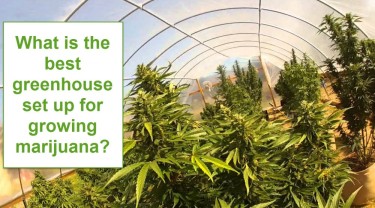
WHAT ARE THE BEST GREENHOUSE SET UPS? READ ON...