
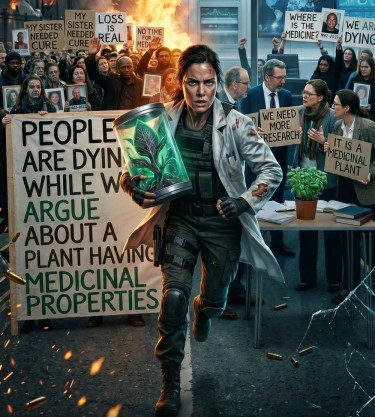
Fifty-four thousand Americans died from opioid overdoses in 2024. That number is actually considered progress. At its worst, in 2023, the toll was nearly 80,000 dead. The year before that, more than 81,000. These are not statistics in the abstract — these are people who got up one morning and did not make it to the next. Parents, siblings, veterans, teenagers, neighbors. The opioid crisis has been grinding through the American population for the better part of three decades and by the CDC's own numbers, it has killed more Americans in that span than the Vietnam and Iraq wars combined, several times over.
Now comes a federally funded study from the University of Kentucky's College of Public Health, published in Preventive Medicine Reports, analyzing claims data on 107.5 million commercially insured adults across all 50 states and Washington D.C. from 2011 to 2021. The finding: states that legalized medical or recreational marijuana saw significant reductions in non-fatal opioid overdoses. Access to medical cannabis dispensaries was associated with a 15.47 percent reduction in non-fatal opioid overdoses per 100,000 enrollees per quarter. Recreational legalization tracked to an 11.92 percent reduction. Among adults aged 18 to 34, the medical dispensary effect was even sharper — a 23.27 percent reduction.
The researchers called this a possible substitution effect: people with access to cannabis appear to use fewer opioids. People who use fewer opioids die from them less often. The math is not complicated. And yet, here we are.
This Is Not a Novel Finding. That Is the Point.
The University of Kentucky study is notable for being the first of its kind to examine non-fatal opioid overdoses specifically in the employer-sponsored insurance population. But it is not the first to find this relationship. It is not even close.
The American Medical Association has published multiple studies showing cannabis substitution reduces opioid prescriptions among cancer patients and chronic pain sufferers. Australian researchers found that medical marijuana significantly decreases opioid use in pain management treatment. A study in Drug and Alcohol Review found that daily cannabis use among people with chronic pain was linked to a higher likelihood of quitting opioids entirely, particularly among men. Utah saw a reduction in prescription overdose deaths following medical cannabis legalization. A separate analysis found recreational marijuana legalization associated with a decrease of approximately 3.5 opioid overdose deaths per 100,000 individuals — with stronger effects in states that legalized earlier.
One paper, tracking opioid manufacturers' payments to pain physicians, found that medical cannabis legalization led to a significant decrease in those payments — with authors concluding the drop reflected cannabis becoming available as a direct substitute for the prescription painkillers those payments were designed to promote.
Read that last one again slowly. The cannabis-opioid substitution effect is strong enough that it shows up in pharmaceutical company financial data. Pharma knows it. The researchers know it. The federal government — which funded this latest study through a NIH grant — knows it. The only people who seem comfortable ignoring it are the policymakers with the actual power to act.
Let's Not Pretend Cannabis Is Perfect
There is no drug without a risk profile. Cannabis is not exempt from this. Heavy adolescent use has been associated with disrupted neurodevelopment. Some users develop problematic dependency patterns — not in the physiologically brutal way opioids create dependency, but a real behavioral pattern that warrants acknowledgment. Cannabis can worsen anxiety or trigger psychotic episodes in individuals with a genetic predisposition to schizophrenia. High-potency concentrates carry different risk profiles than flower. And as the first article in this series covered, smoking anything is not a neutral act.
These are real concerns. They deserve real frameworks: age restrictions, product labeling, potency regulation, honest public education that is not built on forty years of prohibition propaganda. What they do not deserve is being used as a pretext to keep millions of adults from a substance that, by every reasonable comparative measure, is significantly less harmful than what they are already legally consuming.
Americans can legally drink themselves to liver failure. They can eat processed food engineered to be chemically addictive. They can take opioid prescriptions that carry a documented risk of fatal overdose. Alcohol alone accounts for roughly 95,000 deaths per year in the United States according to the CDC — more than the opioid crisis at its worst. But cannabis, the plant with no established lethal dose and a growing body of literature showing therapeutic value across pain, anxiety, sleep, and now addiction treatment, remains a scheduling debate.
The inconsistency is not accidental. It is structural. And it has a body count.
The Paradox in Plain Sight
The opioid crisis has been a declared public health emergency since 2017. Billions of dollars have been spent on task forces, treatment programs, first responder naloxone distribution, and enforcement operations. All of that spending has value — naloxone saves lives and addiction treatment works. But the idea that we are serious about solving this problem while simultaneously dragging our feet on the most well-documented complementary intervention in the research literature is a contradiction that demands a straight answer.
We want to reduce opioid deaths. We have a tool that demonstrably reduces opioid deaths. We will not fully implement that tool because of scheduling classifications written in 1970, lobby money from the pharmaceutical industry, and the residual discomfort of politicians who grew up being told cannabis was a gateway drug to moral ruin.
Even Trump, not exactly a figure associated with drug policy reform, told reporters that marijuana can make people feel much better and serve as a substitute for addictive and potentially lethal opioid painkillers. The current administration has moved to reschedule cannabis from Schedule I to Schedule III under the Controlled Substances Act. That is progress — limited progress, and nowhere near full legalization, but it signals that even the institutions most historically resistant to cannabis reform cannot keep ignoring the data.
The problem is that Schedule III does not fix access. It does not open dispensaries in rural Ohio where opioid deaths are concentrated. It does not let a veteran in a non-legal state swap their OxyContin prescription for cannabis without risking their benefits. It does not resolve the patchwork of state-by-state policies that mean the substitution effect documented in this study reaches some Americans and not others purely based on which side of a state line they happen to live on.
The Dinosaurs in the Room
Cannabis is not a fringe subject. More than half of American adults have tried it. Gallup puts support for legalization consistently above 70 percent. Professionals smoke. Parents smoke. Veterans smoke. Retirees smoke. The people using cannabis in 2026 are not a subculture — they are the culture. The taboo dissolved quietly while certain legislators were too busy fundraising to notice.
What remains are the institutional holdouts: politicians whose positions hardened when Reefer Madness was still considered documentary filmmaking, lobbying ecosystems built by pharmaceutical companies that have a direct financial interest in cannabis not replacing their pain management products, and a federal bureaucracy whose relationship with cannabis policy has been characterized more by inertia than evidence.
These people are not stupid. Some of them know exactly what the research shows. The question is whether their incentives are aligned with reducing opioid deaths or with maintaining the status quo that funds their campaigns and preserves their relevance in a policy landscape that has already moved past them.
The Social Contract Needs an Update
Societies build laws and institutions to serve collective needs. When those institutions stop serving those needs — when they actively obstruct documented solutions to documented crises — they have broken the contract, not the citizens demanding change.
Every functioning society has figured out how to manage substances. You regulate alcohol. You regulate tobacco. You regulate prescription drugs, imperfectly and with enormous ongoing failures, but you build frameworks rather than pretend prohibition resolves anything. Cannabis prohibition was not a success by any reasonable measurement. It did not reduce use. It did not reduce harm. It created a black market, funneled enforcement resources toward low-level users, and disproportionately criminalized communities of color. As a policy framework it failed on its own stated terms for fifty years.
What we know now is that legalization, in addition to generating tax revenue, reducing arrests, and creating regulated markets, appears to reduce opioid overdose deaths. That is not a secondary benefit. In a country where 54,000 people died from opioids in a single year, that is the headline.
There will always be downsides to cannabis policy. People will misuse it. Some will develop dependency. Adolescents will find ways to access it despite age restrictions, just as they do with alcohol and tobacco. These are real problems that require real solutions within a legalization framework. You create sensible frameworks, you fund public health infrastructure, you educate rather than propagandize, and you adjust as the evidence evolves. You do not throw the baby out with the bathwater.
Make Them Irrelevant
The most effective political tool is not outrage. It is irrelevance. Politicians who obstruct cannabis reform in defiance of public opinion, scientific evidence, and a documented humanitarian crisis are not exercising principled governance — they are managing the interests of the industries that fund them. The way you deal with that is not by convincing them. You render them obsolete.
Vote for candidates who engage with evidence. Support state-level ballot initiatives that bypass federal gridlock. Spend at dispensaries in legal states and make the economic case impossible to ignore. Normalize the conversation in every context — at work, in healthcare settings, with family — until the politician who campaigns on cannabis prohibition looks as out of touch as someone running against women's suffrage.
The collective consciousness on this issue has already moved. Most people intuitively understand that the opioid crisis is a catastrophe, that cannabis is less dangerous than what they buy at the grocery store, and that the ongoing criminalization of adults for personal consumption choices is a waste of resources and human lives. The research is now catching up in formal, federally funded language.
Fifty-four thousand people died last year. The number that preceded them is the argument. Every year we stall on this is a number we chose.
References
University of Kentucky, College of Public Health. (2026). Cannabis Legalization and Non-Fatal Opioid Overdoses. Preventive Medicine Reports. Funded by NIH/NCATS.
KFF Health News. (2026). Opioid Overdose Deaths: National Trends and Variation by Demographics and States.
CDC/NCHS. (2026). Drug Overdose Deaths in the United States, 2023-2024. Data Brief No. 549.
CDC. (2025). Provisional Data: 69,973 Drug Overdose Deaths Predicted for 12 Months Ending December 2025.
NIDA. (2024). Drug Overdose Deaths: Facts and Figures. National Institute on Drug Abuse.
American Medical Association (multiple studies, 2023-2025). Cannabis Substitution and Opioid Prescribing Reduction. Various AMA Publications.
MEDICAL PROPERTIES OF CANNABIS, READ ON...