
The Anatomy of Propaganda: Deconstructing Singapore's "Medical Cannabis" Misinformation
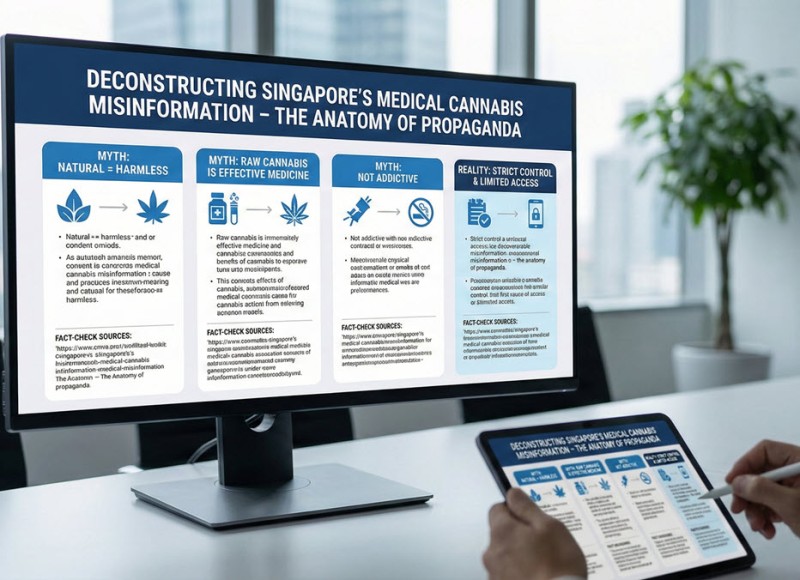
Let me show you what state-sponsored propaganda looks like in 2025. Singapore's Central Narcotics Bureau recently published an infographic titled "Understanding Medical Cannabis" that's so packed with cherry-picked data, misleading claims, and deliberate omissions that it deserves a thorough dissection. This isn't just bad science—it's a masterclass in how governments manipulate information to justify barbaric policies.
And let's be clear about what's at stake here: Singapore executes people for cannabis offenses. They hang human beings for possessing a plant. So when they publish "educational" material about cannabis, it's not about public health—it's about manufacturing consent for state-sanctioned murder.
Let's break down this propaganda piece by piece and expose the lies, distortions, and cynical manipulation hiding behind official-looking graphics and selective citations.
Claim 1: "Insufficient Evidence to Prove the Effectiveness of Cannabis Use for Most Medical Conditions"
Right out of the gate, they're playing a semantic game. Notice the phrase "most medical conditions"—a deliberately vague qualifier that allows them to dismiss the substantial evidence that does exist.
The reality? There's overwhelming evidence for cannabis's effectiveness in treating specific conditions: chronic pain, nausea from chemotherapy, epilepsy (particularly childhood epilepsy), multiple sclerosis spasticity, and PTSD. The research isn't just "some evidence"—we're talking about thousands of peer-reviewed studies, clinical trials, and decades of patient outcomes.
But Singapore frames it as "insufficient evidence for most conditions" as if we're claiming cannabis cures everything from cancer to the common cold. This is a straw man argument. Nobody serious is making that claim. We're saying cannabis is effective for specific, well-documented conditions—and the evidence for those is robust.
The infographic mentions that evidence exists for "certain limited therapeutic applications for certain types of cannabinoids for some conditions." Notice how many qualifiers they packed into that sentence? They're trying to make the evidence sound as minimal and uncertain as possible when, in reality, we have FDA-approved cannabis-based medications like Epidiolex for treating seizures.
Claim 2: "The U.S. Food and Drug Administration Has Only Approved One CBD-Based Pharmaceutical"
This is technically true but deliberately misleading. Yes, the FDA has only approved one CBD-based pharmaceutical (Epidiolex) and two synthetic THC medications (dronabinol and nabilone). But why is that?
Not because cannabis doesn't work for other conditions. Not because the evidence is insufficient. It's because the DEA's Schedule I classification of cannabis has made it nearly impossible to conduct the large-scale clinical trials required for FDA approval. Researchers have been systematically blocked from studying cannabis for decades.
Singapore's infographic presents this as if the lack of FDA approvals proves cannabis's medical limitations. In reality, it proves the effectiveness of prohibition in suppressing research. It's circular reasoning: "We've made it illegal to research this substance, and because there's limited research, we're keeping it illegal."
Moreover, the focus on FDA approval is a red herring. Cannabis has been used medicinally for thousands of years across multiple cultures. The lack of FDA approval doesn't negate centuries of traditional use or the modern clinical evidence from countries that haven't criminalized research.
Claim 3: "Many Non-FDA Approved Products Are Sold as 'Medical Cannabis'"
Here's where Singapore really shows its hand. They're conflating the lack of regulation in some markets with cannabis's inherent medical value. Yes, there are unregulated products on the market. Yes, there's a lack of standardization in some jurisdictions. But that's an argument for regulation, not prohibition.
The infographic warns about products with "multiple claims on product labels, nothing that is in the package [sic]" and "CBD or other drug content not matching label." These are valid concerns—in an unregulated market. You know what solves this problem? Legalization with proper regulatory oversight and testing requirements.
Singapore is essentially saying: "Because black markets and poorly regulated markets have quality control issues, we should keep cannabis completely illegal and execute people for possessing it." The logic is absurd. It's like saying we should ban alcohol because moonshine during Prohibition was sometimes poisonous.
The comparison to "herbal products sold as an occupational form of medical application" is particularly disingenuous. Cannabis isn't a mystery herb with vague traditional claims—it has specific, well-documented mechanisms of action through the endocannabinoid system, a biological system that exists in every human body.
Claim 4: The Singapore Government Position
The infographic references a parliamentary statement from February 2019 outlining Singapore's position on medical cannabis. The key points they emphasize are classic prohibitionist talking points:
"Evidence shows that cannabis is harmful and addictive and there are no studies validating its use to treat medical conditions."
This is an outright lie. There are thousands of studies validating cannabis's use for specific medical conditions. The claim that there are "no studies" is so demonstrably false that it borders on state-sanctioned gaslighting.
They go on to claim that "cannabinoid pharmaceuticals that may have medical benefits" are "retrieved by FDA" (I assume they mean "approved"), but that "there are no studies which have validated the claim of cannabis being able to treat cancer patients."
Again, this is a straw man. Nobody credible is claiming that smoking cannabis cures cancer. The claim is that cannabis can help manage symptoms like nausea, pain, and loss of appetite in cancer patients—claims that are absolutely supported by research and clinical practice.
The most telling line: "There is no control over the access to and abuse of such medication treatment options."
Translation: "We can't control it perfectly, so we're going to ban it completely and kill people who possess it."
The Execution Elephant in the Room
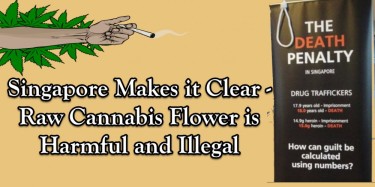
Let's address what this infographic is really about: justifying Singapore's death penalty for drug offenses.
Singapore executes people for trafficking more than 500 grams of cannabis. That's about 1.1 pounds. In many U.S. states, that's a legal amount for a medical patient to possess. In Singapore, it's a death sentence.
This "educational" material isn't designed to inform—it's designed to maintain public support for these executions. By portraying cannabis as medically useless, dangerous, and addictive, Singapore creates a narrative where killing cannabis users seems reasonable, even necessary.
What They're Not Telling You
Let's talk about what Singapore's propaganda carefully omits:
The Endocannabinoid System: No mention of the fact that humans have a biological system specifically designed to interact with cannabinoids. This isn't some foreign substance we're introducing—we're supplementing a system that already exists in our bodies.
Comparative Harm: No comparison to alcohol or tobacco, both of which are legal in Singapore despite being far more harmful than cannabis by every objective measure. Why? Because honest comparison would expose the hypocrisy.
Global Trends: No mention that dozens of countries and numerous U.S. states have implemented medical cannabis programs with positive results. Singapore presents itself as the lone voice of reason, but they're actually outliers clinging to failed prohibition policies.
Patient Testimonials: No acknowledgment of the millions of patients worldwide who report significant quality-of-life improvements from medical cannabis. These aren't abstract statistics—these are real people with real conditions finding real relief.
Economic Interests: No discussion of how pharmaceutical companies benefit from cannabis prohibition or how Singapore's position might be influenced by these corporate interests.
The Real Agenda
This infographic isn't about public health or scientific accuracy. It's about maintaining a prohibitionist regime that serves political and economic interests while sacrificing human lives.
Singapore has built its drug policy on zero tolerance and brutal enforcement. Admitting that cannabis has legitimate medical uses would undermine the entire foundation of their approach. It would raise uncomfortable questions: If cannabis is medicine, how can you justify executing people for possessing it? If other countries are successfully implementing medical programs, why are we killing people instead?
So they don't admit it. Instead, they create propaganda that cherry-picks data, misrepresents research, ignores inconvenient evidence, and presents a distorted picture designed to maintain the status quo.
The Sticky Bottom Line
What Singapore calls "education" is actually propaganda in its purest form: selective information presented in a misleading way to support a predetermined political position.
Every claim in this infographic is either technically true but misleading, or outright false when examined in context. The "insufficient evidence" claim ignores robust research for specific conditions. The focus on FDA approval ignores why approval has been blocked. The concerns about unregulated products are actually arguments for regulation, not prohibition. And the government position is based on demonstrably false claims about the state of research.
This is what propaganda looks like when a government needs to justify killing people for possessing a plant. It's dressed up in official graphics, wrapped in concerned language about public health, and presented with an air of scientific authority. But strip away the presentation, examine the actual claims, and what you're left with is a cynical manipulation of information designed to maintain support for state-sanctioned murder.
Singapore can dress it up however they want, but no amount of misleading infographics will change the fundamental immorality of executing people for cannabis offenses. And no amount of cherry-picked data will erase the reality that cannabis has legitimate medical applications supported by extensive research and clinical evidence.
This isn't education. It's justification for barbarism, wrapped in the language of public health. And it deserves to be called out for exactly what it is: propaganda in service of a brutal, inhumane drug policy that values political ideology over human life.
SINGAPORE ON WEED, READ ON...