

DON'T MESS WITH PURPLE
Texas Isn't Turning Blue. It's Turning Something Nobody Has a Word For Yet — and Cannabis Is Part of Why
By Reginald Reefer | March 2026
There's an old line, allegedly born in the Marine Corps and immortalized on film, that goes something like this: the great state of Texas produces nothing but steers and queers. It's crude, it's dated, and it's the kind of thing that gets you a very specific look at a dinner party in 2026. But somewhere in the original spirit of the insult — the absolute certainty about what Texas was, what it produced, and what it would never be — there is a lesson about the danger of being too sure about a place.
Because it turns out Texas also produces Democrats now. Or something in that general direction. The situation is complicated, which is exactly the kind of sentence that makes political consultants rich and everyone else exhausted.
Let me try to explain what is actually happening in the Lone Star State, why it matters, and why a ballot measure about marijuana that passed yesterday is part of a story that the red-vs-blue binary cannot contain.
The Myth of the Red State
First, let's bury the framing that has been distorting this conversation for two decades. Texas is not turning blue. Anyone telling you Texas is turning blue is either lying to raise money or lying to themselves, and the data does not support the narrative regardless of which one it is. Trump carried the state by 14 points in 2024. No Democrat has won a statewide office in Texas since 1994. These are not minor caveats. They are the ballgame.
But here is the thing about the red-blue framework that the political media industrial complex will not admit, because admitting it would complicate their graphics: it is almost entirely useless as a descriptor of what is happening inside a state. It is a presidential election outcome painted on a map, not a measurement of an electorate.
Consider the actual numbers underneath the narrative. Registered Democrats in Texas outnumber registered Republicans — 8.1 million modeled Democratic voters against 6.6 million Republican ones. The state is not red because of ideology. It is red because of turnout. Democrats in Texas turned out at 58.5% in 2024 while Republicans turned out at 80.3%. That is not a ideological gap. That is an organizational and motivational gap. And organizational and motivational gaps, unlike deeply held values, are solvable problems.
"Texas is not red because conservatives outnumber liberals. It's red because Republicans show up and Democrats don't. That is a very different kind of problem — and a very different kind of opportunity."
Now look at what just happened in the 2026 primary. Democrats cast 2.42 million primary ballots. Republicans cast 2.38 million. In 2022, Republicans cast 900,000 more primary ballots than Democrats. That is not a trend line. That is a reversal. And 28% of Democratic early voters were people who had previously only voted in November general elections — people who don't normally bother with primaries suddenly deciding that this particular primary was worth showing up for. On the Republican side, that figure was 13%.
Something is activating in Texas that has not been activated before. The question is what it is, whether it lasts, and what it actually produces — because "turns blue" is probably the wrong answer even if everything goes right for Democrats.
Trump as Political Particle Accelerator
Here is the theory that nobody wants to say plainly because it implicates everyone: Donald Trump may be doing to American politics what a particle accelerator does to atoms. He is smashing the existing coalitions with enough force that entirely new particles are flying off in directions that the existing periodic table of political identity cannot account for.
The Republican Party that exists in 2026 is not the Republican Party of 2015. It is not the party of George W. Bush's compassionate conservatism, or Reagan's sunny optimism, or even the Tea Party's anti-government libertarianism. It is a personality-driven coalition that has absorbed enough contradictions — protectionist economics alongside deregulation, authoritarian impulses alongside anti-government rhetoric, evangelical morality alongside the personal biography of its figurehead — that it has started to generate its own internal fault lines.
In Texas, those fault lines are visible. Ken Paxton — the state's attorney general, a man who survived a House impeachment on 20 articles of abuse of public trust and bribery, whose wife filed for divorce on biblical grounds while he was running for Senate — is the Republican candidate for the Senate seat John Cornyn currently holds. Cornyn himself was booed off the stage at the Texas GOP convention in 2022 for having the audacity to vote for a bipartisan gun measure after 19 children were murdered at Robb Elementary School in Uvalde. Both of these men are entering a general election with underwater favorability ratings. In Texas. In a Republican primary.
This is not a healthy party. This is a coalition that is consuming itself in ways that are specific to Trump's gravitational effect on everything around him. The voters who are leaving are not going to the Democrats — not yet, maybe not ever in those exact terms. They are going somewhere that does not have a name yet. They are going purple. Or maroon. Or some shade of political identity that the existing color wheel was not designed to represent.
"Trump is doing to the Republican Party what a particle accelerator does to atoms — smashing existing coalitions with enough force that entirely new particles are flying off in directions the periodic table of political identity cannot account for."
James Talarico — the Democrat who just won the Texas Senate primary — is the interesting data point here. He is 36 years old. He is a former public school teacher and a current seminary student. He campaigned in heavily Republican counties. He talked about his Christian faith. He centered his message on economic affordability rather than culture war. He won white voters 71-29 and Hispanic voters 60-39 in the primary against a more progressive opponent. He is, in other words, a Democrat who has been specifically engineered to be acceptable to the new particle that Trump has knocked loose from the Republican coalition.
Whether that is enough to win a Senate seat in Texas remains genuinely uncertain. But the fact that it is not obviously impossible is itself a historical event.
The Cannabis Variable Nobody Is Talking About
And then there is the weed.
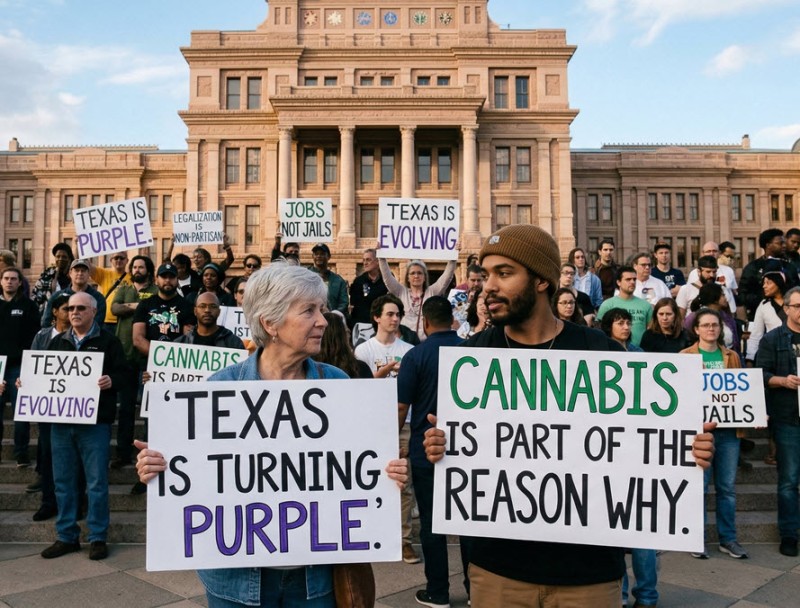
Yesterday — as in literally 24 hours ago as I write this — Texas Democratic primary voters approved a ballot question asking whether the state should legalize cannabis for adults and automatically expunge criminal records for past low-level offenses. They approved it by 80% to 20%. With 92% of polling locations reporting.
Now, before the cynics in the back correctly point out that this was a non-binding proposition on a Democratic primary ballot and therefore means approximately nothing in terms of actual policy — you are right. Texas does not allow citizen-initiated ballot measures. The legislature would have to act, and the legislature has demonstrated its enthusiasm for cannabis reform by repeatedly refusing to hold hearings on legalization bills while simultaneously trying to ban all THC products outside an extremely limited medical program. The gap between what Texas voters want and what the Texas Legislature does is a geological formation at this point.
But the 80-20 figure is not a Democratic talking point. Texas has an open primary system. Republicans could have voted on that question. The sample is not a self-selecting universe of committed progressives — it includes the crossover voters, the independents, the disaffected Republicans who chose a Democratic ballot for reasons that are worth examining. And 80% of them said yes to legalization.
For additional context: Dallas passed the Freedom Act last November with over two-thirds voter approval — making it policy not to arrest people for cannabis possession of four ounces or less. Bastrop passed a similar ordinance with 69.8%. Lockhart passed one with 68%. Lockhart, Texas is not Berkeley, California. It is a small city in Caldwell County, a place where the politics have historically skewed in the direction of people who would describe themselves as conservative Texans. And 68% of them voted to stop arresting people for marijuana.
"Lockhart, Texas is not Berkeley, California. It voted 68% to stop arresting people for marijuana. That is not a progressive wave. That is common sense arriving late to a party it was never invited to."
There is also this number, which belongs in every conversation about Texas politics and cannabis: the Texas hemp industry — legalized in 2019 under a Republican-controlled legislature and a Republican governor — is now an $8 billion annual economic engine employing over 50,000 Texans with over 8,000 permitted hemp retailers operating across the state. Texas didn't legalize hemp because of progressive values. It legalized hemp because Texas is a state that takes economic growth with the seriousness of a religious conviction. And once 50,000 people have jobs in an industry adjacent to cannabis, the political infrastructure protecting prohibition starts to look less like moral principle and more like incumbency protection.
The Lt. Governor tried to ban all THC products outside the medical program in the 2025 session. The hemp industry — 50,000 jobs, $8 billion in annual revenue, 8,000 retailers with political donors and employees and neighbors who vote — pushed back. The ban did not pass as written. When economic interests and prohibition ideology collide in Texas, economic interests have a better track record than people give them credit for.
What Purple Actually Looks Like
So let's try to describe what is actually forming in Texas, without the lazy shorthand of color coding.
It is not a blue wave. It is not a demographic inevitability playing out on a predetermined schedule. The Hispanic vote in Texas — long predicted to be the democratic tsunami that would finally flip the state — split almost evenly between parties in 2024, with 49% supporting the Democratic Senate candidate and 45% supporting Cruz. The assimilation theory holds: as immigrant communities settle and diversify, they become as ideologically varied as everyone else, which is not the reliable Democratic coalition that strategists have been projecting for twenty years.
What is forming instead is something more interesting and less predictable. It is a coalition of economic libertarians who want the government out of their business — including their cannabis business. It is suburban professionals in Dallas and Houston and Austin and San Antonio who are socially moderate and fiscally conservative and increasingly alarmed by a Republican Party that seems more interested in culture war and personal loyalty than governing. It is young voters in El Paso whose turnout nearly tripled in the 2026 primary. It is Latino voters in Hidalgo County — which voted for Trump in 2024 by 3 points, its first Republican presidential vote since 1972 — who nonetheless cast 52,000 Democratic primary ballots against 15,000 Republican ones in March 2026. It is Tarrant County, where Democrats outpaced Republicans in early voting despite Trump winning the county by double digits in 2024.
It is, in other words, a coalition that does not fit the existing template. It is neither the Obama coalition nor the Sanders coalition nor the Clinton coalition. It is something that is assembling itself in response to specific local conditions — a Republican Party that has become genuinely dysfunctional at the state level, a Democratic Party that for once has a candidate who doesn't immediately alienate rural voters, an economy in which cannabis is already a significant industry seeking political protection, and a national environment in which Trump's second term is generating the kind of broad-based political activation that his first term promised but did not fully deliver.
"What's forming in Texas isn't blue. It's the color you get when economic libertarians, suburban moderates, Latino swing voters, and cannabis industry workers all decide the current arrangement isn't working for them. Nobody has named that color yet."
Will it produce a Democratic senator in 2026? Genuinely uncertain. The structural advantages Republicans hold in Texas are real. Gerrymandering is real — the Republican legislature redrew congressional maps in 2025 specifically to lock in five additional seats, a move of such brazen confidence in permanent red state status that it either reflects deep strategic intelligence or historic overreach, and we won't know which for at least a cycle. Paxton's personal baggage is real, but baggage has not previously stopped Texas Republicans at the statewide level.
But the question has changed. It used to be "will Texas ever be competitive?" The answer was always: eventually, theoretically, demographics, patience. Now the question is "could it happen in 2026?" And the honest answer is: maybe. Which is itself the story.
The Sticky Bottom Line
Texas is not turning blue. Stop saying Texas is turning blue. Texas is developing something more interesting — a political identity that the existing binary cannot process, assembled from pieces that don't belong together in the standard model but that are finding each other anyway.
There are steers in Texas. There are queers in Texas. There are Democrats in Texas, there are Republicans who can't stand what their party has become, there are hemp farmers protecting $8 billion in annual revenue, there are Latino voters in border counties who swung to Trump in 2024 and are swinging back in 2025, there are young voters who showed up in tripled numbers in El Paso for a primary that most people weren't paying attention to. There are 80% of Democratic primary voters who said yes to legalizing cannabis in a state where the legislature has been trying to ban THC products entirely.
What do you call that coalition? What color do you assign to a state where the Republican attorney general running for Senate was impeached for bribery, where the hemp industry employs more people than most cities, where a seminarian schoolteacher is the Democratic candidate who polls tied against the scandal-soaked incumbent in a state that hasn't elected a Democrat statewide in thirty years?
I'd call it purple. But it's a very specific shade of purple — bruised, suspicious of everyone, economically motivated, and tired of being told what it is by people who have never spent time there. It's the purple you get when a state has been hit hard enough, often enough, by its own political class that it starts asking whether the arrangement it has been operating under still makes sense.
Trump didn't create that question. But his particular brand of politics — which fractures every coalition it touches, which demands personal loyalty over institutional loyalty, which turns former allies into liabilities and former enemies into strange bedfellows — is accelerating it in ways that the 2028 map may not resemble the 2024 map at all.
Texas isn't turning blue. Texas is turning into something that the cartographers haven't printed yet.
And somewhere in a licensed dispensary that doesn't exist yet but probably will, someone is going to smoke something legal and Texan and domestically produced and look at that new color on the map and think: well, I'll be damned.
Don't mess with purple.
— Reginald Reefer
Sources: G. Elliott Morris, "Is Texas Actually a Blue State?" (August 2025); G. Elliott Morris, "Six Data-Driven Reasons Texas Could Go Blue in 2026" (March 2026); Newsweek, "Democrats' Pipe Dream of Turning Texas Blue Takes Step Forward" (March 2026); Slate, "Texas Redistricting: Democrats Could Still Turn the State Blue" (December 2025); Marijuana Moment, "Texas Voters Approve Marijuana Legalization Ballot Measure" (March 2026); Marijuana Policy Project, Texas State Report (2025-2026); Rose Institute of State and Local Government, 2024 Texas Poll, Claremont McKenna College.
THE STATE OF TEXAS AND DELTA-8 THC, READ ON..